A bit of Game Theory

The prisoners Alice and Bob

A bit of economics is in order just so that I don’t lose sight of my core discipline, and the subject matter of this blog.

I loved learning game theory in a class taught by Prof Gilbert at UC Berkeley. The so-called Prisoner’s Dilemma is the prototypical example trotted out in introductory game theory classes. It illustrates why two rational individuals might not cooperate, even when it’s in their best interest to do so, thus leading to a bad outcome for both.

The Classic Story

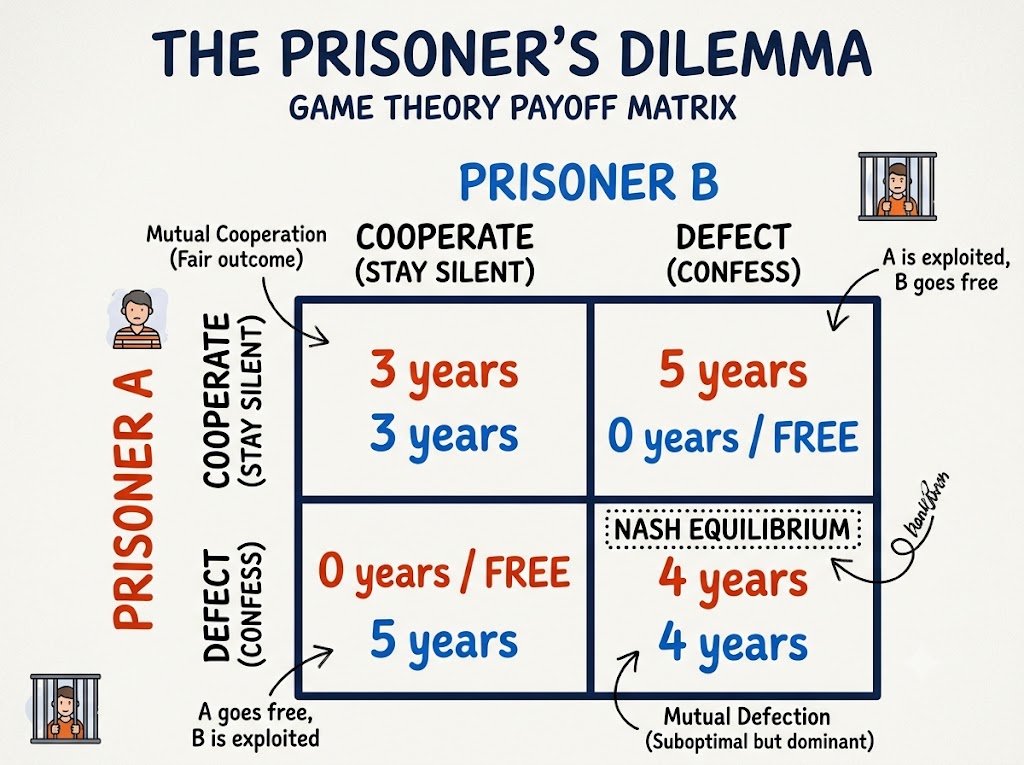
Imagine two suspects, Alice and Bob, arrested for a crime. The police have enough evidence to convict them on a minor charge but not the major charge. For that, they need a confession from at least one of them. They separate the prisoners and offer each the same deal:

      • If both stay silent (cooperate with each other by not confessing), they each get a light sentence: 3 years in prison.
      • If one confesses (that is defect) while the other stays silent, the confessor goes free (0 years), and the silent one gets a heavy sentence of 5 years.
      • If both confess (betray each other), they each get a medium sentence: 4 years.

The payoff matrix at the top of this post summarizes the situation. The prisoners can’t communicate, so each must decide independently.  Continue reading “A bit of Game Theory”
Diwali Greetings!

Today is Diwali, the biggest festival in much of India.

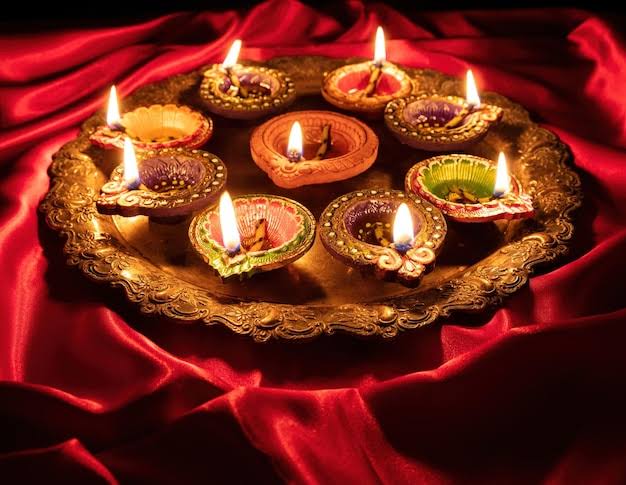
Diwali (from the Sanskrit dīpāvalī, “row of lights”) signifies the victory of light over darkness, knowledge over ignorance, and good over evil.

It is celebrated with fireworks, feasts, and family gatherings. It also carries distinct philosophical, mythological, and historical meanings across traditions.

At its philosophical core, Diwali draws directly from the Upanishadic invocation Tamaso mā jyotir gamaya (“Lead me from darkness to light”). Light connotes knowledge (Jnana). Darkness represents avidya (ignorance, delusion, and ego), while the flame represents awakened self-awareness and truth. The Diya (earthen lamps) is a metaphor for the human body, the oil or ghee as worldly attachments and desires, and the wick as the intellect. When the intellect is ignited by knowledge, worldly desires burn away, radiating clarity. Continue reading “Diwali Greetings!”

Happy Birthday, Tibor Scitovsky

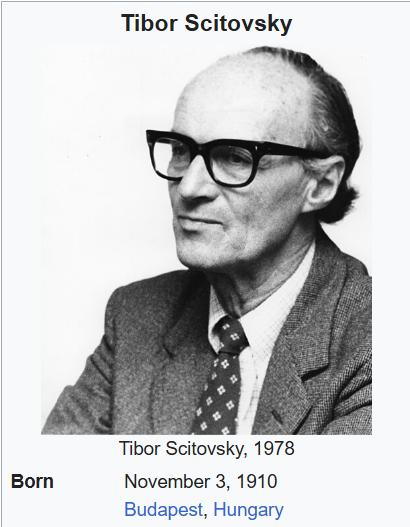
Prof Tibor Scitovsky

The first time I met Prof. Amartya Sen was after a talk he gave at UC Berkeley. I was then a graduate student there. It must have been around 1997 or thereabouts. At that time I was still learning the basics of my subject.

After his talk, I went up to him and introduced myself. I was not only a fellow Bengali economist (although in training), but we shared the same birthday. How cool was that! He was a Nobel laureate economist, to boot.

“Sir,” I said after introducing myself as a graduate student studying development economics, “we share a birthday.” He said he was pleased to know that. He was gracious and kind. People from Shantiniketan are like that only, as they say in India.

A couple of years later, Sen was back at UC Berkeley for another talk. This time I understood a lot more of the subject than I had at his previous talk. Once again after his talk I went up to him and introduced myself.

“Prof Sen. Pranam. I am Atanu,” I said. Pranam in our dharma conveys respect and reverence.

Without the least hesitation he replied, “Hello, Atanu, I’m happy to see you again.” Before I could remind him of our previous meeting he continued, “I have good news for you. You and I share our birthday with Tibor Scitovsky. He too was born on the 3rd of November. We are in good company.” I am quoting him verbatim.

It’s remarkable that Prof Sen would remember a brief 30-second conversation with a nobody like me from a couple of years before. But there it was. I was delighted. I did not agree with his economics since he is too much of leftist (as Bengali economists tend to be) but it pleased me no end. And I was also happy to know that Scitovsky was a member of our gang of economists born on Nov 3rd.

We are in good company, indeed. Continue reading “Happy Birthday, Tibor Scitovsky”