
We take property to be as natural as the air we breathe because it’s all around us and we are used to it. But the idea of property is a relatively modern and quite artificial construct. It’s an entirely human construct, as artificial as a car or a mobile phone. It’s not “natural” at all.
We didn’t have the notion of propety until fairly recently. Anatomically modern humans or homo sapiens have been around for only about 250,000 years, or roughly 10,000 generations. For 95% of human history, we lived in mobile foraging bands. We had no notion of property. We operated under economic and ecological constraints that actively penalized accumulation.
Our ancestors used to be hunter-gatherers.
Owning things was not compatible with the nomadic hand-to-mouth existence of hunting and gathering. While hunter-gatherers did recognize personal possessions (like an axe or or a spear), the modern concept of property—exclusive ownership of land, surpluses, and capital (a quite sophisticated concept) was largely incompatible with nomadic life which only became economically necessary after the Neolithic Revolution.
When one has to walk 10 to 20 miles every few days to follow migrating herds or seasonal plants, anything you could not carry was a liability, not an asset. Carrying things would slow down the group and threaten survival.
Theirs was an “immediate-return” economy. Food was hunted or gathered and had to be eaten within days. Their time horizon was days, not weeks or months. Surplus food was stored in the stomachs of the other members of the group. Communal sharing was a winning strategy for risk-pooling. Their social safety net was reciprocal sharing within the band, just as the Amazonian Piraha do even today.
The idea of property evolved naturally. Around 10,000 to 12,000 years ago, domestication introduced a “delayed-return” economy—systems where labor invested today yields a payoff months or even years later. Surplus could be stored and traded. Their time horizon was seasons and even generations. This created a powerful incentive to claim exclusive rights over resources.
But it wasn’t farming itself that invented property—it was resource concentration, storage, and delayed returns. Agriculture and pastoralism simply made those conditions universal across the globe.
Private property and the idea of wealth came into being only after the Neolithic revolution. With it came the ability to produce now and consume later. That requires that production can be stored and traded. That is wealth.
With wealth begins the possibility of inequality.
I am not overly exercised about inequality. It does grate against my innate sense of fairness but in and of itself, inequality doesn’t bother me. Inequality is a feature of the universe. One has to be resigned to that fact. Sure, extreme wealth of a few and the simultaneous grinding poverty of the many is a despicable situation. But mere inequality is nothing to lose sleep over. There will always be rich and poor people. Always. It’s best to get used to it.
I lose sleep over poverty, not over inequality. I am dirt poor compared to millionaires and billionaires. But, I am grateful that, unlike 99 percent of humans that have ever existed, thanks to sheer luck I don’t remotely suffer any poverty.
(I have distinguished between poverty and being poor elsewhere on this blog but I am too lazy to dig that up right now.)
Wealth is good. It is a consequence of private property. But opinion is divided on whether private property is good. Socialists and communists have a visceral hatred of private property. One has to remember that being opposed to private property goes hand in hand with low intelligence. That low IQ opposition to private property then leads to poverty.
Opposition to private property is partly due to ignorance and partly due to stupidity. Ignorance can be cured but stupidity is incurable and intractable. These days it is easy to fix ignorance thanks to the zillions of opportunities one has for getting informed. But good luck to you if you aim to cure stupidity.
The opposition to private property is not new. John Locke (1632–1704) and Jean-Jacques Rousseau (1712–1778) stand at opposite poles of Enlightenment thought on private property. While Locke viewed property as a natural, pre-political right created by human labor that drives prosperity and freedom, Rousseau saw it as an artificial social convention—a historical confidence trick—that destroyed human equality and invented greed, conflict, and subjugation.
Locke’s Second Treatise of Government (1689) predates Rousseau’s Discourse on Inequality (1755.) They differ in their understanding of the origins of property, the role of the state, the role of money, and its effect on society.
Locke saw nature as a raw, unimproved wasteland whose value comes almost entirely from human effort. I am a Lockean, as were the Founding Fathers of the United States. Private property expands the economic pie, lifting everyone up even if shares are unequal. The US is Exhibit A in that argument.
Rousseau saw nature as naturally sufficient for modest human needs. The trouble is that what is modest varies as people become more prosperous. According to Monsignor Rousseau, private property creates artificial scarcity and dependency, trading authentic human freedom for material trinkets and social chains.
It’s too bad that Karl Marx (1818–1883) was an incompetent thinker. He must have read Locke but sadly did not understand the core ideas. Marx took Rousseau’s critique of private property and transformed it into a historical and economic theory of capitalism.
I don’t like the word capitalism. I wish it was excised from our vocabulary. But that’s not possible in a world of ignoramuses.
Instead of capitalism, we should talk about a system of free markets based on voluntary exchange of private property. Private property and exchange.
We economists focus on exchange and the institutional structure within which exchanges take place.
Where Rousseau saw property as a tragic moral accident born of human gullibility and vanity, Marx saw it as an evolving system of class power—one that reaches its sharpest contradiction when productive capital is owned by a tiny minority while the majority owns nothing but their capacity to work.
Marx was an idiot.
Marx’s magnum opus, Das Kapital (1867) is a critique of the mechanics and internal contradictions of capitalism. The fundamental error Marx made is in his belief in the labor theory of value.
Most certainly, Marx got that labor theory value from Adam Smith’s book An Inquiry into the Nature and Causes of the Wealth of Nations (1776.) That labor theory of value is pernicious nonsense. It is surprising and depressing how many people still believe in that.
Marx argues that the driving force of capitalism is the extraction of surplus value—the unpaid labor performed by workers beyond what is necessary to reproduce their own subsistence—which capitalists appropriate as profit.
The word profit is the sweetest word in the English language to me. Profit creates wealth; loss destroys wealth. Profit is what brings good things to life.
Marx was an idiot. It bears repeating.
He was a financial parasite who sponged off his wealthy friend Engels. He never did an honest day’s work in his life. So much for the labor theory of value!
Why, you may ask, do I have this visceral hatred of communism and socialism? Because I had the misfortune of being born in a socialist country. It was heartbreaking to see the deep poverty in India. A kind-hearted, intelligent and compassionate person, I hated seeing the misery of the poor in India. The question “why is India so abjectly poor” motivated my study of economics.
Marx’s ideas led to the second-greatest slaughter of humans in history. But he did not personally murder anyone, though his ideas led to the slaughter of hundreds of millions of innocent humans. The distinction for the man whose ideas led to the greatest slaughter of people ever (still ongoing) belongs to one who personally slaughtered several hundreds.
Thankfully, like Marx, that evil monster will end up in the dustbin of history soon.
Contemplating human history is a depressing exercise. But all that is soon going to be over. Humanity is at the verge of what I call the beginning of infinite abundance. No more poverty, no more nature-delivered misery.
What do I base my optimism on? On simple logic.
Take a look at this graph.
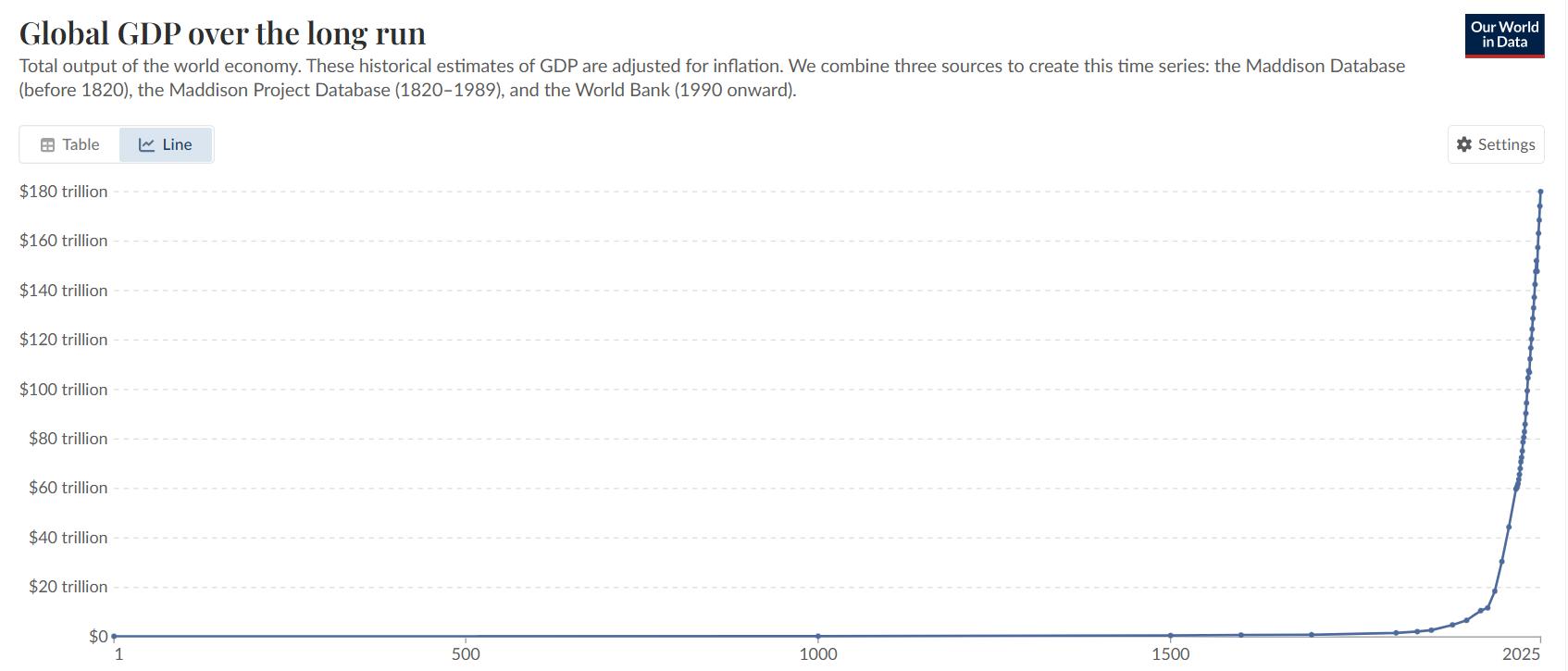
From the beginning of history, global average output per person remained trapped near subsistence levels—varying slightly with natural disasters, and empires, yet showing almost zero sustained upward trend. Then, around 1820, the curve bends sharply upward into a near-vertical shaft as industrialization, fossil-fuel energy capture, and institutional innovation unlocked sustained compounding growth.
The graph is for “Global GDP”, not the per capita global GDP. I don’t have the time to find the per capita global GDP right now. But it is not that different.
The main point of that graph is that for nearly all of human history, people were really, really poor. Prosperity is a modern phenomenon. It is a consequence of private property. That’s it. Prosperity and private property are twins.
I agree that not everyone ends up equally rich but the important thing is that nobody ends up trapped in poverty.
Now I’d like to get to the main point of this post, which is that humanity has been trapped into a mentality of scarcity because it’s a part of our recent human experience. Let me explore that.
Our ancestors had a choice. Poor though they were, they were naturally concerned about their children. They realized that they could consume what they earned; or they could limit consuming what they had and so leave more for their descendants. They themselves were dirt poor (by our standards) but even then they chose to sacrifice their consumption for their children’s consumption.
That made sense in a world in which generational income hardly changed at all. The lifetime income of a person in the year 1000 was no more than the lifetime income of a person in 800, or the year 1200. Look up the data if you don’t believe me.
But that was then. This is now. In the 20th century, lifetime incomes have been going on like that hockey stick graph shows.
To make the idea concrete, allow me to relate a personal bit. The numbers below are made up to indicate magnitude.
My grandparents scrimped and saved and left their children an inheritance. Let me normalize their lifetime income to be, say, $1000. Of that, they consumed only half, and left $500 for their children to consume.
One of their children, my father, had a lifetime income of $10,000. He too limited his consumption so that he could pass on $5,000 to his children. That’s ten times what his father left him. My parents led a hard life, as did his parents. But still they sacrificed so that their children could have a better life.
But it was totally unnecessary. My father’s total lifetime income was $10,000 but my brother’s lifetime income is $500,000. So my father’s lifetime of sacrifice of $5,000 amounts to about 1 percent of my brother’s income.
Therefore, it would have made more sense for my father to spend his income instead of leaving it for my brother because that $5000 did not make any great difference to my brother but it did to my father.
But my father did not know that his son would be a hundred times better off than he was. He did not know that the world is becoming rapidly richer. For hundreds of generations, it made sense to limit one’s consumption and leave the rest for one’s children. He was programmed to sacrifice for his children.
That’s what being a parent is about. One’s utility function as a parent includes the utility function of one’s children, as we economists put it.
I see this atavistic nonsense of saving for one’s children play out tragically right now among my friends and family. They are struggling mightily to pass on another $1000 to their children. But their children’s lifetime income is likely to be $1 million. That additional $1000 that they struggle to gift their children, and for which they are willing to sacrifice relationships, would not amount to a hill of beans to their inheritors.
I know people who would destroy relationships for money that they won’t use but will gift it to their children to whom that money won’t matter at all.
My advice to those friends and family is this. Enjoy what you have. Don’t worry about your children. They’d be immensely economically better off than you are or you can even imagine. It’s not worth killing yourself over it.
So what is my point? Should everyone just consume whatever one has without a thought about the future? Yes. And what about the poor? Good questions. I will go into them in a bit.
Time to listen to some music. This ghazal by Ameer Khusro is about seven hundred years old. It is performed by Ustad Shujaat Khan.
And the bonus track is a Kabir bhajan.
Thank you, good night, and may your god go with you.


