
A bit of economics is in order just so that I don’t lose sight of my core discipline, and the subject matter of this blog.
I loved learning game theory in a class taught by Prof Gilbert at UC Berkeley. The so-called Prisoner’s Dilemma is the prototypical example trotted out in introductory game theory classes. It illustrates why two rational individuals might not cooperate, even when it’s in their best interest to do so, thus leading to a bad outcome for both.
The Classic Story
Imagine two suspects, Alice and Bob, arrested for a crime. The police have enough evidence to convict them on a minor charge but not the major charge. For that, they need a confession from at least one of them. They separate the prisoners and offer each the same deal:
-
-
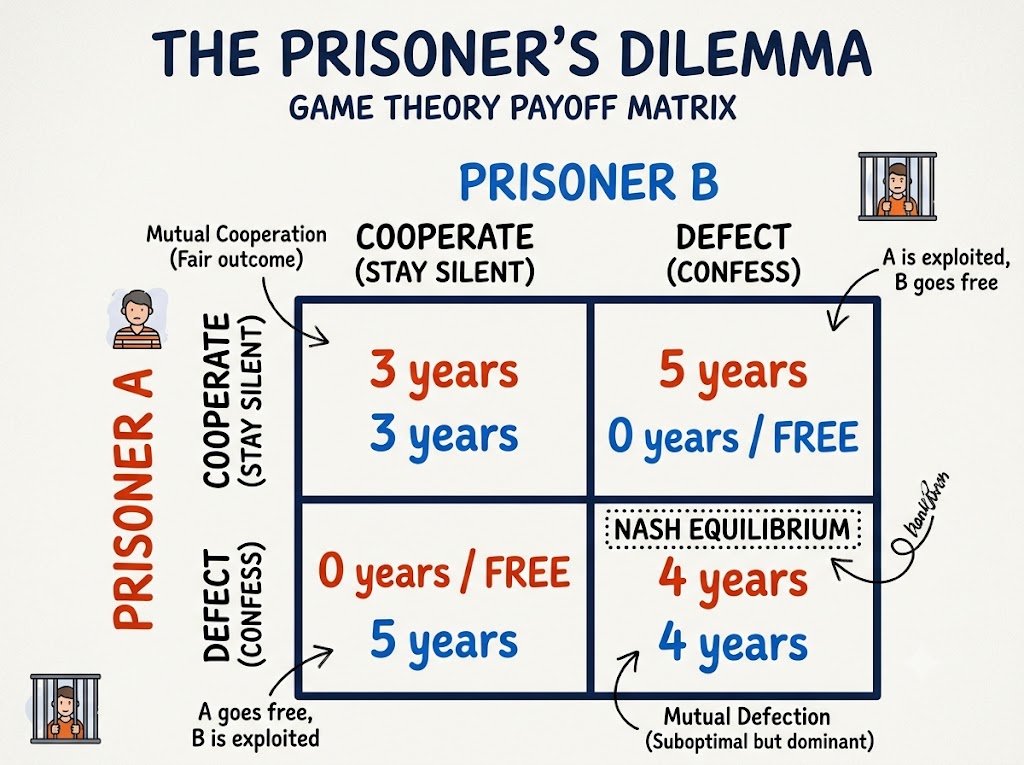
- If both stay silent (cooperate with each other by not confessing), they each get a light sentence: 3 years in prison.
- If one confesses (that is defect) while the other stays silent, the confessor goes free (0 years), and the silent one gets a heavy sentence of 5 years.
- If both confess (betray each other), they each get a medium sentence: 4 years.
-
The payoff matrix at the top of this post summarizes the situation. The prisoners can’t communicate, so each must decide independently.
Why It’s a Dilemma
Note that it’s the prisoner’s dilemma, not the prisoners’ dilemma. Each of them faces a choice between cooperating or defecting. They have to choose individually, not collectively. There’s no “we” in non-cooperative games.
The best collective outcome is if neither of them confess. But from each prisoner’s individual perspective, confessing is always better, no matter whether the other confesses or not.
The outcome that emerges is the worst. This is called a Nash equilibrium after the Nobel laureate economist John Nash. (In the 2001 movie about John Nash, “A Beautiful Mind”, they made a total hash of the concept.) In a Nash equilibrium neither player can do better by changing strategy unilaterally.
In a future post I will write about John von Neumann (1903–1957) the Martian who began the whole discipline.
This particular PD game is a 2-person, 2-strategy, one shot game, full information game — for obvious reasons. You can complicate the game by introducing more players, more than two strategies, mixed strategies, repeated game, incomplete information, etc. It’s astonishing how much one can learn from modeling the real world with simple games.
The prisoner’s dilemma models real-world situations where individual incentives clash with group benefits, like arms races, environmental pollution, price wars between companies, or even everyday choices like overfishing a shared resource. It shows how cooperation can be fragile without trust, communication, or repeated interactions.
One important idea the simple prisoner’s dilemma surfaces is that of being able to make a commitment. In the PD game, why are the two unable to coordinate their strategies? One may think it is because they are kept separate and are not allowed to communicate. But that is not true. The two could be brought together to chat with each other — and then separated when they make their move.
The outcome would be the same as it would be if they had not been able to communicate. Why? Because even if they promised each other, “I will not defect”, once they are separate and need to choose, it is in their self-interest to defect.
That is, they can’t make a binding commitment to not defect, and therefore their “I will not defect” statement is not credible. If they could have made a credible commitment, then the outcome would have been different.
Being able to credibly commit is a powerful instrument. Here’s an instance from the Odyssey. On his journey home, our hero Odysseus faced many challenges. One was to avoid the fate of those who heard the song of the Sirens. Begin excerpt from post two years ago.
The Sirens sang so beautifully that sailors on a passing ship, hearing their song, would jump into the water to get closer to them, and drown in the raging waters of the ocean. The curse the Sirens had was that if any mortal heard their song and yet lived, then the Sirens would die.
So Circe warned Odysseus not to hear the Sirens’ song. But he was curious and courageous. He wanted to do what no man had survived in doing: hear the Sirens’ song and live.
. . . We know that we often make commitments that we are unable to keep because we get tempted to break them. Odysseus could commit at the present time to not jumping into the water when he heard the singing from across the waters, but when he does hear the song in the future, he would break his commitment.
He is wise enough to realize that though he intends to keep his word, he won’t be able to keep it when he faces the music, so to speak. Our ex ante commitments and our ex post actions diverge, as game theoreticians like to point out.
So he pulled out the mechanism design manual out of his economist toolkit and devised a cunning plan to allow him to hear the Sirens’ song but not fall into its fatal allure.
When the ship was approaching the Sirens’ island, he instructed his crew to plug their ears with beeswax so they won’t hear the song and therefore not steer the ship into the rocks.
Next he commanded his crew to bind him tightly to the ship’s mast, and gave them orders to not untie him regardless of how much he pleaded or threatened them.
As they passed the Sirens’ island, Odysseus heard their enchanting song promising knowledge and glory. True to prediction, he was overwhelmed with desire to join them and ordered his men to untie him. The crew ignored Odysseus’s pleas and instead tightened his bonds.
“Tying oneself to the mast,” restricting one’s own freedom is a way of making oneself more powerful in certain situations. This is widely appreciated by economists and seen in many negotiations where being able to make a credible commitment is important.
End excerpt from the July 2024 post, Odysseus.
OK, time to listen to some siren song. Bach’s Toccata and Fugue in D minor fits the bill.
Be well, do good work, and please keep in touch.


