
A bit of economics is in order just so that I don’t lose sight of my core discipline, and the subject matter of this blog.
I loved learning game theory in a class taught by Prof Gilbert at UC Berkeley. The so-called Prisoner’s Dilemma is the prototypical example trotted out in introductory game theory classes. It illustrates why two rational individuals might not cooperate, even when it’s in their best interest to do so, thus leading to a bad outcome for both.
The Classic Story
Imagine two suspects, Alice and Bob, arrested for a crime. The police have enough evidence to convict them on a minor charge but not the major charge. For that, they need a confession from at least one of them. They separate the prisoners and offer each the same deal:
-
-
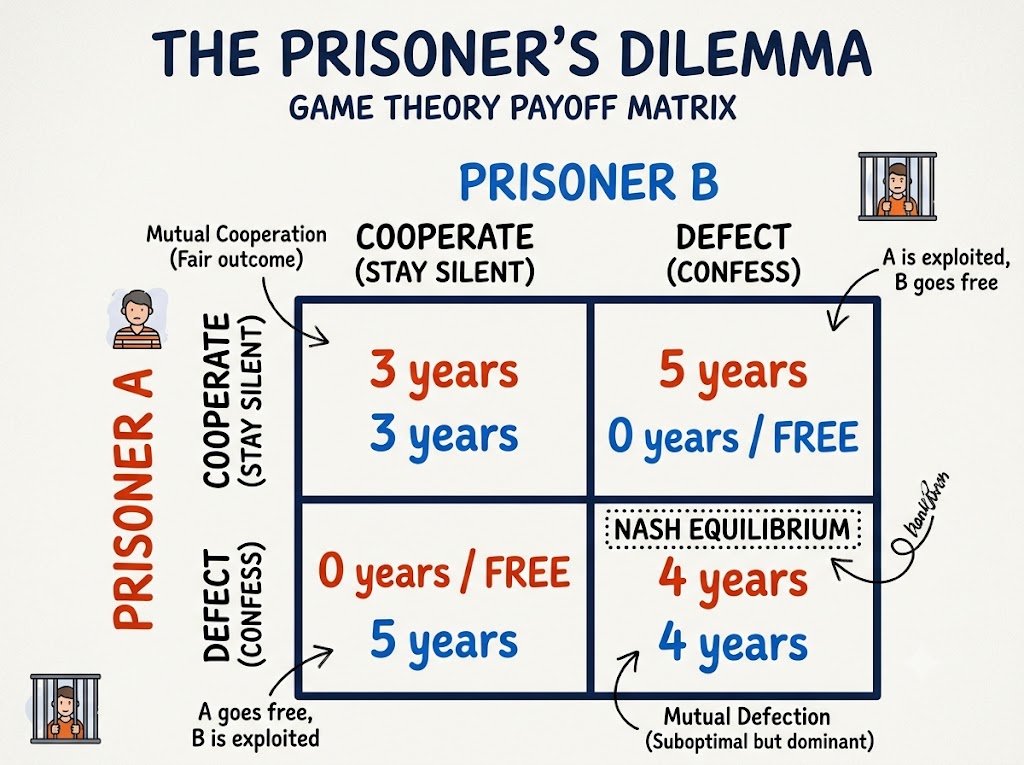
- If both stay silent (cooperate with each other by not confessing), they each get a light sentence: 3 years in prison.
- If one confesses (that is defect) while the other stays silent, the confessor goes free (0 years), and the silent one gets a heavy sentence of 5 years.
- If both confess (betray each other), they each get a medium sentence: 4 years.
-
The payoff matrix at the top of this post summarizes the situation. The prisoners can’t communicate, so each must decide independently. Continue reading “A bit of Game Theory”

