
The first time I met Prof. Amartya Sen was after a talk he gave at UC Berkeley. I was then a graduate student there. It must have been around 1997 or thereabouts. At that time I was still learning the basics of my subject.
After his talk, I went up to him and introduced myself. I was not only a fellow Bengali economist (although in training), but we shared the same birthday. How cool was that! He was a Nobel laureate economist, to boot.
“Sir,” I said after introducing myself as a graduate student studying development economics, “we share a birthday.” He said he was pleased to know that. He was gracious and kind. People from Shantiniketan are like that only, as they say in India.
A couple of years later, Sen was back at UC Berkeley for another talk. This time I understood a lot more of the subject than I had at his previous talk. Once again after his talk I went up to him and introduced myself.
“Prof Sen. Pranam. I am Atanu,” I said. Pranam in our dharma conveys respect and reverence.
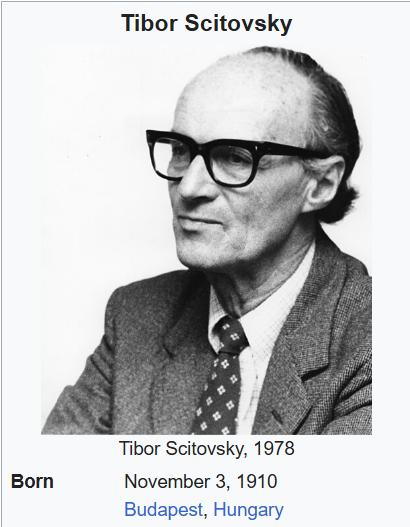
Without the least hesitation he replied, “Hello, Atanu, I’m happy to see you again.” Before I could remind him of our previous meeting he continued, “I have good news for you. You and I share our birthday with Tibor Scitovsky. He too was born on the 3rd of November. We are in good company.” I am quoting him verbatim.
It’s remarkable that Prof Sen would remember a brief 30-second conversation with a nobody like me from a couple of years before. But there it was. I was delighted. I did not agree with his economics since he is too much of leftist (as Bengali economists tend to be) but it pleased me no end. And I was also happy to know that Scitovsky was a member of our gang of economists born on Nov 3rd.
We are in good company, indeed.
Who was Tibor Scitovsky? I checked with Gemini for details just now.
Tibor Scitovsky (1910–2002) was a Hungarian-born (these Hungarians are not human, I tell you) American economist whose work bridged theoretical welfare economics, international trade, and the psychological foundations of consumer behavior.
As it happens, international trade theory was my minor. I studied Scitovsky.
Over a career spanning more than half a century—most notably holding professorships at UC Berkeley (my alma mater) and Stanford University (where I slummed for a year as a Reuters Fellow)—he developed foundational critiques of standard neoclassical assumptions regarding efficiency, rationality, and human satisfaction.
As my major was development economics, I studied neoclassical welfare economics in which the Kaldor-Hicks compensation tests were used to determine whether an economic reallocation represents a net improvement. A change was desirable if the gainers from a reallocation could hypothetically compensate the losers and still remain better off.
In a 1941 paper Scitovsky demonstrated a major logical flaw known as the Scitovsky Paradox. Look it up if you care. To resolve it he proposed that a policy or reallocation improves social welfare if and only if the gainers can compensate the losers to move to the new state, and the losers cannot bribe the gainers to return to the original state.
All that is technical stuff that would not interest non-economists. But his popular book, The Joyless Economy: An Inquiry into Human Satisfaction and Consumer Dissatisfaction (1976) would.
In that book, Scitovsky anticipated modern behavioral economics and hedonic psychology. Drawing on experimental psychology, he challenged the traditional economic view that greater consumption and higher GDP equate to higher welfare.
He distinguished between comfort and pleasure. Comfort, he asserted, arises from reducing discomfort or maintaining homeostasis, but it eventually generates satiation or boredom. The Buddha realized that two and a half millennia before any economist. The book has a section titled “Buddhist economics.”
True pleasure or joy, Scitovsky argued, comes from the dynamic transition between states, moderate arousal, novelty, and overcoming manageable challenges. Moderation is key. That’s what the Buddha taught: the middle path.
Scitovsky distinguished between defensive goods and creative goods. Modern consumer societies (particularly in the United States) over-invest in convenience, physical comfort, and defensive goods (routine, risk-averse consumption) while under-investing in creative activities.
My view is that when the desire for defensive goods is satisfied, people would naturally move to creative goods. It is already happening. What do you think?
Let’s listen to some music, shall we? From their album on Amazonian rivers, here are the songs on the Tiquie and Japura rivers by the band Uakti and Philip Glass.
Have a wonderful day. And of course, a very happy birthday to three great economists: Scitovsky, Sen, and me!


