
Two First Amendments to two Constitutions

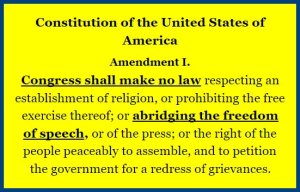
The First Amendment to the US Constitution is 45 words long. The full text reads:

Congress shall make no law respecting an establishment of religion, or prohibiting the free exercise thereof; or abridging the freedom of speech, or of the press; or the right of the people peaceably to assemble, and to petition the government for a redress of grievances.

Just by the way, the first 10 amendments to the US constitution is collectively known as the “Bill of Rights.” They were all ratified on Dec 15, 1791.

The First Amendment to the Indian constitution was introduced by Jawaharlal “Cha-cha” Nehru and was enacted in June 1951. The full text of the amendment is below.

It is not for the fainthearted. You ask why? Because here’s a very brief extract from the more than 1700 words.

No law in force in the territory of India immediately before the commencement of the Constitution which is consistent with the provisions of article 19 of the Constitution as amended by sub-section (1) of this section shall be deemed to be void, or over to have become void, on the ground only that, being a law which takes away or abridges the right conferred by sub-clause (a) of clause (1) of the said article, its operation was not saved by clause (2) of that article as originally enacted.

Please do check out full text below.
Continue reading “Two First Amendments to two Constitutions”

Mr Katju, here be dragons

Mr Katju, who is a retired supreme court judge, provided his insights into “abolishing unemployment in India” on social media yesterday. According to him, Soviet Russia solved that problem by “raising the purchasing power of the masses, and thereby rapidly expanding the economy and consequently abolishing unemployment.”

Mr Katju explains in subsequent comments how the scheme is supposed to work. It’s about reducing prices to increase “purchasing power”, he says. I don’t think he understands what prices or purchasing power means.

I have appended at the end of the post a few screen captures of Mr Katju’s submission to facebook and a couple of comments from his readers.

Mr Katju notes the steps the Soviet government took included the steady lowering of commodity prices, stepping up production, and the creation of jobs that abolished unemployment. He further notes that while the US was suffering the Great Depression of 1929, the Soviet economy was “rapidly expanding.” While not endorsing the Soviet method for India, he says that India should do something so “we can raise the purchasing power of the Indian masses and thereby rapidly expand the Indian economy, which is the only way of abolishing unemployment in India.”

He ends by writing, “The central point, and therefore the main problem before India, is how to raise the purchasing power of the masses? Do we follow the method of socialist countries, or some other method?” Continue reading “Mr Katju, here be dragons”

Domestic Predation began in 1947

If you were an employer, and your employee was inefficient, incompetent, irresponsible and arrogant, you would fire him. There are other people who can do the job. If you were an employee, and the work was demeaning, the boss irascible, the pay miserly, you would quit. There are other jobs in other companies. If you were a customer, and the product was faulty, expensive, unreliable and badly designed, you would take your business elsewhere. There are other suppliers of goods and services. If you were in a partnership, and your partner was insulting, domineering, lazy and greedy, you would dissolve the partnership. We can associate with others. We all have the freedom to do the best we can and deserve our just deserts. But all bets are off when it comes to the government.
Continue reading “Domestic Predation began in 1947”

Quote: Liberty and Government

“Liberty and good government do not exclude each other; and there are excellent reasons why they should go together. Liberty is not a means to a higher political end. It is itself the highest political end. It is not for the sake of a good public administration that it is required, but for security in the pursuit of the highest objects of civil society, and of private life. Increase of freedom in the State may sometimes promote mediocrity, and give vitality to prejudice; it may even retard useful legislation, diminish the capacity for war, and restrict the boundaries of Empire.”

— Lord Acton, The History of Freedom in Antiquity [1877]

Trump is the Monstrous Crow

Tweedledum and Tweedledee
Agreed to have a battle;
For Tweedledum said Tweedledee
Had spoiled his nice new rattle.

Just then flew down a monstrous crow,
As black as a tar-barrel;
Which frightened both the heroes so,
They quite forgot their quarrel.

Trump is the monstrous crow, as black as a tar-barrel. He will be good for the US. The system needs a bit of shaking up. The Republicans and the Democrats — Tweeledum and Tweeledee — have messed it up with their kabuki. Their staged battles, costumes, flying through the air tricks, etc., is highly entertaining. The details of the stage design are a perfect metaphor for the existing political setup.

A disruption will dislodge the status quo and perhaps push the moribund system to a different (and likely better) equilibrium. Granted that Trump is no visionary leader with wisdom oozing out of him. But he is the mild heart attack that jolts a person to take a serious look at his life and turn things around, if I may introduce another metaphor.

US is the top oil-producing country in the world

CNN has a nice graph showing the top oil producers of the world. Here’s the data for 2014 and 2015.

sy174

sy175

You notice two things: the production trend is positive. That partly explains the downward trend in prices over the last year or so. In the not too distant past, I had paid as much as $4.50 per gallon of gas in the SF Bay area. Recently I paid as little as $1.90 per gal at the same pump. It was delightful to pump gas. When I was visiting New Jersey in January, I paid just $1.50 per gal. (For those who are unfamiliar with the archaic system of measurement in the US, a US gallon is 3.78 liters.)

In the US, gas prices move with world prices of crude. No such luck in India. Indians are forced to pay whatever the licence permit quota control raj decrees. Which basically translates into allocative inefficiency, and that means increased poverty. Indians have some seriously shitty karma that they have such worthless governments that don’t understand basic economics.

It’s all karma, neh?

On Technology, Prosperity and Dysfunctional Ideologies

We take it as a given, almost a fact of nature like the seasons or the geography of continents, that different parts of the world enjoy different levels of prosperity. But there’s nothing “natural” about this since this is almost entirely within human control. The differences are stark, and at one end of the scale, heartbreaking. Consider the extremely rich first. Luxembourg has an annual per capita income of over $110,000, Norway over $100,000, Switzerland around $85,000. Those are small countries and outliers with perhaps little to tell us. But the US is large and has an annual per capita income of $53,000. Why is it so rich?

At the other end of the scale are Burundi and Malawi with only $200 or so annual per capita incomes. Why are they so poor? The richest countries are around 500 times richer in per capita terms than the poorest. What accounts for this inequality in incomes of countries? That question has engaged the attention of people for hundreds of years — starting with of course the great Scottish economist Adam Smith who inquired about “The Nature and Causes of the Wealth of Nations” in his famous 1776 book.
Continue reading “On Technology, Prosperity and Dysfunctional Ideologies”

The Wisdom of SS Ravi Shankar

A friend recently quoted SS Ravi Shankar’s profound proclamation. It goes:

“There are people who are married and unhappy and there are people who are unmarried and unhappy. Then there are people who are married and happy and there are people who are unmarried and happy. You better be in the second category. Whether you are married or not, if you are happy, if you are centered, then you are close to enlightenment.”

I read it and I am forced to agree with the German historian Johann Christoph Friedrich von Schiller (1759 – 1805) that against stupidity, even the gods struggle in vain. We mere mortals are powerless to resist such inanities.

Human Exploration of Space is 55 years Old Today

On April 12th, 1961, Yuri Gagarin became the first human in space. The first human space flight lasted 108 minutes. He became an instant hero, as is right since it was an extremely risky voyage and he could have ended up dead. There are many unsung heroes in any such venture. I feel most for the person who was the chief designer of the space vehicle — Sergey Korolev (1907 -1966). Because of the secrecy of the Cold War, he worked without any recognition. The video below is about Gagarin’s historic flight. It recognizes the work of Korolev. Deep respect to both the heroes of the Soviet Union.

I find it remarkable how talented the people of the erstwhile Soviet Union were. Trouble was that even talent could not overcome the self-imposed handicap of communism. Remember that the Soviet Union was not a very large union — only around 200 million people around 1960. They were very successful in science and technology. But communism/socialism forges very heavy chains. Without freedom, even talented people fail. Slavery is always harmful and freedom always the key to prosperity. Too bad India continues to labor under socialist slavery.

Letter to the Canadian Passport office

Bureaucracy is hell. It is aggravating. Government bureaucracy is especially frustrating because the matters they deal with are monopolies — you don’t have a choice of going to some other service provider. And worst of all is the government bureaucracy of poor nations which is the worst of its kind. Indeed, much of the poverty of poor nations can be significantly attributed to the insanity of government bureaucrats and officials. That’s serious business since it costs lives. But even in the saner parts of the world, such as Canada, people do get fed up with bureaucratic idiocy. Here’s a funny example.
Continue reading “Letter to the Canadian Passport office”