
Nobel laureate Geoffrey Hinton, one of the “godfathers of AI,” said in an interview, “I am worried that there’s going to be massive job losses and that would be good if the increase in productivity made us all better off. Big increases in productivity ought to be good for people but in our society they make the rich richer and the poor poorer.”
Dr Hinton, Nobel prize worth smart and intelligent, gets this wrong. True, that an increase in inequality could mean that the rich get richer and the poor poorer. But that is not necessarily so, has never been so, and is unlikely to be so.
No matter how hard one tries, it will be impossible to argue that the poor are getting poorer. Anyone who claims that — Nobel winner or not — is either ignorant or lying.
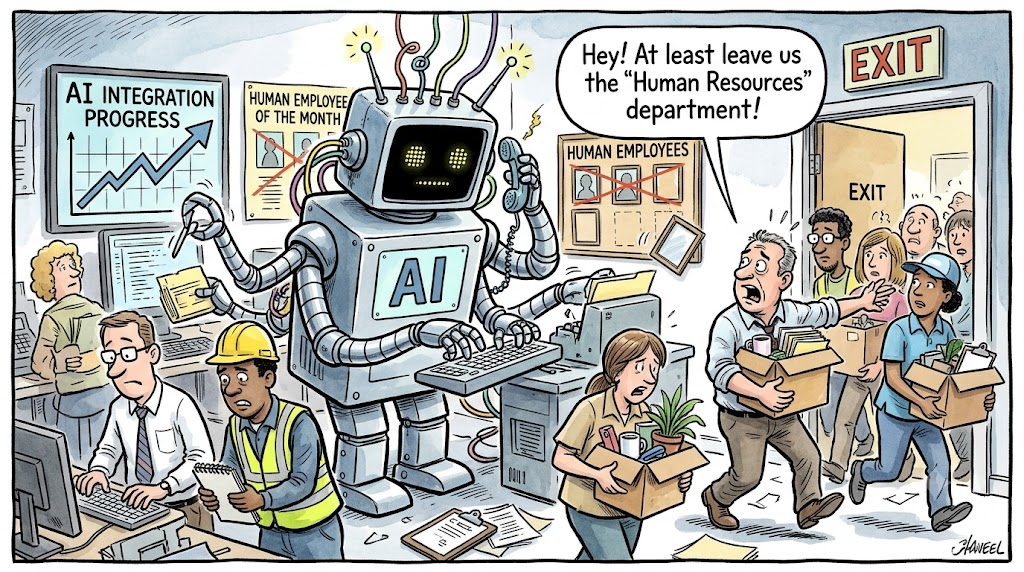
The cartoon at the top of this post was created by Gemini. I gave the prompt but I could not have created that cartoon even if were to spend a couple of days trying to do that.
Certainly, a competent cartoonist would have produced something comparable in a few hours but I could not have paid him. Therefore, Gemini did not take away anyone’s job. The work was done and I believe it added value to my readers without any accompanying cost. That is what AI will do: add value nearly costlessly and without job losses.
Jobs are a means, not an end. If all jobs were eliminated but we got what we wanted, how can that be a bad thing? But, but, but . . . don’t jobs give meaning and purpose to our lives?
We create our own purpose. We have to create the light that illuminates our journey through our lives. If one requires soul-sapping, back breaking work to give meaning to one’s existence, that is a rather meaningless life.
Read the post on AI and Jobs, first published in May 2025.
Let’s listen to Raag Ahir Bhairav played on the sarangi, the instrument with a thousand voices.
Cheers!


A counter by the ex Chairman of CEA….he is talking of replacing economists with AI now…
[image: image.png] Karthikeyan Muthuswamy +91-9967811997
LikeLike
Hi Atanu,
I came across an old blogpost of yours about ChatGPT and AI. Here is the post – https://deeshaa.org/2024/02/08/chatgpt-ai/, the comment section of that blogpost is closed, so I am commenting here.
With regards to AI, I suggest you also read this paper by Michael Jordan, a UC Berkeley professor, called “A Collectivist, Economic Perspective on AI” – https://arxiv.org/abs/2507.06268. Michael Jordan is a legend in the field of Machine Learning. Many of the top names in the field today doing cutting edge work, were either once his students or his post-docs.
In the current environment of hype and hysteria around AGI and superintelligence, the paper gives an alternate and a more sober view about where the field AI might be headed.
LikeLike
Anirudh:
Thank you. I will check out the paper.
LikeLike
The cartoon example makes a useful distinction between replacing work that would have been commissioned and enabling work that would otherwise never have happened. I would measure those separately, along with the time spent checking and revising an AI result. That gives a clearer picture of productivity than counting generated outputs alone. It also leaves room for both effects: people can do new kinds of work while particular tasks within existing jobs change.
LikeLike
The cartoon makes your point for you: you supplied the idea and the tool supplied a skill you didn’t have, which is a productivity gain rather than a lost job. The distribution question Hinton raises is real, but it’s a policy question more than a technology one.
LikeLike