
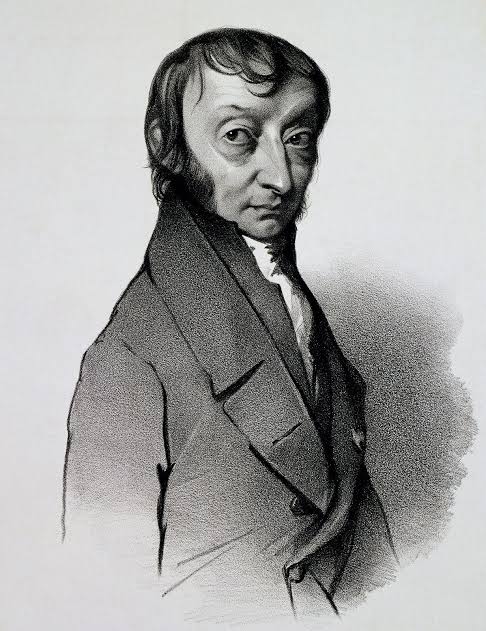
Today is Avogadro’s Day. October 23rd.
The most striking fact about Avogadro’s number is that Amedeo Avogadro never calculated it, nor did he ever suggest the specific value associated with his name today.
Instead, the number arose through a century-long detective story that bridged the gap between macroscopic chemistry and the microscopic reality of atoms.
In 1811, Italian physicist and lawyer Amedeo Avogadro published a paper addressing a dilemma raised by John Dalton’s atomic theory and Joseph Louis Gay-Lussac’s law of combining gas volumes. Avogadro proposed what is now known as Avogadro’s Hypothesis:
Equal volumes of all gases, at the same temperature and pressure, contain the exact same number of molecules.
Avogadro realized that gaseous elements like hydrogen, oxygen, and nitrogen travel as diatomic pairs (H2, O2, N2) rather than isolated atoms. While revolutionary, his proposal was largely overlooked for nearly half a century because contemporary chemists conflated atoms with molecules.
In 1909, French physicist Jean Perrin proposed naming the number of molecules in one gram-molecule (a mole) Avogadro’s constant (NA) in honor of Avogadro’s early insight.
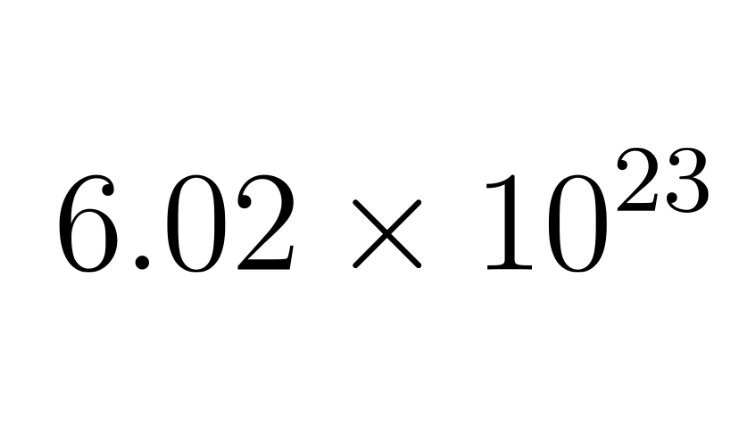 Perrin repeatedly arrived at a value NA ≈ 6.5 x 10²³ mole-1. Perrin provided the definitive, experimental proof that atoms and molecules were physical realities, earning him the 1926 Nobel Prize in Physics.
Over the 20th century, measurements grew steadily more precise using techniques such as X-ray crystal density determinations of ultra-pure silicon spheres. Now we have the exact 6.02214076 x 10²³ value.
It’s interesting to note that not too long ago, just about five human generations ago, many notable physicists considered atoms to be merely useful fiction and that atoms were not real.
Skepticism toward the physical reality of atoms was held by powerful, intellectually dominant figures who controlled major European university chairs, edited leading journals, and set the philosophical agenda in physics and chemistry.
People like Ernst Mach, the radical positivist, of the University of Vienna, argued that science must concern itself exclusively with observable sensory phenomena. No one had seen an atom. Physical atomism was bunk. (Chemical atomism was OK, though.)
Others like Wilhelm Ostwald (founder of modern physical chemistry and 1909 Nobel laureate) and mathematician Georg Helm argued that energy, not matter, was the sole fundamental reality in the universe.
On the other side of the debate was Ludwig Boltzman. He was the originator of statistical mechanics. He had derived the Second Law of Thermodynamics and the concept of entropy (S = k log W) by assuming matter consisted of countless bouncing atoms. Yet in the late 1890s, Mach and Ostwald treated him as a relic defending an obsolete 18th-century worldview.
Suffering from severe depression, declining health, and academic isolation, Boltzmann died by suicide in September 1906—just two years before his life’s work received undeniable experimental vindication.
As it happens, I had written a post two years ago in which Boltzman appeared. Read that post if you like concepts like entropy. Excerpt from the post follows.
In David Goodstein’s 1975 book, States of Matter, the introduction begins with this:
Ludwig Boltzmann, who spent much of his life studying statistical mechanics, died in 1906, by his own hand. Paul Ehrenfest, carrying on the work, died similarly in 1933. Now it is our turn to study statistical mechanics.
Perhaps it will be wise to approach the subject cautiously.
End excerpt.
I remember learning Avogadro’s number in perhaps an 8th standard chemistry class. I can still rattle off that number: six point zero two times ten raised to twenty-three molecules in a gram mole of a gas.
I wasn’t a nerd. I just loved physics and chemistry. I was pretty good at it, too.
Alright. Time for a bit of fun. Today I remembered how much I enjoyed Victor Borge’s humor. It was back in the days before we had broadband internet. For entertainment at home, we had a trusted TV set, and three commercial channels, and a couple of public TV channels.
Fortunately, the quality of the programs was much better than the crap that is available today. Victor Borge was a favorite. (Pronounced “bor-ga.”)
He was from Denmark. A virtuoso pianist and a first-class entertainer. Here’s a bit of Borge — Live in London.
Music. Yes, sir, we will have music. Piano, since we are following Victor Borge. Passacaglia by Handel.
Have a wonderful Avogadro’s day. (And perhaps enjoy a Hass avocado!)


