
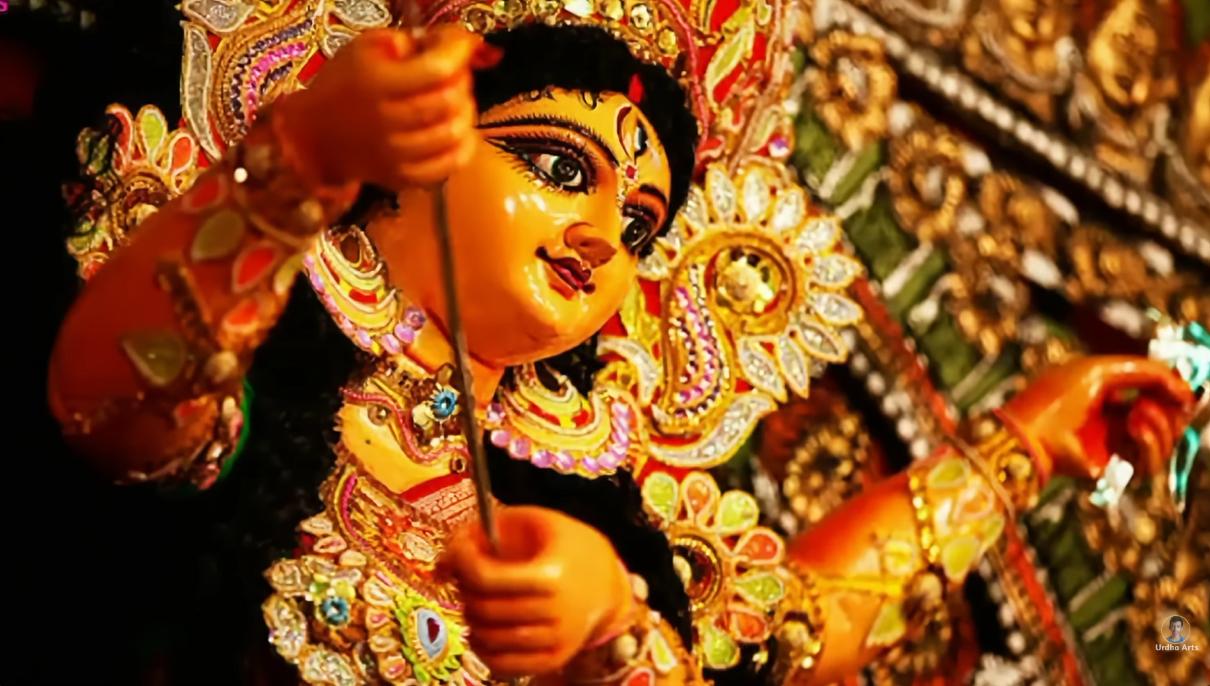
Today is Mahalaya, a day of great significance to Bengalis.
When we were little, we would be woken up at 4 AM by the parental units so we could listen to “Chandipath” on the radio. A radio was all we had. No tv, nor tape recorders, no smartphones and of course no YouTube channels to listen to Chandipath at will. Just that one day of the year. You snooze, you lose.
For nearly a century, since 1931, All India Radio (the government radio channel) has been broadcasting Mahishasuramardini, the dawn chanting of the Chandipath. Shri Birendra Krishna Bhadra’s intense voice echoed in one’s mind long after the program ended.
Within the Bengali tradition, Mahalaya carries several distinct connotations. It marks a metaphysical pivot from remembrance, shadow, and indebtedness to renewal, celebration, and effulgent light.
And it marks a daughter’s homecoming. Durga is the daughter of the Himalayas. That’s also where she lives with her husband Shiva. She is a fearsome cosmic warrior. She is the Mahishasuramardini— the destroyer of the demon Mahishasura.
She is also Uma or Gauri. (I simply love the name Gauri. I have a cousin named Gauri. Uma Thurman’s dad named her after Durga.) It is Durga Ma’s annual return to her parental abode with her four children: Lakshmi, Saraswati, Kartikeya, and Ganesha. Mahalaya is the beginning of the homecoming, and it has the emotional charge of a family reunion. For Bengalis, Ma Durga is the most beloved divine mother. Her homecoming is the high point of the year.
“Ya devi sharva bhuteshu . . .” means “To the Goddess who abides in all beings . . .”. (See note 1 for a bit on the etymology of the words Mahalaya and Chandipath, and “Ya Devi . . .” bit.)
The line forms the first half of a meditative couplet.
या देवी सर्वभूतेषु [गुण/भाव] रूपेण संस्थिता।
नमस्तस्यै नमस्तस्यै नमस्तस्यै नमो नमः॥
Yā devī sarvabhūteṣu [attribute] rūpeṇa saṃsthitā
Namas tasyai namas tasyai namas tasyai namo namaḥ
Translated:
“To that Goddess who resides in all beings in the form of [Attribute] —
Salutations to Her, salutations to Her, salutations to Her, salutations again and again.”
The hymn is a profound expression of radical non-duality. The divine is not confined only to exalted virtues like compassion (dayā) and intellect (buddhi). She is equally present in fundamental biological drives like hunger (kshudhā) and sleep (nidrā), and even in human limitations like error or confusion (bhrānti).
It declares that every aspect of mind, body, and nature is an expression of the same underlying cosmic principle.
Alright, enough of chatter. Time to listen to Chandipath. I will cue up the video to start playing at the bit which has the recurring refrain “Ya devi sharva bhuteshu . . .”
Let’s listen to that bit of the hymn where it cycles through more than twenty distinct universal aspects and human faculties, seeing the divine feminine not just as an external deity, but as the immanent consciousness and psychological fabric of every entity.
The Ya Devi refrain begins around 23:23 time. If you wish to, follow along with the various attributed of Durga mentioned:
-
-
- Vishnu-māyā (divine creative power / cosmic illusion)
- Chetanā (consciousness / vitality)
- Buddhi (intellect, discernment)
- Nidrā (sleep)
- Kshudhā (hunger)
- Chhāyā (shadow / reflection)
- Shakti (energy, vital force)
- Trishṇā (yearning, thirst)
- Kshānti (forbearance, patience)
- Lajjā (modesty)
- Shānti (peace)
- Shraddhā (faith, trust)
- Kānti (beauty, luster)
- Dhyiti (steadfastness)
- Dayā (compassion)
- Mātṛ (mother)
- Bhrānti (error, delusion)
-
For today’s song, let’s listen to another daughter of Bengal, Kaushiki Chakraborty. She’s singing “Adidev Mahadev.” Adidev is the primal force, Mahadev is Shiva. She is accompanied by her 9-year-old son. What a combination!
He’s cute as a button. He sings a wrong note at time 1:44 and touches his ear. His ears are like that of a Buddha. His mother looks at him indulgently. Sweet.
I am happy to report that on November 7th, I will attend a Kaushiki concert.
Subho Mahalaya, everyone.
NOTES
[1] Mahalaya (মহালয়া / महालया) is a compound of two Sanskrit words: Mahā (महा): Great, supreme, vast. And Ālaya (आलय): Abode, dwelling place.
Chandipath comes from two Sanskrit/Bengali words: Chandi (চণ্ডী): Goddess Chandi is the fierce and supreme manifestation of Shakti, or Durga, the Divine Mother. And Path (পাঠ / pāṭha): “Chanting” of a sacred text.
“Ya devi sharva bhuteshu . . .”
Yā (या): “She who”; Devī (देवी): “Goddess”; Sarva-bhūteṣu (सर्वभूतेषु): Sarva = “all”. Bhūta = “living beings,” “entities,” or “manifest existence” “in all beings” or “in all of existence”


