
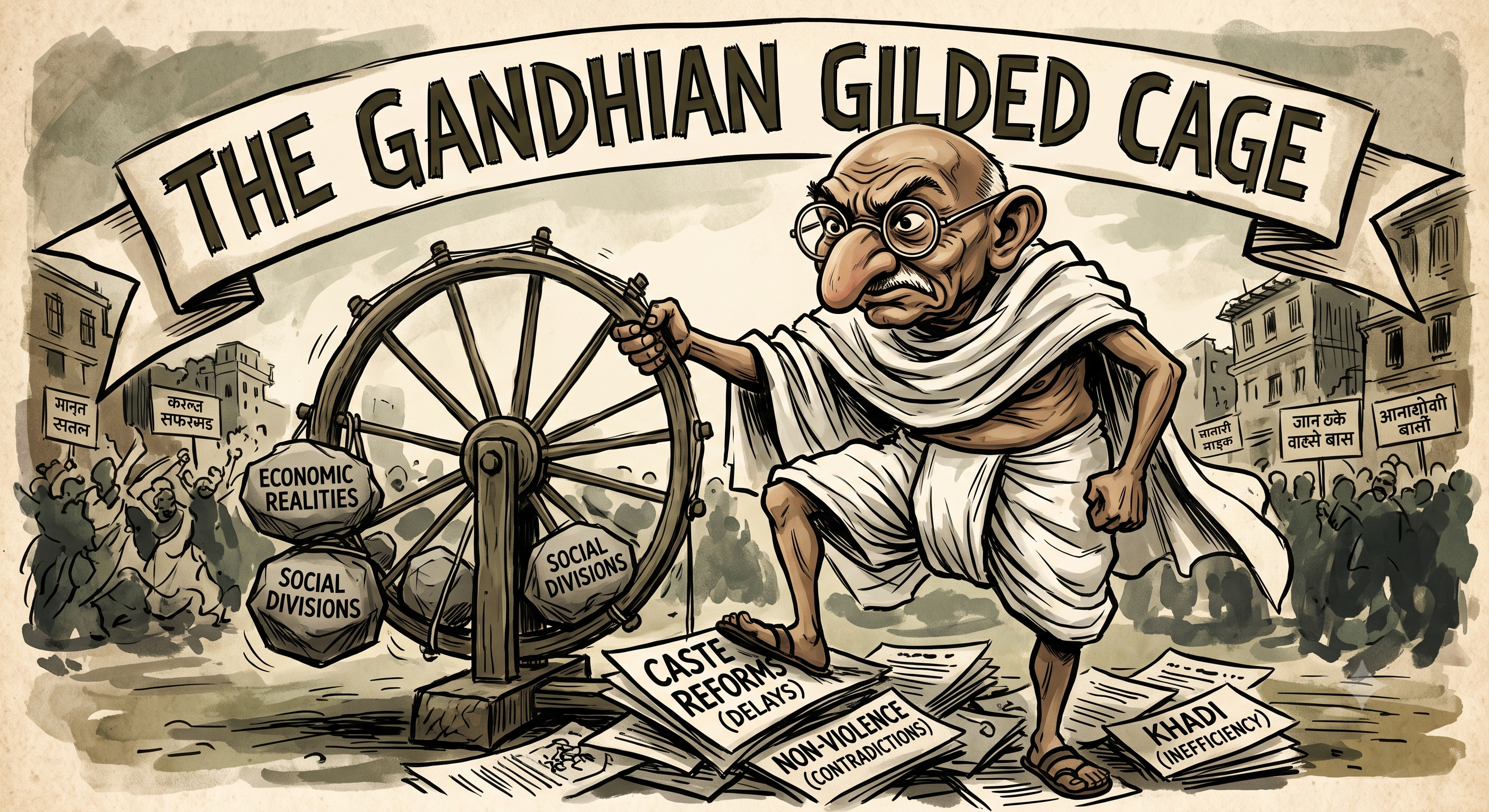
Yesterday was the birth anniversary of Mr. M. K. “Mahatma” Gandhi. Over the years, I have written several posts on this blog critical of the man. No Indian compares to him in his demonstrated capacity for evil. He is the only Indian in a select group that includes Stalin, Lenin, Mao, Pol Pot, Leopold and Hitler.
One of the worst crimes that I find Gandhi guilty of is that he wished for Hindu civilizational suicide. Gandhi, for reasons unfathomable, wanted to accelerate the genocide (a word coined around 1944 meaning the systematic and deliberate destruction of a people by killing substantial numbers of them) of Hindus, Buddhists and Jains.
Islam had been in the business of the wholesale slaughter of non-Muslims in the Indian subcontinent for centuries but had not succeeded. Gandhi wanted the genocide to be completed without any more delay. He dreamed of a Muslim ruled India, of “ushering in a new world,” a Hindu-free India. He wanted to see his dream of Islamic victory realized soon.
During the height of Partition riots in 1947, Gandhi addressed prayer meetings where refugees and communities were grappling with horrific Islamic violence. In April 1947, in New Delhi, Gandhi addressed Hindus facing attacks:
“Hindus should not harbour anger in their hearts against Muslims even if the latter wanted to destroy them. Even if the Muslims want to kill us all, we should face death bravely. If they established their rule after killing Hindus, we would be ushering in a new world by sacrificing our lives.”
In September 1947, when asked about Hindus and Sikhs trapped in violent areas in West Punjab, Gandhi argued that fleeing or retaliating was cowardice compared to what he called “the art of dying”—standing one’s ground without arms or hatred and accepting death rather than resorting to violence.
Gandhi’s exhortation for people to willingly allowing themselves to be slaughtered was not limited only to Hindus, Buddhists and Jains. In 1938, he notoriously gave similar advice to European Jews facing Nazi persecution, suggesting that collective, non-violent self-sacrifice would arouse the conscience of the world and morally defeat tyranny far more effectively than armed resistance.
It’s moral to never initiate violence. Any average human past puberty knows that elementary moral code — even if he is not always able to live up to that standard. But it is immoral to insist that one must not resist unprovoked violence against oneself and one’s loved ones. Only a sociopath would take the side of the aggressor and encourage him to kill innocents.
Gandhi was a naked sociopath and psychopath.
But to a large segment of stupid, brainwashed, retarded Indians, he is a lovely man. He is such a great hero that his ugly-ass image is printed on every effing Indian bank note, every city has an “MG Road”, school children are brainwashed into thinking that he got Indian independence, etc.
Gandhi loved Muslims and hated Hindus. But Hindus worship him and Muslims hate him.
I present to you a summary of my Gandhi-related posts. I prompted an AI to do a summary. Here it is.
Begin quote:
-
-
-
Rejection of Modernity and Industrialization: From a classical liberal perspective, rising living standards depend on industrialization, technological progress, division of labor, capital accumulation, and trade. Dey argues that Gandhi’s idealization of village self-sufficiency (swadeshi and gram swaraj) and suspicion of machinery promoted an anti-progress, anti-growth ethos. In Dey’s view, romanticizing subsistence agriculture and artisanal spinning kept people trapped in poverty rather than facilitating a transition to high-productivity industries.
-
Economic Isolationism vs. Interconnectedness: Dey argues that Gandhi failed to understand economic interconnectedness, specialization, and comparative advantage. He contends that Gandhi’s drive for self-reliance ultimately translated into a form of xenophobic economic isolationism. Dey has described the Gandhian revolution as an economic disaster, comparing its negative socioeconomic effects in India to the damage wrought by command economies.
-
Mismatched Tools for Real-World Problems: In essays such as On Gandhian Self-sufficiency, Dey characterizes tools like absolute non-violence (ahimsa) and satyagraha as “first-best” theoretical tools that only function in an idealized, distortion-free world. When applied dogmatically to a complex, imperfect world with conflicting human incentives and bad-faith actors, Dey argues these methods worsen outcomes and lead to severe societal damage.
-
The “Do-Gooder” Fallacy and Hubris: Dey frequently invokes Friedrich Hayek’s critique of social engineering and the unintended consequences of well-intentioned leaders. He argues that Gandhi suffered from significant egotism, believing his personal moral prescriptions could be universally imposed on a nation without understanding economics or human incentives.
-
Institutional Legacy and Uncritical Veneration: Dey has criticized what he views as a manufactured, uncritical cult of personality around Gandhi that was adopted and institutionalized by post-independence leaders. He contends that treating Gandhi as an infallible “Father of the Nation” shielded bad socioeconomic policies from scrutiny and delayed India’s adoption of free-market reforms.
-
-
In short, Dey views Gandhi not as the architect of India’s freedom, but as an anti-modern moralist whose economic and political doctrines hindered India’s path toward industrial wealth, free enterprise, and prosperity.
End of the material generated by Gemini.
Here’s an AI generated fun video making fun of mass murderers. I asked the creator Le Crapaud to include Gandhi in a future episode.
“Friends” version communiste
« Engueulade au Central Perk » pic.twitter.com/AaE1VaOkL9
— Le Crapaud (@Le_Crapaud47) September 30, 2026
Finally, a song. Flamenco, a meditative mood. La Malagueña – Gaby Moreno.
Have a wonderful weekend. Cheers.


