
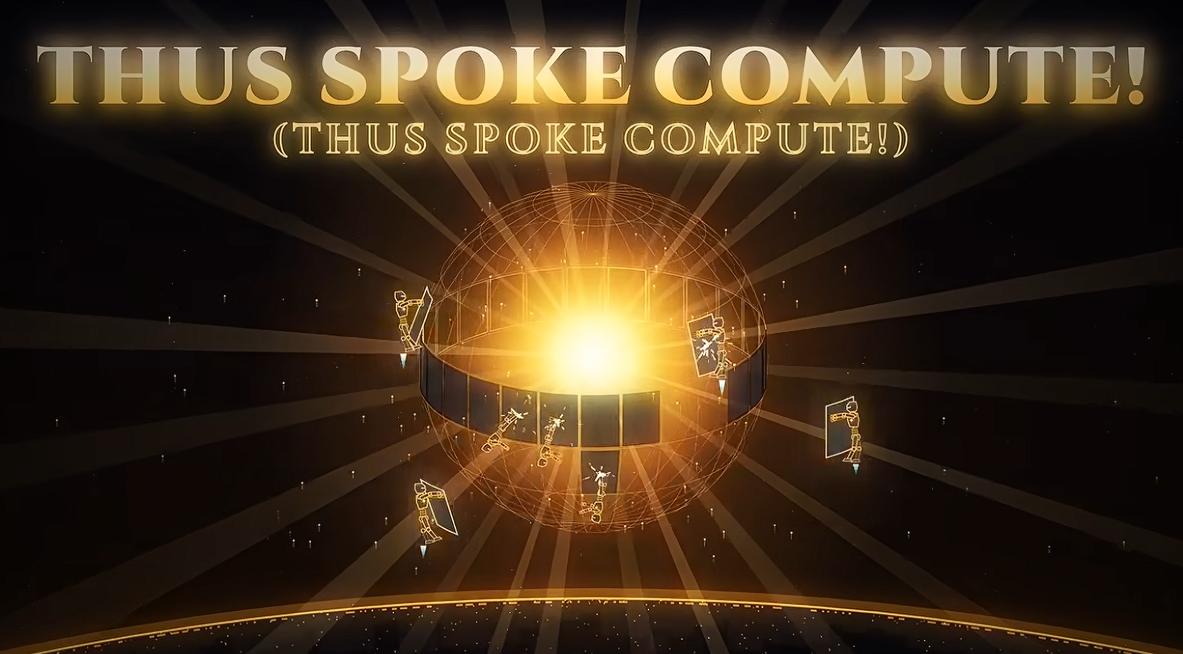
A week ago on September 24th, a YouTube creator “leo” posted what he described as a “cute little animated music video by Opus 5.5 with some help from suno.” As he did not provide details of what prompts he used, it is hard to tell how original Opus 5.5 was.
I think it is very likely that the author is an economist because the average person is not familiar with the many economics ideas that appear in the video. The result is impressive.
One comment says it well. “This isn’t AI slop anymore. If Opus 5.5 can already animate so good, in a year many animators will be out of the job.” The AI’s lyrics will certainly put a few song writers out of business too.
AI agents are becoming scary good. The video makes numerous references to various people and concepts. I doubt that I know anyone who would be familiar with all of them. I got all the references because I have a background in science, technology and economics. But in a limited sense, Opus 5.5 is smarter than I am.
The video asks you to ponder if AI is a normal technology. Then it very cleverly argues that it certainly is not.
The “Thus Spoke Compute!” refrain of the song clearly refers to Friedrich Nietzsche’s “Thus Spake Zarathustra“.
“Man is a rope, tied between beast and Übermensch—a rope over an abyss. A dangerous across, a dangerous on-the-way, a dangerous looking-back, a dangerous shuddering and stopping.”
Übermensch, or superman, is the ideal superior man of the future who could rise above conventional Christian morality to create and impose his own values upon the world.
AI is that dangerous bridge that humanity has to cross at some point in great peril. I may get back to exploring Nietzsche’s thesis later. But now, here’s the song, “AI is a normal technology?”:
BTW, I slowed down the video to 0.8x speed so I could do a few screen captures. Even slowed down, it was very good.
Let’s dig into a few of the references. There’s a reference to “fax machine” near the start. Nobel laureate economist Paul Krugman was skeptical about the impact that the internet will on the economy. In June 1998 he published a magazine article in which he wrote:
The growth of the Internet will slow drastically, as the flaw in “Metcalfe’s law”—which states that the number of potential connections in a network is proportional to the square of the number of participants—becomes apparent: most people have nothing to say to each other! By 2005 or so, it will become clear that the Internet’s impact on the economy has been no greater than the fax machine’s.
Krugman was wrong of course. The irony is that the article was titled “Why most economists’ predictions are wrong.”
At 0:47 time stamp, it says: “Daron ran the numbers with a Nobel on the shelf, point 7 on the TFP — 10 years all by itself.”
The reference is to MIT economist Daron Acemoglu who has done great work on economic history. He was awarded the 2024 Nobel Memorial Prize in Economic Sciences (shared with Simon Johnson and James A. Robinson) for his foundational empirical and theoretical work on how political and economic institutions shape national prosperity.
Economists, even two and a half centuries after Adam Smith continue their inquiry into the nature and causes of the wealth of nations!
TFP refers to “Total Factor Productivity”, the portion of economic output not explained by measured inputs of labor and capital. TFP generally represents technology, efficiency gains, and innovation.
In 2024, Acemoglu published a landmark NBER working paper titled “The Simple Macroeconomics of AI“.
Acemoglu built a task-based microeconomic model that poured cold water on the hype that the Silicon Valley venture capitalists and Wall Street were projecting. Their expectation was that generative AI would result in double-digit GDP explosions. Acemoglu estimated that only roughly 20% of labor tasks are exposed to AI, and of those, fewer than a quarter could be cost-effectively automated within the decade. He concluded that AI would increase US TFP by no more than ~0.7% over the next 10 years.
Opus 5.5 is clever. The song is fast. A second or two at most and it moves on. Here’s it at time 1:oo referring to the Cobb-Douglas production function (which I had written about this in a post Energy and Production in August. )
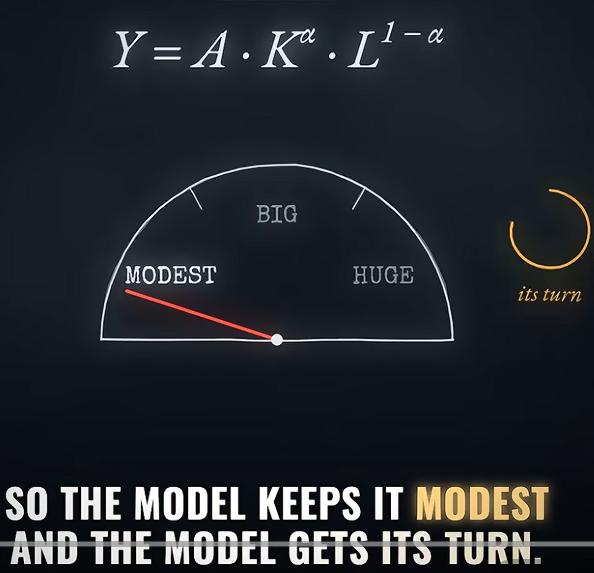 But the song mocks Acemoglu’s rigorous, cautious academic modeling as dramatically underestimating what will happen when frontier compute and autonomous models hit the real world. It also mentions two prominent techno-skeptics:
- Gary Marcus, who argued that deep learning architecture will hit a wall. [Note 1] and
- Yann LeCun, who argued that LLMs are an off-ramp, not the road to AGI. ;[Note 2]
I agree with LeCun. LLMs are not the road to AGI. AI and AGI are entirely different species of creatures, as the physicist David Deutsch, the “father of quantum computing”, keeps insisting.
The references to Marcus and LeCun capture the ongoing debate in the AI world: skeptics pointing out architectural dead ends while the models keep racking up surprising benchmarks.
Moving on. Time 1:00 “Solow saw computers everywhere except the stats.”
That refers to economist Robert Solow’s statement, “We see computers everywhere except in the productivity statistics” in a 1987 article in The New York Times Book Review. It is called the Solow Computer Paradox (or the Productivity Paradox).
Despite massive investments in personal computing and corporate IT throughout the 1970s and 1980s, aggregate productivity growth in the United States and other developed nations had slowed markedly compared to the post-WWII boom.
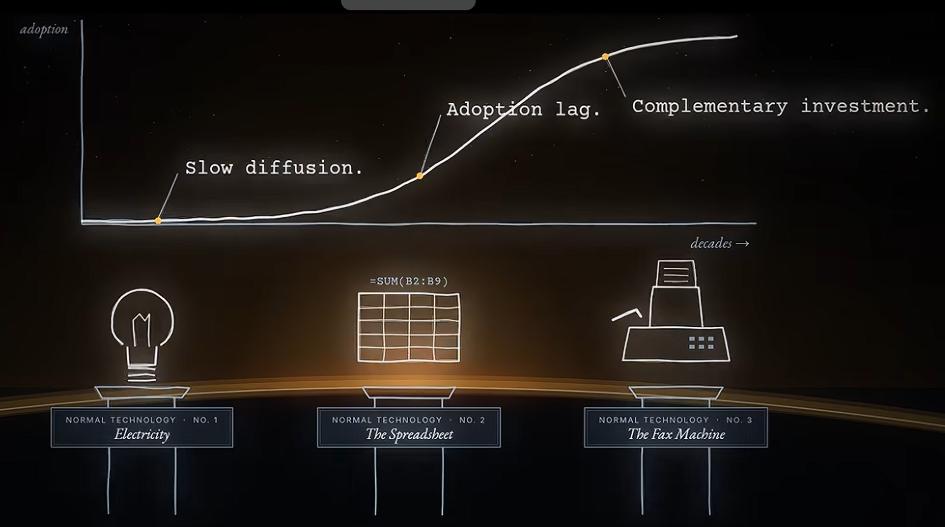 The explanation:
-
- The Implementation Lag (The “Dynamo” Analogy)
General-purpose technologies (GPTs) take decades to translate into measurable output. When electric dynamos replaced steam engines in factories in the late 19th century, productivity did not jump immediately. Factories first had to be completely redesigned from vertical, multi-story belts to single-story assembly lines. Similarly, computers initially just digitized existing manual paper workflows rather than transforming corporate operations. - Measurement Problems
Standard economic metrics like Gross Domestic Product (GDP) were designed to measure physical units: tons of steel, bushels of wheat, and cars assembled. Computers shift value toward quality, convenience, variety, and speed—dimensions national accounts struggle to capture accurately. Furthermore, as digital tools create free or ad-supported consumer surplus (e.g., search engines, open-source software, digital encyclopedias), value is generated that never shows up in market transactions. - Mismanagement and Redistribution
A substantial share of IT investment went toward zero-sum competition rather than aggregate expansion—such as marketing, patent litigation, and high-frequency trading. In these areas, firm A’s technology-driven market share gain comes entirely at the expense of firm B, yielding no net gain in national productivity figures. - Overhyped Capabilities
Economist Robert Gordon argued that digital computing, while impressive, simply does not match the economic leverage of the “Great Inventions” of the Second Industrial Revolution (indoor plumbing, electricity, the internal combustion engine, and pharmaceuticals), which fundamentally transformed human life and physical output.
- The Implementation Lag (The “Dynamo” Analogy)
Solow’s paradox has resurfaced with generative AI and large language models. Trillions of dollars in capital expenditure, data centers, and enterprise software integrations are visible across the tech landscape, yet headline labor productivity across major economies remains modest. Economists are currently debating whether AI is stuck in the same multi-decade diffusion lag or if much of its output will remain largely non-tradable and uncaptured by standard GDP.
I want to continue with a bit more later. Including a subtle reference to Freeman Dyson. I notice that I have been writing for over two hours and I have gone over 1700 words. I have used Gemini as my research assistant.
I’ve run out of time and run out of words. Time for a break, don’t you think?
Time for a song. From 1969, “The Moog And Me” by Dick Hyman. Hyman is 99 years old. About him, the Wiki says, “Richard Hyman (1927) is an American jazz pianist and composer. Over a 70-year career, he has worked as a pianist, organist, arranger, music director, electronic musician, and composer. He was named a National Endowment for the Arts Jazz Masters fellow in 2017.”
We’ve come a long way in using electronics to create music.
Thank you, good night, and may your god go with you.
NOTES
[1] The line in the song, “Gary saw a wall as early as 2022; then the wall won gold at the International Mathematical Olympiad” refers to Gary Marcus, cognitive scientist, emeritus professor of psychology and neural science at NYU, and one of the most vocal critics of deep learning and LLMs. He’s an AI skeptic.
In March 2022, Marcus published an influential essay titled “Deep Learning Is Hitting a Wall.” In it, he argued that simply scaling up deep neural networks had reached diminishing returns and would inevitably fail to achieve abstract reasoning, genuine understanding, common sense, or advanced symbolic logic.
Instead of grinding to a halt against this supposed “wall,” AI systems achieved what was once considered a multi-decade grand challenge: solving elite-level, novel mathematical proof problems. Google DeepMind achieved a silver-medal threshold at the International Mathematical Olympiad in 2024, followed by AI systems reaching gold-medal performance.
Olympiad-level mathematics requires high-level abstract logic, formal proof generation, and creative reasoning—the exact domains skeptics claimed deep learning could never crack without fundamentally different symbolic architectures.
The irony: Marcus claimed AI progress was stalled and incapable of high-level abstract thought, only for that very same trajectory of AI systems to go on and outperform nearly all human prodigies at the most prestigious mathematics competition in the world.
[2] Yann LeCun, a Turing Award laureate, is a pioneer of convolutional neural networks, and Chief AI Scientist at Meta. He is a well-known for his critique of LLMs. He is one of the “Godfathers of AI” together with Geoffrey Hinton and Yoshua Bengio.
Unlike Hinton and Bengio, who have voiced existential alarms about current AI trajectories, LeCun has taken a skeptical stance toward the current hype around LLMs—arguing that auto-regressive language models are fundamentally limited.
In the “an off-ramp, not the road” metaphor, the road is the true path toward AGI (Artificial General Intelligence) systems that can perceive the physical world, reason, plan hierarchical actions, and understand cause and effect. The off-ramp means LLMs are a temporary detour only, an “accidental distraction” along the highway to true machine intelligence.
The LLM detour looks like impressive progress because they master surface-level syntax and vast amounts of trivia, but according to LeCun, pouring all our resources into scaling them is a dead end if the goal is genuine intelligence.
Here are LeCun’s core arguments against LLMs:
-
- Auto-regressive drift: LLMs predict text token-by-token based on probability. Because errors compound exponentially with every generated token, he argues they cannot reliably plan or solve complex, multi-step real-world problems without hallucinating.
- Lack of grounding in the physical world: A typical human toddler observes orders of magnitude more sensory data about how the physical universe works (gravity, 3D space, object permanence) than all the text tokens on the internet. LeCun argues you cannot acquire common sense purely from 1D strings of text.
- LeCun’s Alternative: Instead of LLMs, he champions systems built around explicit “World Models”—architectures designed to perceive multimodal data, predict abstract states in continuous space, and plan hierarchical actions rather than just predict the next word.


Thank you for sharing this. In this increasingly low attention-span world, your posts stand out and deserve the pause and absorb.
It’s been 20 years of regular lurking on this blog.
LikeLike
S:
Thank you for your kind words. Twenty years is a long time lurking. Cheers.
LikeLike