
From a Canadian publication ‘The Province’ (Tuesday, May 1, 1990), author: Crawford Kilian. Continue reading “Hitler in Good Company”
Month: June 2008
Marcus Brigstocke on Religion
Monotheism is evil. And many of the followers of the monotheistic faiths are “vicious tyrannical thugs.”
Bono, ya evil bastard!
Bono, lead singer of the rock band U2, is famous throughout the entertainment industry for being more than just a little self-righteous. At a recent U2 concert in Glasgow, Scotland, he asked the audience for total quiet.
Then, in the silence, he started to slowly clap his hands, once every few seconds. Holding the audience in total silence, he said into the microphone, “Every time I clap my hands, a child in Africa dies.”
From the front of the crowd a voice with a broad Scottish accent pierced the quiet …
“Well, fookin’ stop doin’ it then, ya evil bastard!”
Talking of Bono reminds me. Here’s Jeff Sachs talking about his book “Common Wealth: Economics for a Crowded Planet” with Jon Stewart on the Daily Show:
http://www.thedailyshow.com/sitewide/video_player/view/default/swf.jhtml
Disintermediation
Don’t thank me. As an economist, I am duty-bound to propose efficient ways of achieving goals. Here’s the current problem that I was trying to address. Sify.com reports that “ISI wants to double aid to militants.”
Pakistan’s Inter Services Intelligence (ISI) has very recently proposed to double the financial support to terrorist groups operating in Jammu and Kashmir, India’s external intelligence agency Research and Analysis Wing (RAW) has warned in a ‘top secret’ report.
Why?
Universal Studios should come out with a King Kong stage that features a brand spanking new toilette that should be put into place in a movie set resembling the oval office at the White House, where it is convex shaped like a giant lunar crater telescope mirror, and the vice presidential right arm flush lever would be holding a congratulatory second place nomination prize which should be in the shape of the Mars Phoenix Polar Lander surface digging tool.
Continue reading “Why?”
Reliance’s Rural Business Hubs
A news item from yesterday reports:
“As part of the organised retail initiative, Reliance Retail will be creating several rural business hubs. At one level, these will be centres for aggregation of farm produce. At another level, they will engage with supply of quality farm inputs and provision of products and services to rural consumers,” Mr Ambani said.
That report also notes that Ambani is proposing to build semiconductor plants for solar energy. Good ideas, Mr Mukesh Ambani.
He’s consistent. See the post “A quicker faster way to help rural India” from July 2006. So far, I like what Ambani is interested in: building cities, creating rural hubs, investing in solar energy. More power to Reliance.
(Thanks to Gautam Patil for the link.)
The First Amendment
Mera America Mahan
Every time I see the painted slogan “Mera Bharat Mahan” on the rear bumpers of trucks, it gives me a jolt. The jolt is a mixture of incredulity, pride, cynicism and hope. Pride in my motherland forces a desperate hope that it is true while my innate cynicism dismisses the idea that India is great as incredible.
For many years I have wondered whether there was something that could make India great. Was there a single thing — a policy, a principle, an action, an accident, anything — that could guide India’s path to whatever greatness is potential in it? What if I compared India to other nations, both successful and failed — will I be able to discern that one single thing? I think I am slowly coming around to the viewpoint that there is such a thing that could be the candidate instrument I have been looking for. I think the US has it and India does not.
Continue reading “The First Amendment”
Some thoughts on the Price of Oil — Part 1
One of the main questions occupying the public mind appears to be related to the price of oil. Since economics informs that, and related questions, I think it would be appropriate to reason economically (so to speak) about the matter. Will the unprecedented high price of oil become a permanent feature of the world or is it just a passing phenomenon, a bubble that is bound to burst? What’s the appropriate price of oil? Is the high price of oil a good thing, and if so, for whom?
As this is just a blog post and not a deep analysis meant for a peer-reviewed journal, I will be informal. That CYA disclaimer out of the way, let’s begin at the beginning.
Continue reading “Some thoughts on the Price of Oil — Part 1”
Iraq now, Iran next, Saudi Arabia for later
“It’s the oil, stupid.”
In an opinion piece in the Wall Street Journal of 10th June, Edward J. Markey asks rhetorically “Why Is Bush Helping Saudi Arabia Build Nukes?” He points out that if at all the Saudis need more energy — even after sitting atop the world’s largest oil reserves — then the US should be helping them out by selling them solar technology. Solar technology makes sense in a country three times the size of Texas, and where the desert sands see around 300 days of sunshine every year. He says, “For a country with so much oil, gas and solar potential, importing expensive and dangerous nuclear power makes no economic sense.”
Continue reading “Iraq now, Iran next, Saudi Arabia for later”
Ranking Universities on Web Visibility
Webometric.info analyzes about 15,000 universities world wide and ranks 5,000 of them on their “web performance” which is a weighted combination of
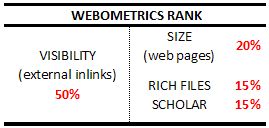
Their objective:
We intend to motivate both institutions and scholars to have a web presence that reflect accurately their activities. If the web performance of an institution is below the expected position according to their academic excellence, university authorities should reconsider their web policy, promoting substantial increases of the volume and quality of their electronic publications.
 Atanu Dey : Life is a Random Draw