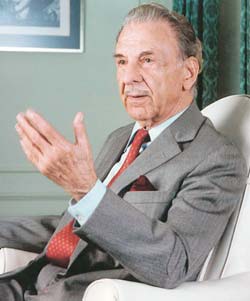
Jehangir Ratanji Dadabhoy Tata

J.R.D. Tata was born in Paris, France in 1904 and died in Geneva, Switzerland in 1993. You’d think that he was as Indian as one gets but he was only half Indian. His father was Ratanji Dadabhoy Tata and his mother Suzanne “Sooni” Brière. His mother tongue was French. As a French citizen, on turning 20, he had to serve in the French army for a year.

J.R.D. was the founder of many Tata companies, including Tata Airlines in 1932 (which became Air India in 1946 — which was nationalized in 1953)  for which he is known as the “Father of Indian Civil Aviation.” He was chairman of Air India until Prime Minister Morarji Desai fired him in 1977.[1]  Continue reading “Jehangir Ratanji Dadabhoy Tata”

Victor Davis Hanson — Why World War 2 Matters

I had not known that Americans call it “World War 2” while the British call it the “Second World War.” That I learned from a public lecture Victor Davis Hanson gave at the Hillsdale College History Department. He is a Senior Fellow in Residence in Classics and Military History at the Hoover Institution, Stanford University, and a professor of Classics Emeritus at California State University, Fresno.

It is hard to overestimate the valuable education one can get from the world wide web, in particular from YouTube. The interwebs, as I like to call it, is a great resource and also the greatest impediment to doing my work. Easily distracted as I am, I find learning stuff delightful. And at times I despair at how little I know of the subjects that interest me.

Anyhow, I have my favorites among the great teachers on the web. Dr Hanson is a marvelous teacher. This is the first time I mention him on this blog (it won’t be the last) but I have been learning from the master for a few years. Here’s a treat for you. Continue reading “Victor Davis Hanson — Why World War 2 Matters”

Anuj Dhar’s talk on Netaji Bose @ Pune, Sep 23, 2017

“Who Killed Bose: Mystery behind Netaji’s Death”.

Public talk by Anuj Dhar. Author and researcher of events connected to Netaji’s life and times. Students, professionals and anyone interested in the history of post-independence India are welcome to the talk.

About Anuj Dhar (wiki): Indian author and former journalist, Dhar has published several books on the death of Subhas Chandra Bose which (according to official and academic views) occurred on 18 August 1945, when a Japanese plane carrying him crashed in Japanese-occupied Taiwan. Dhar claims in his books that there was no air crash and that Bose actually died in the 1980s after living as hermit monk named “Gumnami Baba Bhagwanji” in Faizabad. Dhar is also the founder-trustee of New Delhi-based not for profit organisation Mission Netaji.

The event is free.

Sep 23, 2017, 10 AM to Noon.
Venue: Symbiosis Institute of Management Studies [SIMS]
Range Hills Road, Khadki, Near Military Hospital, Pune – 411020, India

This public service announcement brought to you courtesy of Loknath Rao.

Post script: I have no interest in the matter. Perhaps NSCB died in 1945 or maybe he did not. I am not familiar with Anuj Dhar’s work. But I am mystified by one thing: why would NSCB do what Dhar claims he did? If he indeed was alive all those decades when Nehru and his spawn ruled India, why did he not oppose their misgovernance? For all the effect he had over those years that Dhar claims NSCB was alive, it basically amounts to the same thing as he having perished in a plane crash. In fact Gamnami Baba Bhagwanji appears to have had the same impact on India as I had over those years — namely zero.

Thomas Sowell on Intellectuals and Race

Prof Thomas Sowell of the Hoover Institution at Stanford University is an American institution himself. He is arguably one of the finest contemporary intellectuals. An economist by training, his output of books and articles is prodigious. A brilliant mind and an indefatigable warrior against the forces of unreason, ignorance, bigotry, tyranny, the controlling state, and so on and on.

Here are a few quotes from Dr Sowell.   Continue reading “Thomas Sowell on Intellectuals and Race”

Lee Kuan Yew “Lessons in Leadership” — The Harvard Interview

Mr Lee Kuan Yew

What makes for a good leader? That depends on how you define good and the context — a corporation or a nation or a social movement. How much do qualities such as morality, integrity, intelligence and other personal traits matter? Are leaders born or are they made by accidental circumstances? Can a political leader really alter the trajectory of a nation dramatically for the better?

Because questions like those matter to me, I found much of interest in the Youtube video of the October 2000 interview of Senior Minister Lee Kuan Yew of Singapore by Harvard Kennedy School professors David Gergen, Ron Heifetz, Dean Williams, and John Thomas.  Continue reading “Lee Kuan Yew “Lessons in Leadership” — The Harvard Interview”

In Celebration of Friedrich August von Hayek

Twenty-five years ago today, on March 23 1992, Friedrich August von Hayek died. Winner of the 1974 Nobel Memorial Prize in Economic Sciences, Hayek was an Austrian / British liberal. I consider him to be not just one of the greatest economists of all times but one of the world’s most enlightened social thinkers.

Reading Hayek makes me marvel at the heights that human intellect is capable of. Compared to him, some of the most renowned economists appear to be pygmies. I feel sorry that most people — even those who claim to be economists — have not even heard of him, let alone read him. Here are a few excerpts, from Hayek and about Hayek.
Continue reading “In Celebration of Friedrich August von Hayek”

Of Prizes and People

Prize
First Prize

We humans instinctively categorize, especially people. We are amateur primitive set-theoreticians. There are infinite ways to categorize people since humans have a humongous number of characteristics.

Consider the categories of people who award prize and people who win prizes. In my view, people who institute prizes belong to the most prestigious set. I order the sets as:

  1. People who institute prizes.
  2. People who win prizes.
  3. People who don’t win prizes.
  4. People who award themselves prizes.

For example, Alfred Nobel belongs to the first set; Einstein to the second set; ordinary grunts like us, who never come within shouting distance of any prestigious award make up the majority of humanity, belong to the third set. We are mostly harmless and generally unimpressive. Continue reading “Of Prizes and People”

Lee Kuan Yew’s advice to a young lady doing her PhD

Lee Kuan Yew was what I consider a good human being. He had not just brains and guts, he had a heart. Here’s one side of him that is funny and warm.

Nepotism and Modi

The word nepotism and the name Narendra Modi do not belong in the same sentence. Just read this piece The Other Modis (Dec 29, 2017 2016) in the IndiaToday magazine.

While the story is very interesting and it does show up as a shining exception to the pervasive nepotism of politicians, I am not too touched by the neglect of one’s family. Family and friends matter because they are our support and our inspiration. Certainly, nepotism is bad but not caring deeply about one’s flesh and blood is not a virtue.
Continue reading “Nepotism and Modi”

Thomas Schelling (April 14, 1921 – December 13, 2016) RIP

schellingthomas-cCelebrated economist Thomas Schelling died today at the age of 95. He was the recipient of the 2005 Nobel Memorial Prize in Economic Sciences for “having enhanced our understanding of conflict and cooperation through game-theory analysis”. I note his passing because he was instrumental in my recognizing that I belonged to his tribe — that I was at heart an economist. Mere accident led me to pick up his book Micromotives and Macrobehavior (1978) at the Sunnyvale Public Library sometime back in the early 1990s. He received his bachelors degree in economics in 1944 from UC Berkeley, my alma mater.  Continue reading “Thomas Schelling (April 14, 1921 – December 13, 2016) RIP”