
We’ll know on Nov 8th which fork in the road ahead the US takes. Since I value freedom, I cannot ever support either of the major parties but I hope that Clinton does not win. But it looks like she will. Anyway, here’s my favorite commentator, Pat Condell, on what’s in store for the US.
Author: Atanu Dey
Economist.
Happy Birthday, Ludwig von Mises
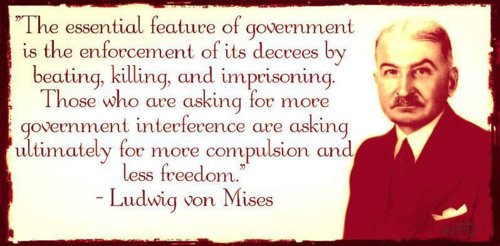 Today, Sept 29th, is the 135th birthday of Ludwig von Mises (1881-1973).
I consider Mises to be one of my gurus. Just to be sure, I used the word guru very seriously — one who dispels the darkness (gu) of ignorance through the radiance (ru) of knowledge. I have been reading his magnum opus Human Action (1949) and The Ultimate Foundation of Economic Science (1962) religiously.
Who was he? “Ludwig von Mises was one of the greatest economists and political scientists of the twentieth century. He revolutionised the understanding of money, inflation and recessions; comprehensively refuted the arguments for socialism; and provided a devastating critique of the methodologies of mainstream economics. His contributions to the Austrian School laid the intellectual groundwork for thinkers such as F. A. Hayek, Murray Rothbard and Israel Kirzner.” Continue reading “Happy Birthday, Ludwig von Mises”
India and Foreign Direct Investment
The economic growth of any economy depends on how much is invested in creating productive assets in it. Factories, buildings, ports, the transportation network, natural resource extraction, manpower training, the use of modern methods of manufacturing, energy production and distribution networks — all require investment. Part of the investment arises from domestic savings, part from foreign borrowings, and part from foreign direct investment (FDI.) Let’s look at how India does in FDI compared to other countries.
Here I will not address what kind of changes need to happen for India to attract, say, 10 times as much FDI as it currently does. That’s feasible but not with the current policies and leadership. Anyway, here are the facts.
Happy Ganesh Chaturthi — the Chicago edition
 Ganesh, the Lord of Beginnings, the Remover of Obstacles is without doubt the coolest of gods. He goes places. Here’s him in the home of Molly and Prashant and their children Ria and Joydeep in Chicago. I stopped here on my way from the East coast to San Jose.
Continue reading “Happy Ganesh Chaturthi — the Chicago edition”
Ask Me Anything — The Boston Edition
Greetings from Boston, MA. I arrived last evening from San Jose, CA to visit my friend Kanchan Banerjee and his family. The weather here was a shock — hot and humid — after the pleasant cool and dry of the SF Bay area. That wonderful weather spoils you something silly. Anyway, lots of stuff going on. What’s on your mind?
The Global Village
 With all the great advances in the technology and engineering of global telecommunications systems, it is often claimed that the world has become integrated and is now a “global village.” Is it really?
What’s a village? One definition states that a village is “a group of houses and associated buildings, larger than a hamlet and smaller than a town, situated in a rural area.” Therefore a village has a few hundred people, and there is a high degree of dependence among them, they know and mind each other. Their knowledge of, and their interest in, the outside world is limited and their concerns are primarily parochial. A village, by its very nature, is not an agglomeration of millions of people. That would be a modern metropolitan area, or a mega-city.
Continue reading “The Global Village”
The Journey So Far, and What Lies Ahead

I arrived in the US on this day, August 15th, back in 1982 at JFK in New York, NY around 5 PM Eastern (Aug 16th, 5:30 AM IST.) Though it’s been many years, I still recall exactly how I felt. It was the best day of my life that far.
I had no idea of what lay ahead.
I came to the US to get a PhD in computer science at Rutgers. At that time I had not known that I was at heart an economist. In any event, I worked for Hewlett Packard for some years in the Silicon Valley, and then went back to school. Now, after 20 years of studying economics, just this past month I concluded that I finally understood the subject.
Continue reading “The Journey So Far, and What Lies Ahead”
Pushpanjali by Antariksha Sanchar
Source: Antariksha Sanchar

(How I came across this: Via Experiments at Processing. Pretty cool animations at that site.)
Independence Certainly but Not Freedom

It is an evident and obvious fact that India has failed to prosper. The cause of that failure is also obvious: the poor quality of its political and bureaucratic overlords. I use the word overlord advisedly because politicians and bureaucrats are not agents of the people — as they should be in a properly constructed government of a free people — but rather are rulers who position themselves above the people as commanders and dictators.
It is also easy to explain why the government is the overlord rather than the servant of the people. The reason is historical. The form, function, structure, objectives and power of the government were determined by the British during their colonial rule of India, starting in the mid-19th century. When it was no longer profitable for the British to continue to hold India as its colony, they transferred control of the British-created government to its favored minions, namely, Gandhi and his protégé Nehru. It is absolutely imperative to recognize that this transfer of power from the British to the Indians was a deliberate and voluntary act on both sides of the bargain.
Continue reading “Independence Certainly but Not Freedom”
Democracy and the Economics of Politics
 “Power tends to corrupt and absolute power corrupts absolutely. Great men are almost always bad men . . .”
The truth of Lord Acton’s observation gets confirmed with sickening regularity. Here I explore that point in the context of democracy. Why do democracies, particularly those with powerful governments, tend to elect bad people? What’s the analytical relationship between power, politics, money and corruption? Continue reading “Democracy and the Economics of Politics”
 Atanu Dey : Life is a Random Draw