
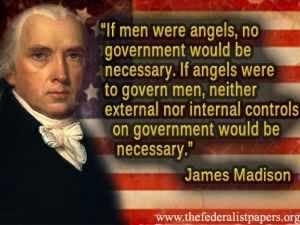
 We take the existence of governments for granted. This is understandable since we have been under some form of government all our lives, and we also believe that some form of government must have existed for as long as recorded history. Government appears to be something as natural as the air we breathe, and therefore we are easily persuaded that it must be as necessary as air. Not just necessary but also that it is a net positive. This does not stand scrutiny, however.
Just as people don’t ordinarily ask “what precisely is air; why do we need it?” so too people don’t ask questions such as “what precisely is government; can society exist without government; what form of government is good; etc?” It takes special effort to pose and answer questions such as those. That is left to students of political philosophy and political science.[1] Continue reading “What is the Government?”
 In the previous post,

 Economists understandably get worked up about the “Nobel” prize in economics (Nobel in quotes because it was instituted in 1968 by the Bank of Sweden “in the memory of Alfred Nobel,” unlike the Nobel prizes in physics, chemistry, medicine, literature and peace.)
 Vocabulary
 Production
 I am a contrarian, someone who frequently takes a view opposite to that held by the majority. My default position is to view with the utmost suspicion any idea that is popular or fashionable. If the vast majority of the population thinks and believes in a certain way, I default to considering it to be wrong. If the majority believes proposition P to be true, I suspect that P is probably false. My null hypothesis is that the majority is wrong. Very rarely have I had to reject the null hypothesis.
 Atanu Dey : Life is a Random Draw