
 The big news in town is the verdict by the Supreme Court of India on the matter of the Ram Janmabhoomi site. It appears that the land has been “awarded” to those who want to have a temple dedicated to the birthplace of Bhagwan Ram. There’s much jubilation among Hindus. But why?
Fact is that that site was a temple in the first place. Islamic invaders destroyed that temple as is their religious duty, and they built a mosque at that site to demonstrate their supremacy. In a polity that rejects Islamic supremacy, it’s easy to conclude that building mosques on temple property is immoral, unethical, uncivilized and just plain wrong. Why did it take decades for the Supreme Court to decide this case? Is the court merely incompetent or just lazy or stupid or what?
Continue reading “The Ram Janmabhoomi Temple Case”
 We all have an intuitive understanding of our world. We make sense of the world by looking at it through “common sense” lenses. These are almost instinctive, or hard-wired as they say in computerese. And the surprising truth is that nearly all of these intuitions are wrong. They are incompatible with the world we live in today.
 Music is of one of my most enduring passions. I can’t play any musical instrument to save my life. But I am grateful that I love music and my taste is eclectic. And I am happy that I live in an age in which I have access to an inexhaustible source of music of all kinds.
 What’s wrong with the climate? Nothing that has not been wrong before — and will not be wrong in the future. What’s wrong is that the climate changes, with or without human help.
 There’s a funny story in Robert Heilbroner’s 1953 book
  Probably because I associate trains with holidays when we were growing up I love trains. One time many years ago I even got to ride a diesel-electric locomotive hauling a passenger train in India — a rare treat. Thanks to YouTube, these days you can get a virtual ride in a locomotive. My favorite train-driver’s view channel is one that goes by the handle HinduCowGirl.
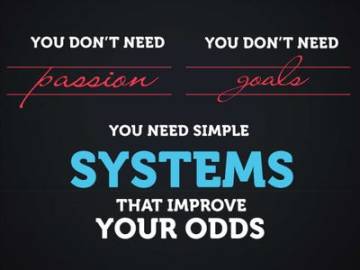 I like Scott Adams. He’s down to earth, quite clever, knows how to make it. His book How to Fail at Almost Everything and Still Win Big: Kind of the Story of My Life outlines his system. He says — and I agree 100% — that goals are for losers. Winners don’t set goals; they create a system, and then work as hard as they can. If you have a good system, you will make it. The focus is on the process, not the outcome.[1]
 Atanu Dey : Life is a Random Draw