
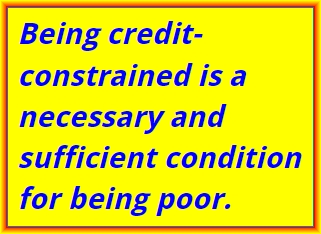
 For anyone concerned about the poor and poverty, the first task is to clearly define the words “poor” and “poverty.” Wealth and income are reasonable measures that usually serve in defining a poor person: one who has less than some defined minimum of wealth and/or income.
But that definition is not comprehensive. What if a person could borrow the money needed for an investment with a sufficiently high return such that it would be possible to return the money with interest, and still have some left over? Then the person is not poor. Meaning, anyone able to borrow is not poor. Conversely, anyone who is unable to borrow is “credit-constrained” and is comprehensively poor.
For a person to be considered poor, it is not necessary that the person have zero net worth or wealth. The sufficient condition for being poor is that one is credit constrained. Even if a person has negative net wealth, as long as the person is able to borrow, the person is not poor.
For example, consider a person who does not have money for acquiring a particular skill that would enable him to earn a very good living. Suppose further the person could borrow the money needed and be able to pay back the loan from the higher income from the acquired skill. When he borrows, his net wealth (his assets minus the loan liability) will actually be less than zero. Yet he will not really be poor because it will only be a temporary situation. In this case, he creates assets (acquires the skill) using the loan that later enables him to repay the loan.
We are familiar with many cases of “wealthy” people who at some point in their lives had negative or zero wealth but were able to borrow (sometimes to the tune of hundreds of millions) that allowed them to build up their fortunes and repay the loans. Even with a negative net wealth, they were not poor because they were not credit constrained.
So what is the main implication of this definition of being poor? It is this. An efficient way to help those who are poor is to somehow release the credit-constraint they face. Economic efficiency considerations recommend that.
But what if the poor are being denied access to wealth that they have a legitimate claim to, and which they need? Then it would be a moral imperative to return that wealth to them.
The poor of India have a share of the public wealth of India. It is economically efficient and morally right to give them that wealth. It has to be done now, and not in some indeterminate future. [Previous post in this series: Public Wealth Return.]

 I love a good debate, and naturally so because I am the argumentative kind. Most of all, I like debates centered around religion.. The line dividing the opposing sides is sharp, and the positions irreconcilable. I delight in the skewering that monotheism takes in them.
 “Doggie, wait here a sec. I have got this important thing to get done. Then we go on with our walk, okay?”
  If you ever saw me on a flight, you’d be convinced that I was a country bumpkin first time inside a plane. I look out the window (always a window seat, thank you) take pictures, and always take videos of the landing and takeoff. On ground, I always look up when I hear jet engines. At the airport, I watch planes land and take off. I find airplanes fascinating — especially the big birds. The plane I love the most is the Boeing 747, the “Jumbo jet”, the Queen of the Skies.
  After quite a few years, I find myself in India on Ganesh Chaturthi. At my friend’s place in Mumbai where I am staying, today (Thursday 13th Sept) we had Ganesh puja in the morning. There’s Shri Ganesh and of course his favorite modaks (left foreground). I have some videos too which I will upload to Youtube in a bit.
 Atanu Dey : Life is a Random Draw