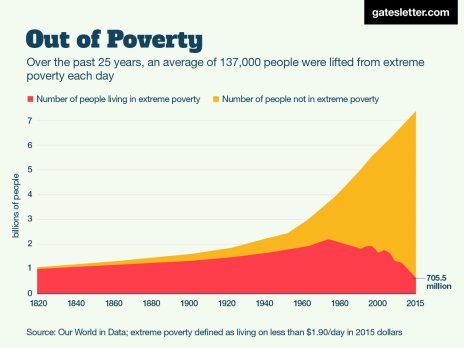
 This is an optimistic piece — a rarity for sure around this blog. Here I claim that in 15 years or so, extreme poverty which afflicts around one billion people, mainly in the so-called third world, will be eradicated. That problem has plagued mankind since the beginning but the end is in sight.
Technology
Global extreme poverty will be eliminated as a side-effect of technological advances, primarily made by people who probably neither care about poverty nor do they intend to solve that problem. Which is good news for India. India has the largest number of people suffering extreme poverty in the world. Around half of the billion extremely poor people of the world live in India.
There are two kinds of problems. There are hard problems and there are impossible to solve problems. Given time, with advances in knowledge, all hard problems will be solved. Poverty is a hard problem but not an impossible problem since in many parts of the world it has been solved for all practical purposes. The critically important key to eradicating poverty is knowledge.
Knowledge
Knowledge is what economists call a “public good.” Once produced, knowledge can be repeatedly used without diminishing the available stock. It is “non-rival” in consumption. Technology increases monotonically because of the accumulation of knowledge. And technology (which is essentially knowledge of how to do something) developed somewhere gets adopted in the rest of the world with surprising rapidity. It is very cheap to use once developed.
Consider the cell phone, internet and computer technologies that were developed in the Western economies (they are called developed economies partly because they developed technology) but those advances spread to every part of the globe. Just like the computation and communications technologies, it will be people in rich countries who will develop the technology to eliminate poverty in poor countries, albeit not by design nor intent.
That means India’s dire poverty will be solved not by Indians — least of all by the insanely inept, criminally corrupt government of India which is arguably the fountainhead of India’s poverty — but by others. I note in passing that India’s telecommunications problem was created by the government but it was solved using foreign technology.
In the following I conjecture how the end of poverty will happen. Continue reading “The End of Poverty”

 The human freedom index — A Global Measurement of Personal, Civil and Economic Freedom — of 2017 is out. There’s India near the bottom of the list. Indians are not free — but that’s not news, is it? For a couple of centuries at least, Indians have not been free. This fact goes a long way in explaining why Indians are not prosperous.
 There are things we can accomplish as individuals and there are things that we can more effectively and efficiently achieve collectively. For the latter, we create what are called institutions to serve as instruments for getting things done. The
  I’d like to explore a few important concepts like government, constitutions, democracy, etc. They are embedded in the fabric of Indian society. Taking a clear-eyed view of their genesis, nature, function, modes of failure, and implementation can be intellectually rewarding but more importantly it can help in creating the good society. I’ll start with something seemingly unrelated — clubs.[1]
 In the context of exponential technological growth (a topic that I explored in the piece “