
 James Buchanan proposed a simple test to distinguish economists from non-economists. It was that economists would not agree with the old adage that “whatever is worth doing, is worth doing well.” If you’re confused by that, you aren’t an economist.
Economists know that everything has costs and benefits. Not just this or that thing but everything. That includes good things and bad things. Even good things have costs, and bad things have benefits. Furthermore, economists “think at the margin.” And finally, there’s such a thing as “sunk costs.”
To keep this brief, let’s just say that an economist would stop before reaching that nebulous “well done” stage. He would stop when the marginal cost exceeds the marginal benefit. If something is worth doing, it is worth doing as long as the net benefit is positive. And then stop.
Back to our topic at hand on billionaires (the previous bits are part 1 and part 2.) Continue reading “Billionaires are Different — Part 3”

 I concluded the

 The big news in town is the verdict by the Supreme Court of India on the matter of the Ram Janmabhoomi site. It appears that the land has been “awarded” to those who want to have a temple dedicated to the birthplace of Bhagwan Ram. There’s much jubilation among Hindus. But why?
 We all have an intuitive understanding of our world. We make sense of the world by looking at it through “common sense” lenses. These are almost instinctive, or hard-wired as they say in computerese. And the surprising truth is that nearly all of these intuitions are wrong. They are incompatible with the world we live in today.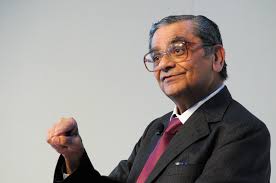
 Music is of one of my most enduring passions. I can’t play any musical instrument to save my life. But I am grateful that I love music and my taste is eclectic. And I am happy that I live in an age in which I have access to an inexhaustible source of music of all kinds.
 What’s wrong with the climate? Nothing that has not been wrong before — and will not be wrong in the future. What’s wrong is that the climate changes, with or without human help.
 Atanu Dey : Life is a Random Draw