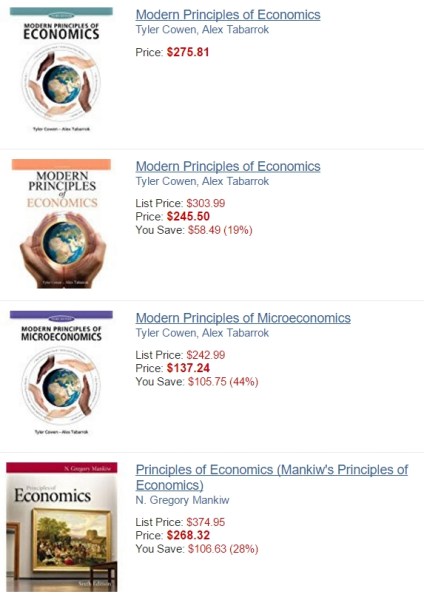
The Price of Econ Textbooks

I haven’t read these books that Amazon recommended to me via email today. But I hope that within the pages of these books the authors somewhere explain the economics of textbook publishing and why these books on the principles of economics cost an arm and a leg.
Thankfully in modern times, the principles of economics is accessible to many who can’t afford those prices. It’s all there on the web. Continue reading “The Price of Econ Textbooks”

The Demand and Supply of Fines and Corruption

supply-and-demandA comment on the last piece prompts this tiny lesson in microeconomics.

“Corruption is one big pain point in the economic growth of a country. I have this funny idea but would like your inputs from an economists perspective. If things get costly it reduces its demand. Can corruption be made costly? This may increase compliance. Just to illustrate. If we raise fine for a fault, say traffic violation, which suppose today is Rs 500 to Rs 5000. Today the violator gets away by paying Rs 100 to traffic police. This is 20% of legal cost. If the penalty is 5000 and assuming traffic police acts rationally thereby asking for bigger bribe…won’t that deter future violations by the offender? Here I presume that traffic police will act smart knowing fully well that offender isn’t going to pay 5000 but at the same time he himself won’t settle for just Rs 100 and may raise ‘price’ to Rs 200 or 300. This is effective 100-200%% jump in bribe money that may pinch offender at some point in time. Pls throw some light.”

To start off, let’s examine the statement “If things get costly it reduces its demand.” In lay terms, that is true but economically speaking, prices don’t affect the demand or the supply of a product. To understand why not, we have to clearly understand what economists mean by “demand” or “supply” and distinguish them from “the quantity demanded” and “the quantity supplied.” Continue reading “The Demand and Supply of Fines and Corruption”

Why does India grow so fast if its education system is so poor?

educationWe have to admit that India’s education system gets an F grade. India does not feature in any of the world rankings of universities. Sure there is a lot of hype about the IITs but aside from the delusions of the seriously uninformed, the IITs don’t add up to a hill of beans. I have been writing about IITs on this blog for a over a decade. Here’s one — IITs are not what they are cracked up to be, which is likely to stick in the craw of many IITians.

If India’s education system, including higher education, is so poor then how is it that it is one of the fastest growing large economy?
Continue reading “Why does India grow so fast if its education system is so poor?”

Hanson’s essay on “Trump and the American Divide”

Make America Great Again

Victor Davis Hanson, a Senior Fellow at the Hoover Institution in Stanford University, wrote a long piece for the Winter 2017 issue of City Journal magazine titled “Trump and the American Divide.” I find reading a well-written, thoughtful long piece in a magazine more interesting and informative than a few dozen breathlessly written newspapers short pieces. Good long pieces take time to write and are usually written a reasonable interval after the event(s), which allows both the writer and the reader a wider perspective. Continue reading “Hanson’s essay on “Trump and the American Divide””

The Ownership Society — Revisited

deg320 The idea of “empowering” people was all the rage a few years ago. The answer to all of India’s woes, it seems, lay in empowering people, whatever that meant. I thought it was basically stupid. Why? Because people who are not free in any meaningful sense of the word cannot be empowered. Here’s what I wrote back in October 2005 on what is an “Ownership Society.” Brief excerpt follows: Continue reading “The Ownership Society — Revisited”

Why India Needs a New Constitution

On Livemint, I have an opinion piece titled “Why India Needs a New Constitution” which is part of a series on the book Liberalism in India: Past, Present and Future.

Here it is, for the record:

Why India needs a new Constitution

Continue reading “Why India Needs a New Constitution”

A Tale of Two Shocks

Two shocks rocked the world: Donald Trump’s upset victory in the US presidential elections, and the demonetization of high-denomination currency in India. Both can be expected to have profound repercussions. I will pass commenting on the tears of Hillary Clinton — delicious though they are to yours truly — except to say that to me the result was as unexpected as it was delightful.

The Indian economy experienced a massive shock with the announcement that Rs 500 and Rs 1000 currency notes will no longer be legal tender starting from just a few hours after the announcement. An astounding 86 percent of all currency was rendered worthless for transactions, and only the remaining 14 percent was expected to serve for a short term (hopefully) the myriad purposes that money usually serves in an economy. A monetary shock of that magnitude cannot but have complex intended and unintended consequences. Continue reading “A Tale of Two Shocks”

Politics by Principle, not Interest

Politics by Principle, not Interest

From the description of the book “Politics by Principle, not Interest” (1998) by James Buchanan and Roger Congleton.

“The very logic of majority rule implies unequal treatment or discrimination. If left unconstrained, majority coalitions will promote the interests of their own members at the expense of other persons. This book focuses on the effects of applying a generality constraint on the political process. Under this requirement, majorities would be constitutionally prohibited from treating different persons and groups differently. The generality principle is familiar in that all persons are to be treated equally. In summary, this book extends the generality norm to politics. Continue reading “Politics by Principle, not Interest”

The Global Village

zzz404With all the great advances in the technology and engineering of global telecommunications systems, it is often claimed that the world has become integrated and is now a “global village.” Is it really?

What’s a village? One definition states that a village is “a group of houses and associated buildings, larger than a hamlet and smaller than a town, situated in a rural area.” Therefore a village has a few hundred people, and there is a high degree of dependence among them, they know and mind each other. Their knowledge of, and their interest in, the outside world is limited and their concerns are primarily parochial. A village, by its very nature, is not an agglomeration of millions of people. That would be a modern metropolitan area, or a mega-city.
Continue reading “The Global Village”

Planning Works but not Always

Walter E Williams “Wealth comes from successful individual efforts to please one’s fellow man … that’s what competition is all about: “outpleasing” your competitors to win over the consumers.”
— Walter E Williams.

Part II.

I ended the previous bit of this essay with these questions: First, why is it that central planning appears to work in familial situations and in firms but not in economies? Second, does planning really work for firms and corporations? Finally, if it is indeed true that centralized planning does not work at the economy level, why do petty despots (like Nehru) go for it despite the ruin it causes?

I will address the first two questions here and the third question in the next part.

Let’s see why planning works in families. The parents are emotionally motivated to do what’s best for the family and are best placed to plan for the family simply because they care. They know the preferences of family members, know the means available, the tradeoffs involved, and so on. The information and computing power required to get to an approximate solution to meet the objectives are well within their cognitive capacity. Though not trivial, planning for a family is a manageable task.
Continue reading “Planning Works but not Always”