Why we misapprehend the world

We all have an intuitive understanding of our world. We make sense of the world by looking at it through “common sense” lenses. These are almost instinctive, or hard-wired as they say in computerese. And the surprising truth is that nearly all of these intuitions are wrong. They are incompatible with the world we live in today.
Anatomically modern humans have existed for at least 200,000 years (or maybe even 300,000 years). For nearly all of that extended time, humans lived in small bands of around 150 individuals and survived as hunter-gatherers. Continue reading “Why we misapprehend the world”

Dr Bronowski at Auschwitz

Dr Jacob Bronowski (1908 – 1974) the wiki informs us, was

“a British mathematician and historian. He is best known for developing a humanistic approach to science, and as the presenter and writer of the thirteen part 1973 BBC television documentary series, and accompanying book, The Ascent of Man, which led to his regard as “one of the world’s most celebrated intellectuals”.”

This is the ending sequence of episode 11 of the series recorded at the Nazi concentration camp in Auschwitz in German occupied Poland. Around one million people were killed there between 1940 and 1945. Continue reading “Dr Bronowski at Auschwitz”

Scott Adams on Goals

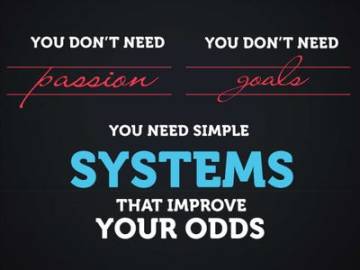
I like Scott Adams. He’s down to earth, quite clever, knows how to make it. His book How to Fail at Almost Everything and Still Win Big: Kind of the Story of My Life outlines his system. He says — and I agree 100% — that goals are for losers. Winners don’t set goals; they create a system, and then work as hard as they can. If you have a good system, you will make it. The focus is on the process, not the outcome.[1]
Another point he makes is that passion is overrated. Many successful people would ascribe their success to their passion and advise people to follow their passion, but there are many more failures who also followed their passion. Continue reading “Scott Adams on Goals”

What is the Government?

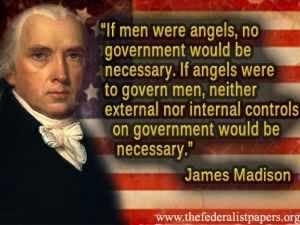
We take the existence of governments for granted. This is understandable since we have been under some form of government all our lives, and we also believe that some form of government must have existed for as long as recorded history. Government appears to be something as natural as the air we breathe, and therefore we are easily persuaded that it must be as necessary as air. Not just necessary but also that it is a net positive. This does not stand scrutiny, however.

Just as people don’t ordinarily ask “what precisely is air; why do we need it?” so too people don’t ask questions such as “what precisely is government; can society exist without government; what form of government is good; etc?” It takes special effort to pose and answer questions such as those. That is left to students of political philosophy and political science.[1] Continue reading “What is the Government?”

What’s Capitalism – Part Two

In the previous post, What’s Capitalism, I had noted that capitalism is a combination of (1) private property, (2) free markets, (3) voluntary trade, and (4) institutions which legally enforce contracts. I briefly touched upon the first three already; here I discuss the matter of “institutions which legally enforce contracts.”

Contracts

“A contract is a legally binding agreement which recognizes and governs the rights and duties of the parties to the agreement. … An agreement typically involves the exchange of goods, services, money, or promises of any of those.” The wiki’s definition serves our purpose. The two parties agree to do, or refrain from doing, some specific act. An example: the agreement that homeowner Alex reaches with Bob for remodeling the kitchen. Continue reading “What’s Capitalism – Part Two”

Climate Change

Climate change hysteria is the big three-ring circus in town, and as can be expected, children are clamoring to not just watch the circus but to join it as well, as children with over-active imagination are wont to do.

It’s fair to say that those running the circus are in it for the money, and are not motivated by altruism and universal benevolence. They want to grab your attention so that they can grab your wallet. There’s a sucker born every minute.[1] Continue reading “Climate Change”

The “Nobel” prize in Economics

Economists understandably get worked up about the “Nobel” prize in economics (Nobel in quotes because it was instituted in 1968 by the Bank of Sweden “in the memory of Alfred Nobel,” unlike the Nobel prizes in physics, chemistry, medicine, literature and peace.)

In any event, you cannot evade the fact that it confers enormous prestige, and most regrettably it buys unjustified influence among politicians and policymakers, especially in developing nations. Continue reading “The “Nobel” prize in Economics”

The Asymmetry between Free Entry and Free Exit

When asked why he was resigning from a particular country club, Groucho Marx’s explanation was “I don’t want to belong to any club that would have me as a member.” That he was allowed to enter meant that the club’s standards were low, and therefore he’d not want to be a member. Very droll. Anyway, there’s an obvious asymmetry between entry and exit. Continue reading “The Asymmetry between Free Entry and Free Exit”

Bibek Debroy on the Mahabharata

I believe YouTube is an inexhaustible treasure house of audio and video content guaranteed to delight and instruct every conceivable taste. I spend altogether too much time on the web, and quite a bit of it on YouTube. I am sure that I would have been much smarter and wiser had I had the benefit of the web when I was growing up. Better late than never, though.

Bibek Debroy’s talk on the Mahabharata is a shining example of the gems you find on the web.

It’s as delightful as it is edifying. Bibek-da, as I like to call him, is a scholar of unparalleled distinction of the Indian classics. Not  just that, he’s a distinguished member of my tribe, an economist. What’s not to like about him! Continue reading “Bibek Debroy on the Mahabharata”

Why I’m an Anti-natalist

I am a contrarian, someone who frequently takes a view opposite to that held by the majority. My default position is to view with the utmost suspicion any idea that is popular or fashionable. If the vast majority of the population thinks and believes in a certain way, I default to considering it to be wrong. If the majority believes proposition P to be true, I suspect that P is probably false. My null hypothesis is that the majority is wrong. Very rarely have I had to reject the null hypothesis.

Therefore it should not come as a surprise to you that I am anti-natalist given that most people are natalist. Mind you, there is no causal connection: majority beliefs do not cause me to hold the beliefs I do. It is only that I am more likely not to find myself on the side of the majority. My antinatalist position would not change even if nobody held it or if everybody did. My position is rational, in the sense that I reasoned my way into it. Continue reading “Why I’m an Anti-natalist”