
 For anyone concerned about the poor and poverty, the first task is to clearly define the words “poor” and “poverty.” Wealth and income are reasonable measures that usually serve in defining a poor person: one who has less than some defined minimum of wealth and/or income.
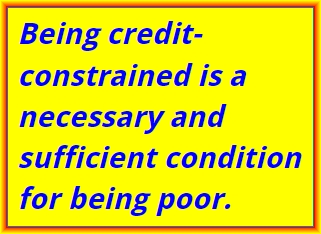
But that definition is not comprehensive. What if a person could borrow the money needed for an investment with a sufficiently high return such that it would be possible to return the money with interest, and still have some left over? Then the person is not poor. Meaning, anyone able to borrow is not poor. Conversely, anyone who is unable to borrow is “credit-constrained” and is comprehensively poor.
For a person to be considered poor, it is not necessary that the person have zero net worth or wealth. The sufficient condition for being poor is that one is credit constrained. Even if a person has negative net wealth, as long as the person is able to borrow, the person is not poor.
For example, consider a person who does not have money for acquiring a particular skill that would enable him to earn a very good living. Suppose further the person could borrow the money needed and be able to pay back the loan from the higher income from the acquired skill. When he borrows, his net wealth (his assets minus the loan liability) will actually be less than zero. Yet he will not really be poor because it will only be a temporary situation. In this case, he creates assets (acquires the skill) using the loan that later enables him to repay the loan.
We are familiar with many cases of “wealthy” people who at some point in their lives had negative or zero wealth but were able to borrow (sometimes to the tune of hundreds of millions) that allowed them to build up their fortunes and repay the loans. Even with a negative net wealth, they were not poor because they were not credit constrained.
So what is the main implication of this definition of being poor? It is this. An efficient way to help those who are poor is to somehow release the credit-constraint they face. Economic efficiency considerations recommend that.
But what if the poor are being denied access to wealth that they have a legitimate claim to, and which they need? Then it would be a moral imperative to return that wealth to them.
The poor of India have a share of the public wealth of India. It is economically efficient and morally right to give them that wealth. It has to be done now, and not in some indeterminate future. [Previous post in this series: Public Wealth Return.]
 You can bet on this fact: that occasionally there will be natural disasters like floods, fires, and earthquakes. You can also bet on a follow-on fact: that in those places, prices of essential goods and services will go up. And finally you can bet your life on this: that popular accusations of price gouging by greedy corporations and windfall profits will motivate politicians and bureaucrats to impose price controls.
 When Nobel laureate physicist Ernest Rutherford (1871 – 1937) claimed that “Physics is the only real science. The rest are just stamp collecting” he was perhaps displaying the arrogance that comes with the territory of knowing certain fundamental truths that are denied to non-physicists.
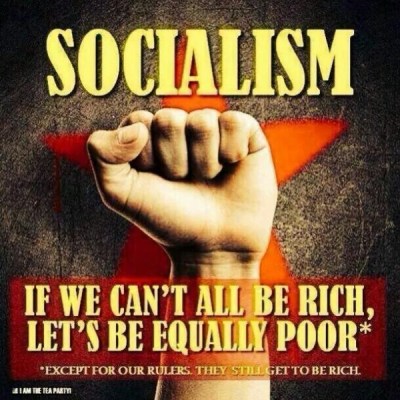 Robert Heilbroner (1919 – 2005) defined socialism as “a centrally planned economy in which the government controls all means of production.”
 “At the heart of economics is a scientific mystery: How is it that the pricing system accomplishes the world’s work without anyone being in charge? Like language, no one invented it. None of us could have invented it, and its operation depends in no way on anyone’s comprehension or understanding of it. … The pricing system–How is order produced from freedom of choice?–is a scientific mystery as deep, fundamental and inspiring as that of the expanding universe or the forces that bind matter.”
 Death and Taxes


 Atanu Dey : Life is a Random Draw