
 I came across an interesting bit in a video I was watching yesterday. “How many health care providers are in the room?” asked the kind lady in it. After a show of hands, she said, “Thank you, thank you, thank you. I feel like a lot of the work both of us care about so much is in service of others and all of you are dedicating your life for that same purpose.”
The dedication to the “service of others” part caught my attention. It’s curious that healthcare providers such as doctors and nurses, and other people like firefighters, military personnel, etc., are popularly held in higher esteem than sanitation workers, bus drivers, computer programmers, sales people, etc. Somehow some occupations are more “selfless” than others. Sorry to be contrarian but it’s simply not true that occupations can be categorized that way.
Certainly occupations can be justifiably categorized as immoral or moral, legal or illegal, intellectually hard or easy, physically challenging or easy, and so on. But as long as one is getting paid and not doing voluntary work, there’s no selflessness involved. That is not to imply people in various paid occupations are narrowly selfish and lack human decency; it is only that all of us are most of the time primarily — though not solely — motivated by self-regard and not by self-denying altruism. Continue reading “Honoring Those Who Serve Us”
 Quite often I enjoy the pleasure of shocking people with my contrarian viewpoints. For some people, the shock is replaced with the pleasure of understanding something that goes against plain common sense. When that happens, I am very gratified but when it doesn’t, I feel sad.
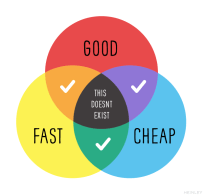 It would be best if we had zero crime, or zero pollution, or zero inequality (of wealth, income, health, beauty, intelligence, lifespans), or zero transportation deaths, et cetera. That is, it would be best if we could obtain the best and not have to pay too much for it. But, alas, the real world refuses to comply with our wishes. For anything good that the real world grudgingly gives us, it exacts a cost.
 We humans value economic goods. But everything we value doesn’t necessarily have to be an economic good. What’s the defining characteristic? The demand for the good has to exceed the supply for it to be thought of as an economic good.

 Economists are uniquely qualified in their understanding of one particular aspect of human activity, and that activity is unique to humans. No other animal trades, or exchanges, among its kind. Adam Smith wrote that “the propensity to truck, barter and exchange one thing for another is common to all men, and to be found in no other race of animals.” And no other discipline focuses on trade as much as economics does. Indeed, the most parsimonious description of economics is that it is the systematic study of trade, and trade-offs.
 Here’s a graduation speech that won’t tax your time and, without taxing your brain, will remind you of what is worth remembering. In 2007,

Prabhudesai referred to JEE (Joint Entrance Exam) in a comment and wrote, “An examination that has too much of competition resulting to very high cost of producing one engineer. For a poor country like India it is a massive blow.”
Is that type of competition good? That is socially wasteful competition. It belongs to a broad class of activities that are technically known as “rent seeking.”
One of the principal ways of obtaining wealth is by earning a profit. Profits are the difference between the cost of producing something and the price obtained from its sale. Profits indicate that wealth has been created and value delivered. Rent seeking occurs when one attempts to obtain some wealth without actually creating wealth.
Continue reading “A Bit on Rent Seeking”