
 We humans value economic goods. But everything we value doesn’t necessarily have to be an economic good. What’s the defining characteristic? The demand for the good has to exceed the supply for it to be thought of as an economic good.
Let’s look at some goods and ask if they are economic goods or not. You are walking along a clear mountain stream in the wilderness. Is the water an economic good? No, because the demand for the water in the stream (only you are the consumer for miles around) is much less than the supply. Is the water of value to you? It certainly is: you can drink the water or take a bath. A thing of value need not be an economic good but any economic good has a positive value (and conversely, an economic bad has a negative value.) Continue reading “The Cost of Things”


 Economists are uniquely qualified in their understanding of one particular aspect of human activity, and that activity is unique to humans. No other animal trades, or exchanges, among its kind. Adam Smith wrote that “the propensity to truck, barter and exchange one thing for another is common to all men, and to be found in no other race of animals.” And no other discipline focuses on trade as much as economics does. Indeed, the most parsimonious description of economics is that it is the systematic study of trade, and trade-offs.
 Here’s a graduation speech that won’t tax your time and, without taxing your brain, will remind you of what is worth remembering. In 2007,
 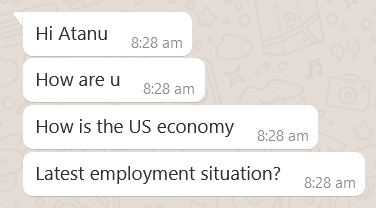 When people get to know that I am an economist, for instance on a flight, I often get asked about the economy or even the stock market. I just make up some stuff if the mood strikes me but sometimes I tell them that I don’t know. You tell me, I say.
 Basic economics partitions goods into private goods and public goods, and property into private property and public property. Private goods are defined as those goods that are rival — one person’s consumption of the good reduces the amount available for others to consume — and excludable — a person can be prevented from consuming the good. Thus a cookie is a private good. A cookie eaten reduces the stock of cookies, and cookies can be locked up.
 The relationship between economic freedom and prosperity is empirically verifiable. Countries that are relatively economically free — meaning free markets and private ownership of capital — do better than countries that are not economically free.
 Atanu Dey : Life is a Random Draw