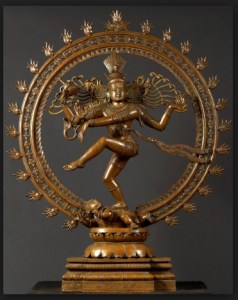
Nirvighnam KuruMe Deva Sarva-Kaaryeshu Sarvada॥
Sri Ganesh Chaturthi Greetings
Nirvighnam KuruMe Deva Sarva-Kaaryeshu Sarvada॥
Today was hot. It was 102°F in San Jose, CA, my fair city. That beat a 1945 record for the day of 99°F. I kid you not. Here’s a screen capture of the weather here. (For those of you in the civilized world of metric measures, 102°F is around 39°Celcius.) Continue reading “Is it hot enough for you?”
My friend Keith Hudson passed away in England today. He was 82 years old.

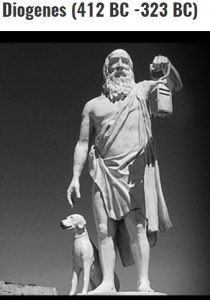
Diogenes of Sinope lived in a tub in the marketplace. Since it was a long time ago, around the 4th century BCE, the details are few. He is also known as Diogenes the Cynic.
I feel a certain intellectual kinship to Diogenes because I too am a cynic. He must have been a remarkable man, going by the stories told about him.
It is said that he sometimes walked around with a lamp even in broad daylight. When asked why, he replied, “I am looking for an honest man.” A cynic to the core. Continue reading “Diogenes of Sinope”

We humans instinctively categorize, especially people. We are amateur primitive set-theoreticians. There are infinite ways to categorize people since humans have a humongous number of characteristics.
Consider the categories of people who award prize and people who win prizes. In my view, people who institute prizes belong to the most prestigious set. I order the sets as:
For example, Alfred Nobel belongs to the first set; Einstein to the second set; ordinary grunts like us, who never come within shouting distance of any prestigious award make up the majority of humanity, belong to the third set. We are mostly harmless and generally unimpressive. Continue reading “Of Prizes and People”

A comp sci joke claims that there are 10 kinds of people: those who understand binary numerals and those who don’t. Being a former computer science student myself, I find it tickles my funny bone. Continue reading “There are 10 Kinds of People”
Pondering the fact of death, I am reminded that impermanence is a central feature of the world we live in. The phenomenal world — of things and events — is called maya in the dharmic traditions (namely Jain, Hindu, Buddhist & Sikh.)
The world is maya. Many people simply translate it as “ the world is an illusion” but that is incorrect. The world is real. Maya does not mean that the world is unreal or that it is an illusion. It means something like this: the world as we perceive it is not what the world actually is. We cannot directly perceive the reality that is at the foundation of what exists. That reality is given a word — Brahman. Most of us cannot comprehend the Brahman because we are limited beings. Continue reading “Maya, Moksha, Nama and Rupa”
I am a Hindu.In what sense am I a Hindu? Does what I read, write, wear and consume make me a Hindu? I think, read and write in English, I wear Western style clothing, I live in a Western country, etc. Even then I am a Hindu at the core of my being.
What defines me as a Hindu is my core belief system. How I comprehend the world is what determines whether I am a Hindu or not. The important distinction here is between “material beliefs” and “cosmological beliefs.” Continue reading “Material and Cosmological Beliefs”
Money is important. The real economy cannot function without a stable and predictable currency. Money serves as a numéraire, which the wiki defines as “a basic standard by which value is computed . . . the numéraire is one of the functions of money, to serve as a unit of account: to provide a common benchmark relative to which the worth of various goods and services are measured.”
These days, nearly all money is fiat money issued by the central bank of an economy which is controlled (indirectly perhaps) by the government. The quantity, and therefore the “price” of money (which is the interest rate), is controlled by the central bank. Continue reading “Ask Me Anything — The Demonetization Edition”

The Center for Civil Society convened a day-long conference on Nov 20th at The Claridges Hotel, New Delhi, to honor the memory of S V Raju. I attended and had the opportunity to meet with many friends and also some people I had heard about but never met before.
About the event, CCS notes: Continue reading “Liberalism in India: Past, Present and Future”