Twenty-five years ago today, on March 23 1992, Friedrich August von Hayek died. Winner of the 1974 Nobel Memorial Prize in Economic Sciences, Hayek was an Austrian / British liberal. I consider him to be not just one of the greatest economists of all times but one of the world’s most enlightened social thinkers.
Reading Hayek makes me marvel at the heights that human intellect is capable of. Compared to him, some of the most renowned economists appear to be pygmies. I feel sorry that most people — even those who claim to be economists — have not even heard of him, let alone read him. Here are a few excerpts, from Hayek and about Hayek. Continue reading “In Celebration of Friedrich August von Hayek”
“Why India Needs a New Constitution.” is the title of the chapter I contributed to a Festschrift published in November 2016 by the Center for Civil Society in Delhi.
That idea rubs Indians the wrong way because Indians generally believe that the constitution is a fine work. Not that they have examined it for themselves. They think that it must be so because politicians praise the constitution and uncritically accept their verdict.
It is like the fable of the emperor’s new clothes, except in this case the people have not themselves seen the emperor in his new clothes. They have only heard of reports that the emperor has a new set of clothes, and experts who have seen the new clothes have declared them to be wonderful. The belief has been implanted in the people, and they will vehemently oppose any suggestions to the contrary.
I argue that the emperor’s new clothes are in fact his old clothes, and therefore the “new” clothes do an equally bad job of hiding his unsightly nakedness as his old clothes did.
Some time ago I published the draft of a “Constitution for a Free India” (click to read, right-click to download pdf) which I propose should replace the current Indian constitution. In the preamble of the draft, it says —
“… The people of India as the principals agree unanimously through this constitution to empower as their agents governments at the national and state levels which shall carry out the legitimate wishes of the people as expressed by their political choices in elections. … “
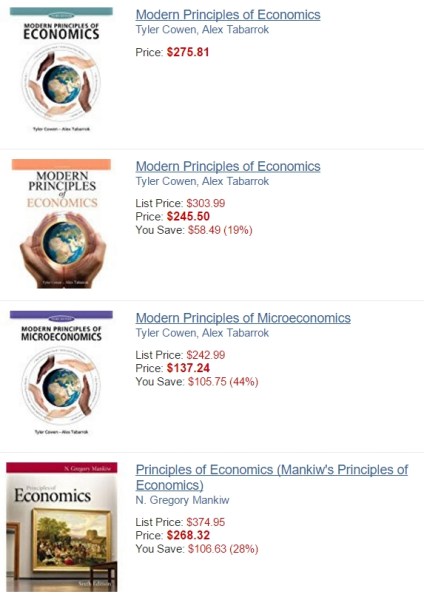
I haven’t read these books that Amazon recommended to me via email today. But I hope that within the pages of these books the authors somewhere explain the economics of textbook publishing and why these books on the principles of economics cost an arm and a leg.
Thankfully in modern times, the principles of economics is accessible to many who can’t afford those prices. It’s all there on the web. Continue reading “The Price of Econ Textbooks”
This ad is probably from the mid-1980s. A massive 26MB hard drive for only $5K. As the ad points out, that’s less than $200 per MB. Now that’s a deal you couldn’t have refused. We should note that $5K in those days is equivalent to $10K in today’s dollars. Imagine, paying $10K for storage just enough for a few mp3 songs! Continue reading “Ask me anything: I am always amazed edition.”
Most people would readily identify a heap of gold ingots as wealth. But a moment’s reflection is enough to conclude that what can be considered wealth depends on the context.
Imagine Robinson Crusoe alone on his otherwise uninhabited island coming across a pile of gold nuggets in a stream. What’s more valuable to him: the gold or the fresh water in the stream? Gold is pretty useless to him because he cannot use it for anything. Gold is a heavy, soft metal. A piece of iron would be more valuable for making a knife or a pickax. Gold is of little value to him.
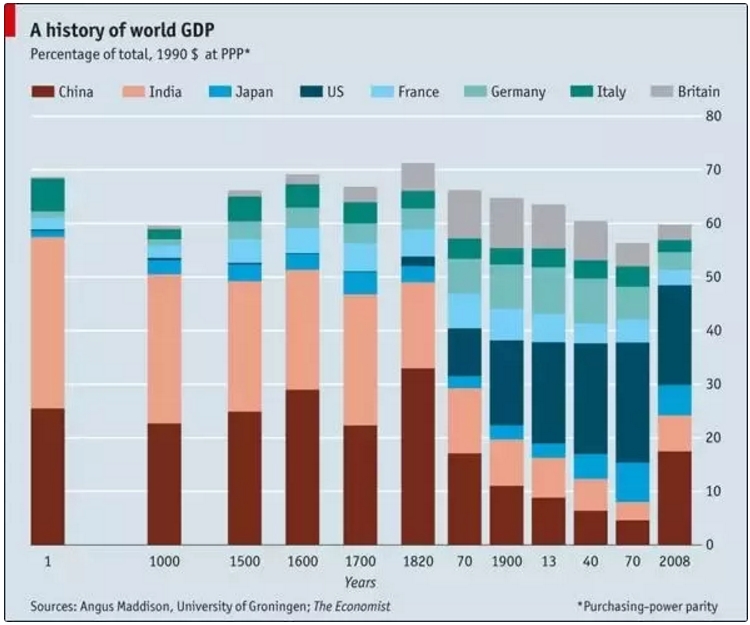
The persistence of the canard that India was once a rich country is understandable. A quick glance at the simple graph illustrates very clearly why it is easy to conclude that India was rich.
This piece has loads of graphics — more than any other piece I ever wrote. No arguments here, just a lot of data-based graphics.
Here’s the TL;DR version: India is not rich today, and really never was rich in the past. In fact, all countries were poor until about a thousand years ago. India had a large share of the world GDP because India’s population was a large share of the world population. India was not rich. It was merely big. Just like it is today: big and poor. Like China used to be just a few decades ago.
If you ask me what are the necessary causes of the wealth of nations, I will answer — having spent decades learning about and pondering that question — in just one word: Freedom!
Freedom is the sweetest word I know in English.
The advancement of civilization is essentially the expansion of individual freedom — the release from constraints imposed by nature, by other humans or by one’s mental and physical limitations. The notion of the freedom of a group has content only when individuals of that group are free. If the individuals are not free, the group cannot be considered to be free in any sense.
Freedom means you have the right to do whatever you please, provided you respect the corresponding right of others to do as they please. In short, mind your own business. A free society is one in which everyone minds only his own business. Free societies are prosperous societies.
The greater the collectivization of society, the greater the size of the government, the greater the constraints on individual liberty, the less free the society, and consequently the less prosperous the society. Unconstrained democracy is inconsistent with individual freedom, and therefore group freedom, and consequently leads to impoverishment.
Below I outline briefly why the universal application of the notion of minding one’s own business leads to the possibility of universal prosperity through individual freedom. And conversely, when people poke their noses into other people’s businesses, it leads to needless misery. Continue reading “The Wealth of Nations — Part 2: Freedom”
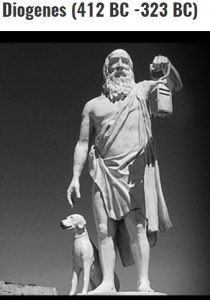
Diogenes of Sinope lived in a tub in the marketplace. Since it was a long time ago, around the 4th century BCE, the details are few. He is also known as Diogenes the Cynic.
I feel a certain intellectual kinship to Diogenes because I too am a cynic. He must have been a remarkable man, going by the stories told about him.
It is said that he sometimes walked around with a lamp even in broad daylight. When asked why, he replied, “I am looking for an honest man.” A cynic to the core. Continue reading “Diogenes of Sinope”

 Twenty-five years ago today, on March 23 1992, Friedrich August von Hayek died. Winner of the 1974 Nobel Memorial Prize in Economic Sciences, Hayek was an Austrian / British liberal. I consider him to be not just one of the greatest economists of all times but one of the world’s most enlightened social thinkers.


 Atanu Dey : Life is a Random Draw