Years ago in Berkeley, I watched this Pedro Almodóvar movie, Talk to Her. My advisor and I would go to the movies every so often. In one scene, Caetano Veloso sings this song, Cucurrucucú Paloma. I don’t understand Spanish but I do know that paloma means dove. The song is heartachingly beautiful. The voice conveys so much loss and longing.
Author: Atanu Dey
Rising Equality
I can justifiably claim that equality is rising in the world. Meaning, the world used to be less equal than it is today, and that in the future it will become more equal than today. The reason that claim appears to contradict reality is that I have not specified the dimension for the comparison implicit in any measure of equality. When it comes to comparisons of material wellbeing, there are three distinct dimensions — consumption, income, and wealth.
My claim is that consumption equality is increasing, not wealth or income.
Here’s a trivial case that illustrates what I mean. Warren Buffet’s income and wealth is six orders of magnitude greater than mine. Meaning his wealth is measured in units of “000,000,000” and mine is measured in units of “000.” Billions as opposed to thousands. Similarly his income per year is measured in billions and mine in thousands. Certainly, compared to Buffet in terms of wealth and income, I am dirt poor. But I am not dirt poor compared to Buffet in consumption. Continue reading “Rising Equality”
Happy Birthday, America! and President Calvin Coolidge
The American War of Independence, aka the American Revolutionary War (April 19, 1775 – September 3, 1783), was fought by the thirteen colonies of British America against the British Empire then ruled by King George III.
On July 2nd of 1776, the Second Continental Congress, a meeting of delegates from the thirteen colonies, voted for independence from Britain, and two days later, on the 4th of July the Declaration of Independence was adopted in a meeting in Philadelphia, Pennsylvania. Thomas Jefferson was the principle author of the declaration.
“By the time that the Declaration of Independence was adopted in July 1776, the Thirteen Colonies and Great Britain had been at war for more than a year. Relations had been deteriorating between the colonies and the mother country since 1763. Parliament enacted a series of measures to increase revenue from the colonies, such as the Stamp Act of 1765 and the Townshend Acts of 1767. Parliament believed that these acts were a legitimate means of having the colonies pay their fair share of the costs to keep them in the British Empire.” [Wiki.] Continue reading “Happy Birthday, America! and President Calvin Coolidge”
While my guitar gently weeps
Nice song. Good musicians. Especially the fellow on the piano. As someone remarked in the comments to the video, he shows a lot of promise. I think he should join some band or something. Or maybe take up writing. Anyway, enjoy.
Speaking out Against Fascists
My favorite bit of the US constitution is the Bill of Rights. It’s that bit of the constitution that puts chains on the government. For instance, the US constitution does not “grant” the freedom of speech because the freedom of speech is prior to any constitution. The 1st amendment, among other things, restricts the government from passing legislation that restricts the freedom of speech.
Here’s an example of a citizen exercising his freedom of speech.
I like the way he calls the school board “Benito.” The board is Mussolini’s spawn.
Honoring Those Who Serve Us
I came across an interesting bit in a video I was watching yesterday. “How many health care providers are in the room?” asked the kind lady in it. After a show of hands, she said, “Thank you, thank you, thank you. I feel like a lot of the work both of us care about so much is in service of others and all of you are dedicating your life for that same purpose.”
The dedication to the “service of others” part caught my attention. It’s curious that healthcare providers such as doctors and nurses, and other people like firefighters, military personnel, etc., are popularly held in higher esteem than sanitation workers, bus drivers, computer programmers, sales people, etc. Somehow some occupations are more “selfless” than others. Sorry to be contrarian but it’s simply not true that occupations can be categorized that way.
Certainly occupations can be justifiably categorized as immoral or moral, legal or illegal, intellectually hard or easy, physically challenging or easy, and so on. But as long as one is getting paid and not doing voluntary work, there’s no selflessness involved. That is not to imply people in various paid occupations are narrowly selfish and lack human decency; it is only that all of us are most of the time primarily — though not solely — motivated by self-regard and not by self-denying altruism. Continue reading “Honoring Those Who Serve Us”
Saturday Song – Play it Again
I would suffocate and die if I didn’t listen to music for a few hour every day. Here’s what I am listening to right now.
Nice, ain’t it? It’s from the movie 1974 “The Tamarind Seed.” Continue reading “Saturday Song – Play it Again”
Yuri Bezmenov Warned the World
Two things bring the KGB propaganda expert Yuri Bezmenov (1939 – 1993) to mind — the pandemic and the progressive/woke movement in the US.
He attended elite schools in the USSR. He was trained as an expert in Indian culture and Indian languages. As a KGB agent, he worked in India from 1963 to 1965, and then again from 1969. In February 1970, he was supposed to go watch a movie in a Delhi theater with two of his colleagues. He never showed up at the movie. Instead, he put on a hippie disguise and escaped to Athens, Greece.
Eventually, he ended up in the US, as one would naturally expect. And as you’d expect, he was a strong critic of the Soviet system. More than that, his explanation of what subversion is, and how it works, is important for us to understand what’s happening now. It’s fascinating that once you understand some basic principles, a lot of the world makes sense. Continue reading “Yuri Bezmenov Warned the World”
People, the Ultimate Resource
Quite often I enjoy the pleasure of shocking people with my contrarian viewpoints. For some people, the shock is replaced with the pleasure of understanding something that goes against plain common sense. When that happens, I am very gratified but when it doesn’t, I feel sad.
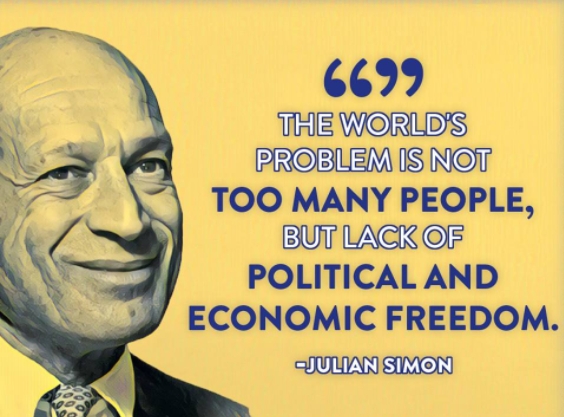
One of the many contrarian ideas I have is that there are no “natural” resources and that all resources are creations of the human mind. As economist and professor of business administration Julian Simon (1932 – 1998) argued that “the most important of all resources is human beings.” (The Ultimate Resource 2. Page 581). The more humans, he insisted, means more abundance and less scarcity.
We are all concerned about facing scarcity. Not all of us face the same scarcity, though. The good news is that scarcity is going down. To understand why that is so requires we define scarcity in some broad sense. We intuitively understand that prices have something to do with scarcity.
If the price of something is going up, it means that (1) the quantity available is decreasing, or (2) the quantity demanded is increasing, or (3) a combination of both. If the price is trending up, it is likely that scarcity is increasing, and vice versa. The price trend is a proxy measure of scarcity. If the trend is falling prices, then we conclude that scarcity is decreasing. Continue reading “People, the Ultimate Resource”
The Best is not Optimal
It would be best if we had zero crime, or zero pollution, or zero inequality (of wealth, income, health, beauty, intelligence, lifespans), or zero transportation deaths, et cetera. That is, it would be best if we could obtain the best and not have to pay too much for it. But, alas, the real world refuses to comply with our wishes. For anything good that the real world grudgingly gives us, it exacts a cost.
To gain any benefit one has to pay a cost. The best may come at such a high price that it may not be worth it. How much of a good thing we actually end up having depends on a cost-benefit analysis. That particular amount of a desirable good for which the cost balances the benefit at the margin is the optimal amount of that good. The optimal amount is almost never at one or the other extreme of the case.
As an aside, the Buddha recognized this universal truth and advised against extremes. He preached moderation in everything, and therefore Buddhism is known as the “Middle-wayed Way.” I think that the Buddha would have made a pretty good economist. He thought at the margin. Continue reading “The Best is not Optimal”