
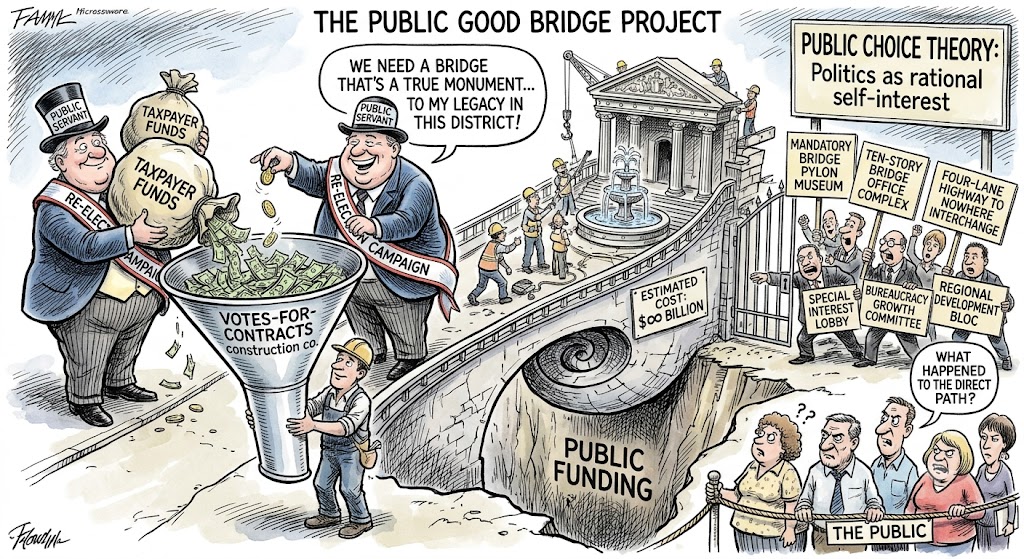
James M. Buchanan was awarded the 1986 Sveriges Riksbank Prize in Economic Sciences in Memory of Alfred Nobel, aka the economics Nobel prize “for his development of the contractual and constitutional bases for the theory of economic and political decision-making.”
The primary reason for the award was his foundational role in pioneering public choice theory—applying the tools and behavioral assumptions of economics to politics and the public sector.
James Buchanan held that the solution to better governance did not consist in somehow electing better people. The better path is to find better “rules of the game.”
(It’s getting better all the time. Better, better, better.)
 He believed that “if men should cease and desist from their talk about and their search for evil men and commence to look instead at the institutions manned by ordinary people, wide avenues for genuine social reform might appear.”
He advised economists to stop pretending as if they were in the business of advising “benevolent despots” on what to do, and instead concentrate on finding and promoting better constitutions and rules. These rules—like a balanced-budget amendment or rules requiring a supermajority (e.g., 67%) to raise taxes—would make it harder for the system’s flaws to produce bad outcomes.
The lesson that public choice theory teaches is this: Don’t expect people in government to be any better than people elsewhere. Instead, build a system of rules that channels their self-interest into creating good results for everyone.
Public choice theory applies the logic of economics to the world of politics. Economists have developed analytical tools that help in understanding human behavior in the marketplace. Public choice theory uses those tools to explain the behavior of people as they go about the business of choosing in their capacity as members of the public. Hence public choice.
Economists usually assume that people in their private capacities as buyers and sellers in the marketplace are self-interested. A business owner wants to make a profit, and a shopper wants to get the best deal. Public choice theory simply says that we should not expect people to suddenly become selfless angels who somehow know what is true, good and beautiful the moment they enter a voting booth or get a government job or get elected to political office.
Public choice theory says people are people. They are motivated by the same self-interest in their roles as voters, bureaucrats and politicians as they are at other times. This is the assumption of behavioral symmetry.
Public choice theory looks at politics “without romance.” It assumes that politicians, bureaucrats (public servants), and voters are normal people, guided by their own incentives and self-interest, just like everyone else.
Let’s compare how public choice theory differs from the traditional view with respect to the key players.
1. The Politician
Traditional View: A noble public servant trying to do what’s best for the country.
Public Choice View: A person whose primary goal is to get re-elected.
This incentive explains why politicians often favor policies with short-term, visible benefits (like building a new stadium or sending out stimulus checks) but long-term, hidden costs (like national debt). Conversely, they hate policies with short-term pain (like raising taxes or cutting a popular program), even if they would be good for the country in the long run.
2. The Bureaucrat (Public Servant)
Traditional View: A neutral expert who implements the law efficiently.
Public Choice View: A person who may be motivated by things like job security, power, and prestige.
How do you get more power or prestige in a government agency? By increasing its budget and staff. A bureaucrat’s incentive is often to make their agency bigger, not necessarily more efficient or cost-effective. This can lead to government “bloat” and inefficiency, not because the people are bad, but because their incentives don’t reward cost-cutting.
3. The Voter
Traditional View: A responsible citizen who carefully studies the issues and candidates.
Public Choice View: A person who is “Rationally Ignorant.”
Your one vote has zero chance of changing a national election. Therefore it is irrational for you to spend 40 hours researching the federal budget. This rational ignorance of voters lets politicians and special interests get away with policies that sound good on the surface but may not be in the public’s best interest.
4. The Special Interest (Lobbyist)
Traditional View: A group that informs politicians about important issues.
Public Choice View: A group that exploits a key flaw in the system: “Concentrated Benefits, Diffuse Costs.”
Imagine a bad policy, like a tariff on imported sugar. This policy is fantastic for the 10,000 domestic sugar farmers since it may be worth $100,000 to each of them. They have an incentive to spend millions to lobby politicians. However, the cost of the tariff is spread across 300 million citizens, who each pay an extra $3 per year for sugar. The cost is so small and spread out that nobody has the time or incentive to organize a “National Anti-Sugar-Tariff” protest. The sugar farmers (the special interest) win and the public (the voters) lose. This isn’t because the politicians are evil, but because they are responding to the incentives they face.
I prompted Gemini to write a brief note on Buchanan. It responded, in part, with the following.
Core Pillars of Buchanan’s Contribution
- “Politics Without Romance”: Before Buchanan, prevailing welfare economics often treated the state as a benevolent social planner working solely to maximize public welfare. Buchanan challenged this by applying methodological individualism: politicians, bureaucrats, and voters are motivated by the same self-interest, incentives, and constraints as actors in a market.
- Constitutional Political Economy: In foundational works like The Calculus of Consent (1962, co-authored with Gordon Tullock), Buchanan distinguished between ordinary day-to-day political choices and the constitutional “rules of the game.” He argued that sound economic outcomes depend on constitutional constraints that restrict rent-seeking, deficit spending, and special-interest capture.
- Exchange-Based View of Politics: Rather than viewing politics as an exercise in discovering an elusive “collective will,” Buchanan framed the state as a forum for complex multilateral exchange, drawing heavily on the Wicksellian tradition of voluntary agreement and near-unanimity for legitimate public decisions.
That’s pretty good. Thanks, Gemini.
The title of this post says public choice theory again. Because here’s a piece on Public Choice Theory from Nov 2024. You can never have too much of public choice theory.
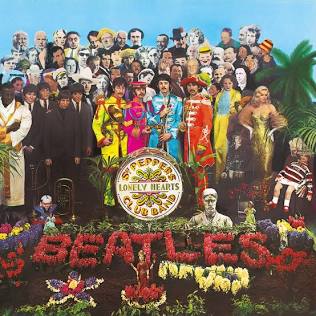
“Getting Better” is a track in the Beatles album “Sgt Pepper’s Lonely Hearts Club Band“. We’ll skip that one here. Released in 1967, it is widely regarded as a watershed moment in popular music. It marked the definitive shift of rock from disposable singles-driven teenage entertainment to a recognized, serious art form.
Instead let’s listen to “Within you, Without you,” which is George Harrison’s sole composition on the album, recorded without the other Beatles. It features Indian classical musicians playing sitar, tabla, dilruba, and tambura, underpinned by Martin’s sympathetic string arrangement and rooted in Advaita-style philosophical contemplation.
That’s it for now. Thank you, good night, and may your god go with you.


