
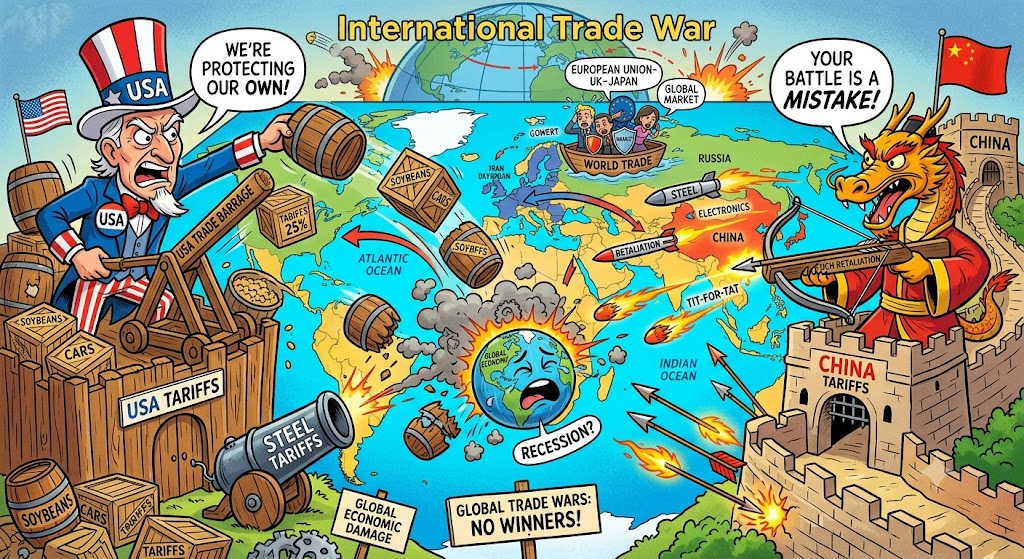
Trump recently signed the Lindsey Graham Sanctioning Russia and Iran Act of 2026, which grants the US statutory authority to levy tariffs of up to 100% on goods imported from the top international buyers of Russian oil and gas. In the 2022-2026 period, China imported around 50% of Russia’s crude exports, and India imported around 37%. China and India are Moscow’s energy lifelines and therefore they are the main targets.
Certainly, Trump’s move is bad news for India. The US is India’s single largest merchandise export market of over $90 billion annually. A punitive tariff would devastate the export sectors and skew the bilateral trade balance.
What should be India’s response? Should India respond by raising tariffs on US imports? That would be a stupid response. Regardless of what the trading partner does, allowing free import of goods and services is the best policy.
Free trade, domestic or international, is the best policy. No taxes and no barriers to trade is a first-best policy. However since we live in a second-best world, we have to resort to second-best policies at times. To do that, we have to first understand in which precise ways is the world distorted and then figure out the second-best response.
The stance “they are imposing tariffs on our exports to them, and therefore we will impose tariffs on their exports to us” is not very bright. It’s akin to saying “they are punishing their citizens by taxing them, and so we should punish our citizens to retaliate against the foreign country.” Or, “they are throwing rocks in their own harbors, and therefore we should throw rocks in ours too.”
The US is a rich economy. It can afford to be stupidly wasteful without its people starving. India is a past master of idiotic economic policies. They have impoverished India enough. Time to wise up.
Free trade is the best policy. Free trade does not appeal to common sense. Free trade is counter-intuitive. But it is both analytically and empirically valid. Economists have argued for free trade for at least a couple of centuries — and unfortunately failed to convince policymakers.
Policymakers of course are motivated by their self-interest. Controlling the economy gives them money and power, both potent aphrodisiacs. No academic scribblier is likely to convince politicians and bureaucrats to relinquish their stranglehold on the economy. Sure their policies will lead to widespread poverty (as it has done in India) but it will enrich them and their cronies. That’s what matters, not some lofty notions of prosperity of the masses.
I believe that the way out of the mess of Trump’s trade wars for India is to stick to first principles. First, no retaliatory tariffs. Second, gradually remove all tariff and non-tariff barriers to trade. Third, reduce income taxes and corporate taxes. Doing that will increase economic growth.
The most important lesson that a study of economics teaches is that economic freedom is the only guaranteed road to prosperity. The correlation between economic freedom and prosperity is robust. The direction of causation from the former to the latter is analytically irrefutable.
Trump’s stupidity will cost Americans dearly. But that does not have to hurt the Indian economy — unless India chooses to respond inappropriately. Will India do the right thing? I don’t think so.
C’est la guerre.
This is in part a response to a comment by reader Sai Krishna Chippa.
Previous posts: On Trade and Trump’s Tariffs. Part 1. Part 2.
Today’s musical coda is Love is a Friend by the Dreamcatcher.
Be well, do good work, and keep in touch.


A very good piece. Please continue writing more such articles that address contemporary issues and offer thoughtful perspectives on them
LikeLiked by 1 person