
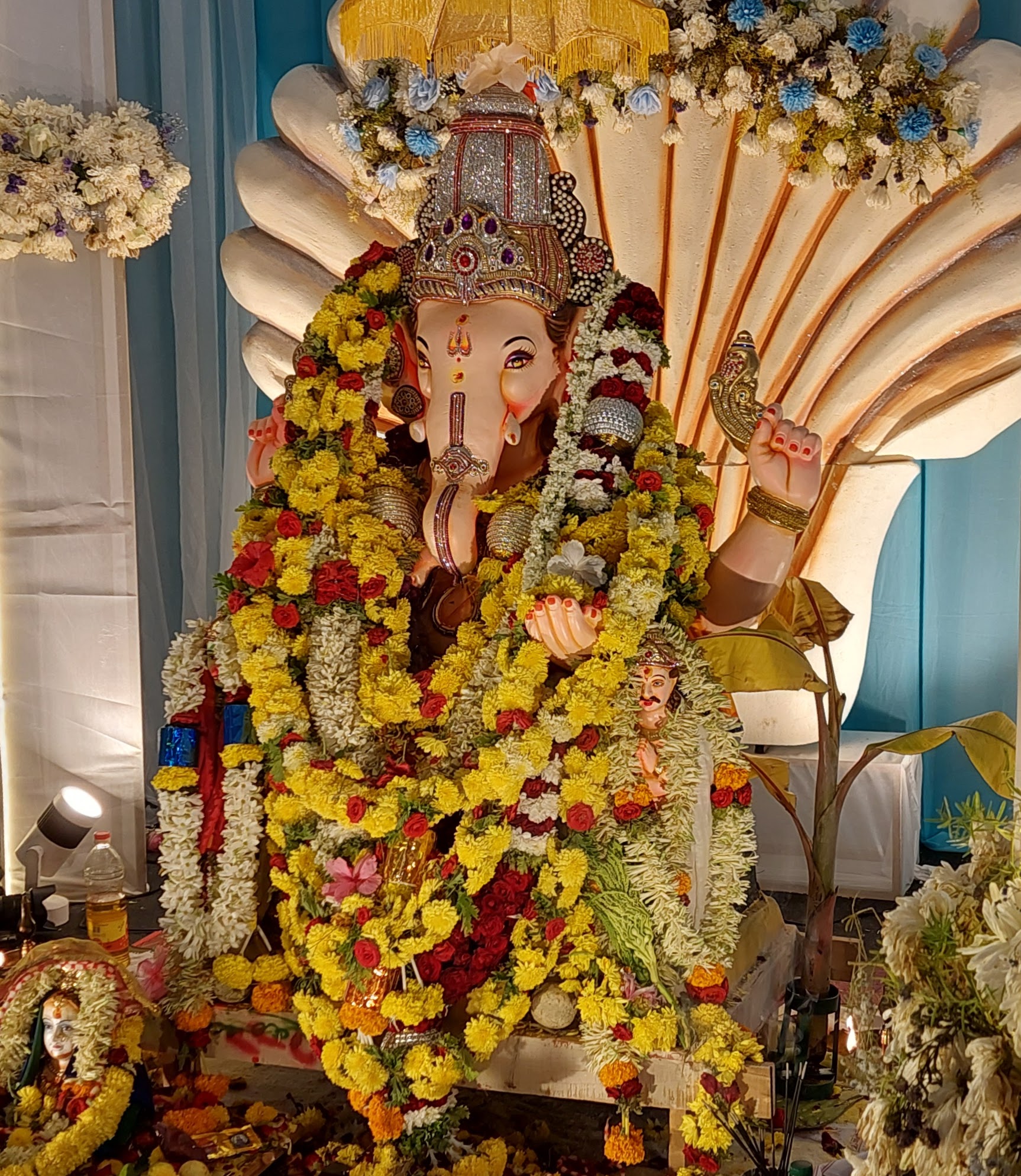
 Well, what do you know! Ganapati Bappa is back in town.
It’s Ganesh Chaturthi.
Sept 14th begins this year’s Ganesh puja. As is my custom, I try to recall some story regarding Ganesh that I had heard as a child. We Hindus, Buddhists and Jains grow up listening to stories about our devas and devis.
Ganesh is definitely my favorite deva. He is described as “the one with the curved trunk and an immense body, whose splendour is equal to that of a million suns.” He is invoked before any other gods. There’s a story about that. Before starting any venture, he is asked to “remove all obstacles from my tasks, always and in all undertakings.”
In previous posts, I have related the story of how he got a broken tusk, how he very cleverly circumnavigated the entire cosmos three times in a minute, and other things. This time I will relate the story of Kubera’s feast.
Kubera’s Feast
Kubera, the celestial treasurer and king of the Yakshas, possessed unimaginable wealth, but with it came immense vanity. Convinced that no one in the three realms could rival his opulence, he decided to host a feast so grand that even the gods would marvel at his fortune.
He journeyed to Mount Kailash to personally invite Lord Shiva and his wife Goddess Parvati as guests of honor. Shiva saw through Kubera’s pride. Smiling serenely, Shiva the ascetic declined saying that Kailash was his place and extravagant banquets did not suit him.
Sensing Kubera’s disappointment—and wishing to cure him of his conceit—Shiva proposed an alternative: “Our young son, Ganesha, will represent us. If you can satisfy his appetite, consider your feast a success. Full disclosure: he has a very healthy appetite.”
Kubera readily agreed, convinced that satisfying a small boy would be trivial for someone of his boundless means. When Ganesha arrived at Kubera’s glittering golden city of Alakapuri, he was welcomed with royal fanfare and led to a banquet hall overflowing with mountains of delicacies.
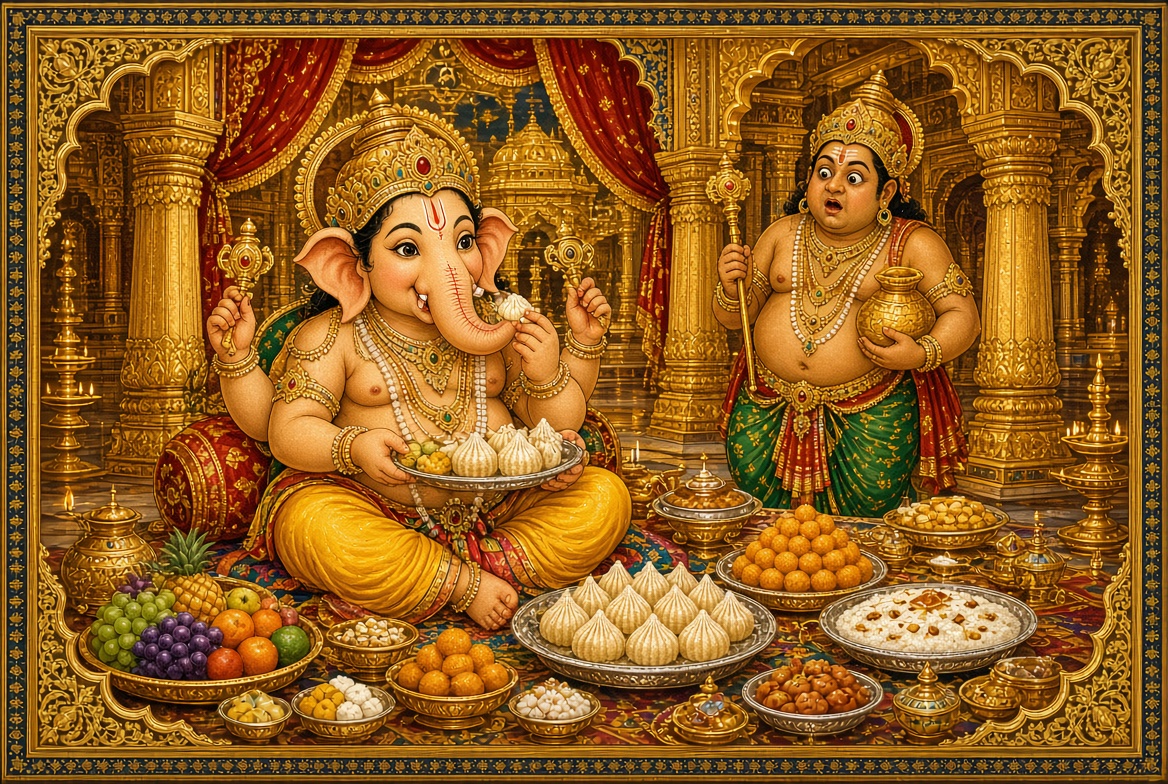
Ganesha sat down and began to eat. Plates of rich sweets, seasoned rice, roasted grains, and exotic fruits vanished into his mouth in seconds. As soon as the servers replenished the platters, Ganesha emptied them again, demanding more with cheerful urgency.
Soon, the royal kitchens were stripped bare. The cooks raced to prepare fresh courses, but Ganesha consumed raw grains, spices, and cooking butter faster than they could stoke the hearths.
Still ravenous, the divine child began swallowing the silver and gold vessels, the furniture, playfully warning a terrified Kubera that if food was not brought immediately, he would eat his host next.
Panic-stricken and devoid of both food and pride, Kubera fled back to Kailash and threw himself at Shiva’s feet, begging for relief. Shiva gently explained that material riches can never satisfy true hunger; only food served with devotion, not arrogance, carries nourishment. Handing Kubera a single fistful of puffed rice, Shiva told him to offer it to Ganesha with humility, not pride.
Kubera rushed back, bowed low before the boy, and presented the modest handful with genuine devotion. Ganesha ate it and burped with contentment, his hunger finally quelled, and Kubera’s vanity ended.
It may appear that this is a moral lesson on humility. But the interaction between Ganesha and Kubera is a treatise on value, desire, and the nature of the absolute.
The Asymmetry of Finite Riches and Infinite Reality
Kubera represents the apex of material accumulation (artha). As the lord of treasures, his domain is strictly quantitative—his wealth can be inventoried, counted, and displayed. When he attempts to feed Ganesha, he makes a category error: attempting to satisfy the infinite with the finite.
Ganesha is venerated not merely as a remover of obstacles, but as Brahman—the formless, all-pervading ultimate reality (“Tvam pratyaksham Brahmasi”). Ganesha’s vast belly does not signify gluttony; it symbolizes the cosmos itself, within which all universes are contained, sustained, and eventually dissolved. Kubera’s entire store of grain, gold, and palace furnishings is a trivial fraction of creation. An infinite vessel can never be filled by discrete physical quantities.
Ganesha’s unquenchable hunger acts as a mirror to Kubera’s own psychological state. The more Kubera piles on plates to show off his capacity, the hungrier Ganesha becomes. This mirrors trishna (the thirst of ego-driven desire). Material accumulation does not extinguish greed; it expands the appetite for recognition.
Kubera did not invite Ganesha out of love (bhakti) or duty of a host (atithi dharma); he invited the Shiva and Parvati to validate his own grandeur. Consumption without reverence becomes devouring destruction. Left unchecked, the hunger born of hubris ends up consuming the host himself.
The turning point comes when Kubera returns with a single handful of roasted puffed rice and offered it with humility.
A thousand banquets served in vanity could not satiate Ganesha but a handful of rice extinguished the hunger instantly. This is found in the Bhagavad Gita:
Patram pushpam phalam toyam yo me bhaktya prayacchati.
“Whoever offers me with devotion a leaf, a flower, a fruit, or water—that I accept.”
Kubera initially approached the feast as a transaction where his wealth could “purchase” divine favor and social status. Ganesha devours Kubera’s pride to restore him to his rightful function: not an owner of wealth who derives identity from its display, but merely its reliable trustee.
Here endth the story.
Happy Ganesh Chaturthi everyone.
On this occasion, let’s listen to the 200-year-old classic by South Indian poet Muthuswami Dikshitar. This is a Carnatic fusion version sung by Shankar Mahadevan.
Thank you, good night, and may your god go with you.


