Happy Birthday, Prof Hayek

Herr Dr Prof Friedrich August von Hayek is one of my three favorite economists—the other two being James Buchanan and Milton Friedman. Like them, I too am a classical liberal. Since Hayek was born on May 8th, 1899, today’s a day to celebrate.

I confess that I did not fully appreciate the core lessons of economics until after I had finished my formal studies. I had learned the usual neoclassical stuff — including impressive looking math involving the calculus and maximization of twice-differentiable continuous functions, Lagrange multiplies and other sillinesses. I am not dissing the use of math; just that the mathiness is silly. Continue reading “Happy Birthday, Prof Hayek”

An Essay into the Nature and Causes of Poverty — Part 4

Property

At a very abstract level, the formula for prosperity is to have a liberal market order and institutions that support that liberal market order, namely those that protect property rights, enforce contracts and settle disputes, and provide the rule of law.

Property rights does not imply the privileging of the rights of property over the rights of humans, although socialists mistakenly believe that that is what it means. The right to private property is the source of all human rights. Without the right to own property, one is hardly a human being; one becomes mere chattel or property. Continue reading “An Essay into the Nature and Causes of Poverty — Part 4”

Are you a Bayesian?

I have been a Bayesian since I first learned Bayes’ theorem when I was a teaching assistant for a Statistics 101 course at UC Berkeley around 25 years ago.

It’s one of those neat ideas that one should know to be able to reason competently about the world we live in. Thanks to the Indian education system, I had not been exposed to any hint of that fascinating rule in my 18 years of attending school in India. Anyway, better late than never.

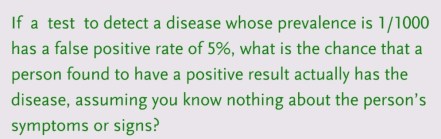
The late great John McCarthy insisted that “he who refuses to do arithmetic is doomed to talk nonsense.” I think he who is ignorant of Bayes’ rule cannot avoid talking nonsense about probabilistic events. Consider the question posed in the image above. Continue reading “Are you a Bayesian?”

An Essay into the Nature and Causes of Poverty — Part 3

Tequila $8000 per liter

It is hard to overemphasize how critically important exchange is in any economy, including that of primitive hunter-gatherer societies. Only hermits who voluntarily choose to live in extreme isolation don’t engage in exchange, and those who are marooned on deserted islands are forced to be self-sufficient.

Exchange 

For the rest of us, we rely on exchange for meeting practically all our needs. Just reflect on the fact that every one of us consumes a very tiny fraction, if anything at all, of what we actually produce. The factory worker produces cars but most of his consumption consists of non-cars; the doctor produces medical services but consumes very little of that; similarly the architect, the farmer, the green grocer, ad infinitum Continue reading “An Essay into the Nature and Causes of Poverty — Part 3”

Steven Pinker’s Harvard Course on Rationality

I like to think that I am a reasonably rational person. Given enough evidence (information) and time to ponder the facts, I believe that I generally reach correct conclusions. I also believe that the average person is capable of rational thought but it requires determined, effortful practice and lots of time. It really is hard work. Unfortunately, most people are not inclined to do that because they irrationally and wrongly believe the cost of doing so exceeds the benefits.

The Wikipedia introduces rationality thus: “Rationality is the quality or state of being rational – that is, being based on or agreeable to reason. Rationality implies the conformity of one’s beliefs with one’s reasons to believe, and of one’s actions with one’s reasons for action. “Rationality” has different specialized meanings in philosophy, economics, sociology, psychology, evolutionary biology, game theory and political science.” Continue reading “Steven Pinker’s Harvard Course on Rationality”

Ask me Anything — Viruses and Ideas Edition

I trust you are well and keeping yourself safe from the Chinese virus. Here’s an old post from four years ago about viruses for your reading pleasure. It’s titled “Viruses, Ideas and their Life Expectancy” which is topical.

Quote: Continue reading “Ask me Anything — Viruses and Ideas Edition”

The Third World War

Hitler 1933

“War is a judgement that overtakes societies when they have been living upon ideas that conflict too violently with the laws governing the universe… Never think that wars are irrational catastrophes: they happen when wrong ways of thinking and living bring about intolerable situations.”                        — Dorothy L. Sayers

In the near future, we are likely to call this the Third World War, or WW3.

World Wars are events that are global, cause severe economic damage, and result in very large numbers of deaths. Unlike ordinary wars, which are localized, by definition world wars involve the entire planet and no nation is entirely immune from the death and destruction that follows.

This world war, unlike the previous two in the last century, is not a military war. But like them, it will lead to some economic, social, and political upheavals that could not have been anticipated at the start. The start of world wars can only be identified in hindsight, when the whole world is engulfed in conflict. Continue reading “The Third World War”

First of May

Equality of Outcome

Today is “May Day,” the first of May. In many European cultures, it’s a traditional spring festival holiday, celebrated since ancient times. For communists and socialist, it’s the “International Workers’ Day” and they too call it “May Day.”

India being a socialist / communist country, 1st of May is “Labour Day” and is a public holiday.

It’s kind of fitting that the communist/socialist celebrate “May Day” because “Mayday” is the international life-threatening distress call for mariners and aviators. It’s derived from the French m’aider (‘help me’). That use originated in 1921. When a population falls victim to socialism, it’s in life-threatening distress and needs urgent assistance to recover from the disease that kills in the scores of millions. I remember the countless victims of collectivism on this day.

And finally, there’s an old favorite love song “First of May” by The Bee Gees. Here, have a listen: Continue reading “First of May”