Profits are Corporations’ Social Responsibility

The business of business is profit. That’s the whole point in doing business. If a business is following the rules and legally making a profit, it is discharging its social responsibilities. I wrote an opinion piece on corporate social responsibility (CSR) in today’s Mint arguing that corporations are not responsible for solving social problems.

Here’s the text of the article.
Continue reading “Profits are Corporations’ Social Responsibility”

Naming of Things

Some years ago I came across a single-panel cartoon which showed a statue of a figure on horseback. It was clearly the statue of Shivaji Maharaj, the great Maratha hero. Standing in front was a little kid with an adult. The kid was asking, “But what was the statue called before it was renamed Shivaji Maharaj?”

In Mumbai, the trend is that everything gets renamed after Shivaji. And in the broader context of India, everything gets named after Nehru and his clan. Naming things is easy in India. “Mahatma Gandhi, Jawaharlal, Indira, Rajiv, and Sanjay” are the choices for the first bit, as in “Jawaharlal Nehru University,” or “Indira Gandhi International.” It won’t be too long before we have “Sonia, Priyanka, Rahul, Spotty” added to the list. (Spotty is just a place holder as I am not sure what the name of the Gandhi family dog actually is.)
Continue reading “Naming of Things”

Monkey See, Monkey Do: Plastic Bag version

Back in September 2005, the government of Maharashtra had decided to ban plastic bags. The problem they were trying to address was of trash clogging up the storm drains in Mumbai resulting in the flooding of the city during the monsoons. Yes, the city does get flooded but banning the plastic bags was not the right response. A little bit of reasoning would have revealed that the proper thing to do is to charge user fees for the plastic bags — that would let the market solve the problem and enforcement would be much easier than enforcing a ban.
Continue reading “Monkey See, Monkey Do: Plastic Bag version”

Wasting Public Money

“Will the Indian mind ever get decolonised?” is the question that R Vaidyanathan asks at the end of his column titled “The colonial conquest of India by Cambridge varsity” in DNA today. (Hat tip: Raja Shekhar Malapati.) It is about the government of India giving Cambridge University Rs 26,00,00,000 (US$ 6,500,000) to support the ‘Jawaharlal Nehru Professorship of Indian Business and Enterprise.’ That professorship is to mark the centenary of Nehru’s arrival at Cambridge.
Continue reading “Wasting Public Money”

Basant Panchami

Saraswati puja is done on Basant Panchami — which is the fifth day of the start of spring (Basant). Traditionally people fly kites and wear something yellow.

I did not know that today was Saraswati Puja until my sister called this morning to tell me to go and attend a puja today. As I am new to this area, I did not know where to go. If I didn’t find a puja, there’s always the old standby of bowing to a book.

Around noon, I heard the sound of a conch shell and some bells. Looking out the window from my 11th floor apartment, I could make out some sort of gathering in the public events building down in the courtyard. I immediately grasped (I am clever like that) that that is where a Saraswati puja was going on. In a moment, I was down there in the middle of the event.

Maa Saraswati, as we Bengalis affectionately call her, is the goddess of wisdom and learning. As wisdom and learning can be communicated by speech, she is also the goddess of speech, the Vak Devi. (Vak in Sanskrit is a cognate of the English word “voice.”) Learning involves the mind and the intellect. She is represented with four arms. She holds a lotus and a book in two of her hands. The lotus symbolizes the pure mind and intellect, and the book learning. With her other two hands she plays the veena, as she is also the goddess of music and the creative arts. As the wife of Brahma, the creator god, she holds all the creative energy of the cosmos and is the mother of the vedas (‘veda’ means wisdom and is a cognate of the word wisdom). She is dressed in white and sits on a white lotus symbolizing purity.

There were about 100 people in the puja down at the courtyard, not surprisingly all of them Bengalis. I met a few and introduced myself. Got to speak a bit of Bengali. Growing up in a Bengali family, the idea gets planted early on in life that one has to worship Saraswati — which basically means that you have to worship learning and knowledge. Reverence for books is a visible sign of that.

I spent about an hour at the puja. “Pushpanjali” was very good. One gets a warm and fuzzy feeling realizing that people do care about learning and knowledge. As long as we continue to worship knowledge and wisdom, all hope is not lost. India may yet have a future.

[Pictures of the event coming up soon on Picasa. Update: I am too lazy to do that now. So here’s a picture of a typical Saraswati puja from the web, below the fold.]
Continue reading “Basant Panchami”

Outsourcing Insanity

I know that outsourcing things to India is all the rage in the world today and how the world is getting to be flat (thanks, Tom Friedman, what would we do without your wisdom) but this is getting a bit ridiculous. Apparently Rowan Williams, the Archbishop of Canterbury, wants to outsource the idea of how the legal system should be run in a democratic state to India. His idea is that the state should recognize sharia, the Islamic legal system, for those who profess Islam in the UK. India discriminates among its citizens based on their professed beliefs and Mr Williams clearly considers it to be an excellent model to follow.
Continue reading “Outsourcing Insanity”

The Global Web

Ever wonder what it takes to make it possible for you to visit gazillions of websites? I suppose we wonder only when there is a disturbance in the web, as it happened a few days ago when five undersea fiberoptic cables mysteriously snapped and some parts of Middle East and India were affected. So I did a little futzing around the web and found a pretty good write up on one cable system — the FLAG: the Fiberoptic Link Across the Globe. The report is really really long and really really informative. It is also old — written in 1996, when FLAG was still being laid. Go read the report Mother Earth Mother Board. It makes great weekend reading.

Here’s a contemporary map of the amazing physical world wide web which underlies the digital world wide web.

[Click on the image above to see an enlarged version.]

Here are some fun facts taken from the above image.

* The vast majority of the world’s communications are not carried by satellites but an altogether older technology: cables under the earth’s oceans. As a ship accidentally wipes out Asia’s net access, this map shows how we rely on collections of wires less than 10 cm in diameter to link us all together.

* The first intercontinental telephony submarine cable system, TAT-1, connected N . America to Europe in 1958 and had an initial capacity of 640 kilo bytes per second (kBps). Today that is about 7 trillion Bps — a 10 million time increase.

* SeaMeWe-3 is 39,000 kms long

* Southern Cross is 30,500 kms

* China-US is 30,500 kms

* FLAG Europe-Asia 28,000 kms

* South America-1 25,000 kms

Darwin’s Big Idea

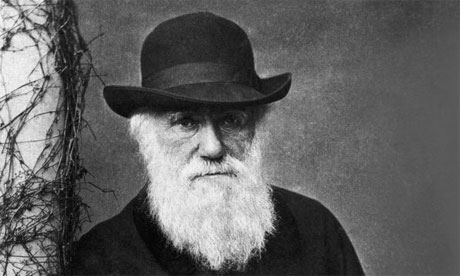
Richard Dawkins summarizes Darwin’s big idea in one sentence: “Given sufficient time, the non-random survival of hereditary entities (which occasionally miscopy) will generate complexity, diversity, beauty, and an illusion of design so persuasive that it is almost impossible to distinguish from deliberate intelligent design.”

Dawkins remarks on the amazing explanatory power of the idea of natural selection. I find reflections of that sort of explanatory power in Adam Smith’s idea that markets work and lead to social welfare gains.

It is interesting that it takes many years of internalizing of a big idea before one can fully comprehend it. It is only after it has been comprehended that one can then express it succinctly and accurately. And to understand why some others find it hard to comprehend certain ideas. Dawkins writes:

It is mainly its power to simulate the illusion of design that makes Darwin’s big idea seem threatening to a certain kind of mind. The same power constitutes the most formidable barrier to understanding it. People are naturally incredulous that anything so simple could explain so much. To a naive observer of the wondrous complexity of life, it just must have been intelligently designed.

I have worked out a model why we find it hard to comprehend — internalize — certain ideas. I will go into it one of these days. For now I would like to note that Charles Darwin (1809 – 1882) was influenced by the ideas of a fellow Englishman, the great economist Thomas Malthus (1766 – 1834).

Great ideas are the greatest achievements of humans. What is worth pondering is why these ideas arise among certain people and not among others. Are there any regularities that characterize the populations within which great ideas arise? In 1776, Adam Smith (1723 – 1790) published his An Inquiry into the Nature and Causes of the Wealth of Nations. In the same year, the founding document of the United States of America, the Declaration of Independence, was written (principally) by Thomas Jefferson (1743 – 1826). And again it was in 1776 that Thomas Paine (1737 – 1809), “The Father of the American Revolution,” published Common Sense.

Why?

[Link: Richard Dawkins on “Why Darwin Matters.”]

Was Nehru a Dictator? — Part 2

I had arrived at the hypothesis that Nehru was a dictator not from a careful reading of history but rather a careful observation of contemporary reality. First, I saw that Nehru was clearly considered one of the greatest leaders of India — so much so that his descendants were considered by a very large segment of Indians to be natural born leaders. Second, Nehru’s name graced too many institutions for my comfort. It reeked of idol worship. Third, he appeared to be a person of very limited intelligence and even more limited wisdom. The development path of India was perhaps set back a couple of generations at least and at the horrible human cost of hundreds of millions of lives lived in abject misery.
Continue reading “Was Nehru a Dictator? — Part 2”