
Stephen Moore of the Wall Street Journal has an article today, “Missing Milton: Who Will Speak for Free Markets“, which makes me despair for India. Milton Friedman was arguably one of the greatest proponents of freedom, and naturally therefore, an advocate of free markets. Trading is a uniquely human activity and humans engage in trade spontaneously and therefore human freedom must necessarily imply the freedom to trade. Human freedom without free markets is a fairly vacuous and meaningless idea. Prohibiting free markets is a necessary and often sufficient for guaranteeing poverty. That’s what all oppressors do — whether they are colonial powers or homegrown communists or socialists.
Continue reading “Missing Friedman, Missing Markets”
“Defeating Political Islam”
In yesterday’s Washington Times, Diana West has a review of Moothy Muthuswamy’s book, “Defeating Political Islam: The New Cold War.”
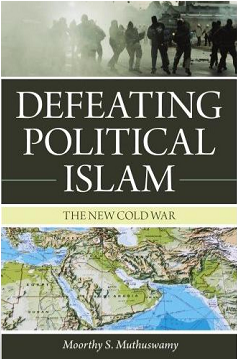
A few bits of the review below the fold.
Continue reading ““Defeating Political Islam””
On Massive Education Interventions
Much of the benefits of modern life we enjoy and take for granted arises from scale economies in manufacturing — the larger the quantity manufactured by a firm, the lower the average cost. But there is a countervailing effect. Up to a certain size, the overheads of managing a firm goes down as the size increases. Beyond that point, the costs of managing go up with size. That limits how large firms can get. The market weeds out firms that grow too big because the inefficiencies show up in higher cost of production. That process is not unlike Darwinian natural selection in the biological world. There are creatures of all sorts of sizes but there are natural limits to how large even the largest can become. Become too large and you get sorted out.
Continue reading “On Massive Education Interventions”
Antipathy to Social Networks
I am not really anti-social and neither am I a misanthrope. I love humanity in the abstract but I admit that I find most not worth the bother, and consider a significant number pretty intolerable. Upon reflection, I concluded that the behavior that most bothers me is herding. Herding is alright for sheep and their ilk but when humans do it, it is pitiable.
Continue reading “Antipathy to Social Networks”
Links are good: David Weinberger
You never thought of the web reflecting the morality that permeates human behavior, did you? I did not. I just read a fine article on the topic. The article title by David Weinberger, “The Morality of Links“, is a tad disturbing to me because it smacks of anthropomorphism but the article is a delight to read. The article is from a collection in the book, “The Hyperlinked Society: Questioning Connections in the Digital Age“, Joseph Turow and Lokman Tsui, editors.
Weinberger starts off with the simple declaration “Links are good” and then goes deep into what makes us human. Here are a few excerpts, for the record.
Continue reading “Links are good: David Weinberger”
The Bank for your Next Life
They say you can’t take it with you. So the only alternative is to keep it in safekeeping till you get back and reclaim what was yours when you reincarnate. Now you need not wonder where to stash your cash. There’s Reincarnation Bank for you.
Continue reading “The Bank for your Next Life”
Reasons why the BJP Lost
I don’t follow elections even though their outcomes dictate economic policies, which in turn determine the fate of economies. Given my interest in economic development, I should care about elections but I don’t. I also don’t follow the post-elections dissections of analysts mainly because I have better things to do but partly because I feel — incorrectly perhaps — it’s all a matter of opinion and conjecture. It feels like a lot of post-hoc rationalization.
Continue reading “Reasons why the BJP Lost”
Economic Policies Matter
A short century ago the US and Argentina were rivals. Both were riding the first wave of globalisation at the turn of the 20th century. Both were young, dynamic nations with fertile farmlands and confident exporters. Both brought the beef of the New World to the tables of their European colonial forebears. Before the Great Depression of the 1930s, Argentina was among the 10 richest economies in the world.
That’s from a fascinating article by Alan Beattie in the Financial Times of May 23rd titled “Argentina: The superpower that never was.” The article continues with —
Continue reading “Economic Policies Matter”
Keeping Afloat in a WWW-world
I received an SMS just moments ago: “A thirteen-year old’s day in Surat: school 7 to 2. Daily tuitions 4:30 to 7:30. Saw ICSE standard 8th textbooks. Detailed and depressing. What a state!”
No surprise to me as I have observed the same sort of insanity in the case of the children of friends and family.
Continue reading “Keeping Afloat in a WWW-world”
Solution to India’s Greatest Failure
In a recent piece in the Wall Street Journal titled “India’ Greatest Failure,” Paul Beckett writes about T.S.R. Subramanian who retired as India’s most senior civil servant in 1998. Beckett quotes from TSR’s book, “GovernMint in India” — “Since no part of the Establishment has an interest in punishing corruption, trying for a more sweeping solution quickly leads into the realm of blind hope.”
Continue reading “Solution to India’s Greatest Failure”
 Atanu Dey : Life is a Random Draw