 Even though I know precious little about the formation of mass psychology, I am certain that how the citizens of a nation collectively view the world must have a causal relationship with the fortunes of a nation.
As individuals we are singularly powerless to alter the environment we grow up in. We have to take that as a given, outside our control, exogenous. How we view the world is not of our choosing. Our mental models are formed largely unconsciously, and shaped contingently. It is an enormous intellectual challenge for us to critically examine our conditioning — and in most cases plain old-fashioned brainwashing by state institutions — and change our perception of the world.
Most critically, how people perceive government and governance matters. The what, why, and how of government differs from nation to nation, and those differences are consequential. To change how the collective’s conception of government and governance is to change its destiny.
This line of thinking is motivated by an email that my colleague Rajesh Jain received, and forwarded to me. I include the full text of the email and my response, for the record. Continue reading “Government as the Overlord”

 It makes good sense for the slave master to persuade his slaves that idleness is a sin and he’s doing god’s work when he flogs the slaves to work harder. The harder the slaves work, the more the master can take for himself. But of course the real motive has to be concealed and clothed in moral raiment.
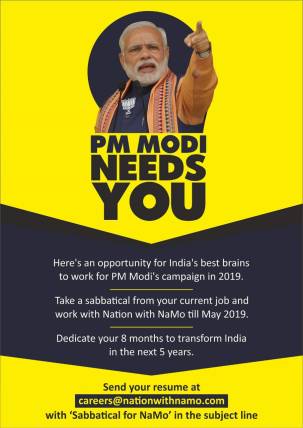 Here we go again. Now that India’s 2019 general elections are just a few months away, Mr Modi wants you to help him “transform India.”
 “War is a judgement that overtakes societies when they have been living upon ideas that conflict too violently with the laws governing the universe … Never think that wars are irrational catastrophes: they happen when wrong ways of thinking and living bring about intolerable situations.”
 In a
In a  I respect two former prime minsters of India — Shri PV Narasimha Rao and Shri AB Vajpayee. If only they had had the mandate to make those fundamental changes that they wanted to make. Both, unfortunately, did not have the necessary popular support in the parliament. And equally unfortunately, those prime ministers who did have massive parliamentary support did not have the vision to put India on a path to prosperity. Indians collectively suffer very bad karma.
 I am so thrilled to be forwarded on Whatsapp a bunch of pictures with the caption, “First Tank Delivery By L&T under “Make In India”. The message approvingly said, “Proud Moment For India.” Here are the pictures:
  Atanu Dey : Life is a Random Draw