The State of the Indian Economy

“What’s the state of the Indian economy, and what needs to be done?” asked K. Srinivas. The Indian economy is not doing too well but neither is it in dire straits. The rough indicator of the health of an economy is its GDP growth rate. It’s around 5 percent per year, which is not really robust for a country as poor as India. That rate would be fabulous for a rich country like the US, but for India it spells continued misery.

The government, of course, would like to claim a higher GDP growth rate and do so by manipulating the numbers. But quibbling over small numbers doesn’t buy you much. Regardless of whether it is 5 or 6, the bad news is that the economy is in trouble. Why is that so? Continue reading “The State of the Indian Economy”

Change of Seasons — Fall Begins

Today is the first day of Fall in the Northern hemisphere, and at 3:50 am Eastern Time (7:50am UT)  was the beginning of the September equinox. At 3:50 am ET, the Sun crossed the celestial equator.

“An equinox is commonly regarded as the instant of time when the plane of Earth’s equator passes through the center of the Sun. This occurs twice each year: around 20 March and 23 September. In other words, it is the moment at which the center of the visible Sun is directly above the Equator. … On the day of an equinox, daytime and nighttime are of approximately equal duration all over the planet. They are not exactly equal, however, due to the angular size of the Sun, atmospheric refraction, and the rapidly changing duration of the length of day that occurs at most latitudes around the equinoxes.” [Wiki.]

At my location (39.66N, 75.67W) sunrise was at 6:51 am and sunset will be at 6:59 pm, making the day 12 hours and 8 minutes long. Continue reading “Change of Seasons — Fall Begins”

Small is Beautiful. Government is not.

At heart, I am an anarchist. The average person will recoil with shock and horror from such an admission because ‘anarchy’ almost always implies social disorder, chaos and disaster.

But that reaction is wrong, and not surprisingly so. After all, that same fellow would get starry-eyed at the mere mention of democracy. India is the largest democracy in the world, don’t you know!

As a system of governance, anarchy resonates most with how I approach the world. I reject hierarchy and authority. I had arrived at this conviction long before I got to know about the French politician and philosopher Pierre-Joseph Proudhon (1809 – 1865), the first self-professed anarchist.

Proudhon in his Confessions of a Revolutionary defined anarchy as “order without power” and “the absence of a master,” and wrote that “whoever lays his hand on me to govern me is a usurper and tyrant, and I declare him my enemy.”

I concur.
Continue reading “Small is Beautiful. Government is not.”

TIL about the Global Oxygen Cycle

It is fun to learn new stuff. Today I learned some interesting things about the global oxygen cycle. Of course, I had known about photosynthesis from my school days. It is the process which converts CO2 and H2O and produces oxygen and the stuff that trees and plants are made of.

Aside: Many people don’t realize that all plants are basically carbon and that the carbon comes from atmospheric carbon-dioxide. Therefore higher concentration of CO2 implies higher rate of plant growth, and so increasing CO2 concentration has the beneficial effect of faster plant growth (and not just global warming.) Continue reading “TIL about the Global Oxygen Cycle”

From the archives: Unconstrained Government

Any serious analysis of the structural causes of India’s dysfunction has to refer to the institutional deficiencies. One major causal factor is that the government has practically no constraints on it. An unconstrained government has the power to effect radical change if it so desired, or to impose the status quo by not allowing any innovation or dissent. The content of the actions of an unconstrained government, therefore, matters immensely.

Unconstrained government power is wonderful provided good and wise people govern. But good and wise people, by their very nature, are the exception in the population, and even rarer in government. Given that an unconstrained government has the power to extract and exploit riches from the economy, the most avaricious and the most corrupt can be expected to compete for the power to govern. The outcome is predictable: a kakistocracy — the government of the least capable and the most corrupt. Continue reading “From the archives: Unconstrained Government”

Order without intent

Adam Ferguson (1723 – 1816) was a moral philosopher and historian. He was a major figure in the Scottish Enlightenment. In his An Essay on the History of Civil Society (1767) he observed:

“Every step and every movement of the multitude, even in what are termed enlightened ages, are made with equal blindness to the future; and nations stumble upon establishments, which are indeed the result of human action, but not the execution of any human design.”

The claim is that sometimes order emerges from the actions of the collective without there being some master plan that was being followed. The term “spontaneous order” describes that well: “the emergence of various kinds of social orders from a combination of self-interested individuals who are not intentionally trying to create order through planning. The evolution of life on Earth, language, crystal structure, the Internet and a free market economy have all been proposed as examples of systems which evolved through spontaneous order.” (wiki) Continue reading “Order without intent”

Reading: Confucius Lives Next Door

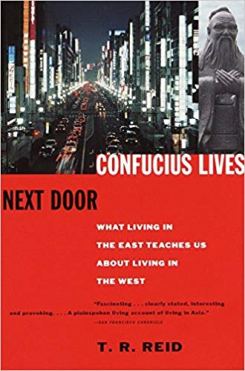
I am reading a most delightful book. It’s Confucius Lives Next Door: What Living in the East Teaches Us About Living in the West by T. R. Reid, published in 1999. He was the Tokyo bureau chief of the Washington Post. He and his family spent a few years in Japan in the 1990s.

Here’s an except from chapter 2 “Eastern Flavor”:

Continue reading “Reading: Confucius Lives Next Door”

Why Capitalism

My support for capitalism is primarily based on moral and ethical grounds. That capitalism also is economically efficient is an added bonus to me. Its instrumental role in creating more wealth than alternative systems is great but even if that were not so, I would still support it because it is the only system that is consistent with individual freedom and choice.

Capitalism is based on private property rights and voluntary exchanges in free markets. It’s essentially an impersonal process — no one is giving out commands for people to follow — out of which emerges an order that is beyond anyone’s ability to foresee or improve upon (unless there is a benevolent, omnipotent, omniscient dictator who controls every single entity, which in our case we have not got.) This process leads to outcomes that are, in the words of the Scottish Enlightenment philosopher Adam Ferguson “the result of human action, but not the execution of any human design” (1782).

Are distributions of income and wealth obtained by this process fair? Since the distribution obtained itself is not the intention of any person or persons, we can only ask if the process which leads to the distribution is fair or not. Therefore if we agree that the process is fair, we can accept that the resulting distribution is fair.

Is it morally superior to other systems? I believe that a system that does not involve coercion is superior to a system that requires coercion of some by some others. Capitalism does not involve coercion, while socialism and communism cannot be enforced without coercion. Therefore I judge capitalism to be morally superior to collectivist enterprises.

Who Owns You?

If in answer to the question “who owns you?” a person replies “I own myself” then we are dealing with a free person and not a slave. But where does this self-ownership arise out of? It’s a natural right. What’s a natural right? It’s a right that follows from being human; it’s not a right that is granted by anyone.

And from that natural right of self-ownership follow other rights. Those rights are negative rights. What are negative rights? They are rights that do not impose obligations on others to do something; only that others refrain from forcing one to do something. In contrast to that, positive rights impose an obligation on others.

An example of a negative right is a person’s right to life and liberty. That does not impose any obligations on others; only that others refrain from taking the life and freedom of the person. An example of a positive right is the “right to education” that the government of India has enacted. That imposes an obligation on taxpayers to fund the education of others.

To the extent that people of a society have positive rights, to that extent the society is not composed of free people; they don’t fully own themselves. If you are forced to work against your will for the benefit of others, you are a slave.

A state that protects the negative rights of citizens and does not grant positive rights is Robert Nozick’s minimal state. A minimal state is a protective state — one that only protects citizens. It does not produce other goods or services, does not interfere in the economy, does not redistribute income or wealth to achieve social justice goals, etc.

In his book Anarchy, State and Utopia (1974), Nozick writes:

Our main conclusions about the state are that a minimal state, limited to the narrow functions of protection against force, theft, fraud, enforcement of contracts, and so on, is justified; that any more extensive state will violate persons’ rights not to be forced to do certain things, and is unjustified; and that the minimal state is inspiring as well as right. Two noteworthy implications are that the state may not use its coercive apparatus for the purpose of getting some citizens to aid others, or in order to prohibit activities to people for their own good or protection.

Along the minimal state-maximal state continuum, India falls close to the maximal state end of the spectrum. That fundamentally means that Indians are not free. They are slaves of the state. Slaves are never very productive.  Lack of freedom and lack of prosperity are twins: if you have the former, you necessarily have the latter.

Do Indians own themselves? Not really. There are laws that make Indian citizens wards of the state, and to that degree, slaves of the state. The Indian state provides all sorts of “free” goodies to its needy citizens, in exchange for which it enslaves them. That enslavement leads to more neediness, which the state then addresses by a little more enslavement. It’s a vicious circle of dependence and poverty.

I think here it would be appropriate to address a question from a comment to a previous post:

Question: There are consenting adults who want to commit suicide. Assume, I open a business which offers exotic and very satisfying pre-suicide and suicide experience. If you are in government, will you stop me?

Allow me to rephrase that question: “Is the government justified in stopping a person from committing suicide?”

The answer is, “It depends on who owns the person.” If the government owns the person, i.e., the person is the property of the government, then because it is wrong to destroy the government’s property, the government is justified in stopping the person from killing himself.

However if the person owns himself — the self-ownership condition — then it is no one’s business what the person does with his own self. Not only is he free to live or die, he is also free to use his body any which way he wants to, and he also owns whatever his labor produces.

When people lose their freedom, when they become enslaved through some process (which in most cases involve their consent to some extent), they become sub-human. They become chattel of the master.

In our case, the government is the master that owns the people. Therefore the people are not free, even to kill themselves.

Personality Cults

I came across that picture on my twitter feed. An old man bending to touch the feet of a man who has no particular accomplishments at all.

I dislike cults, and that goes double for personality cults. I feel revolted by the pitiable groveling of the followers. I suppose by debasing themselves, they elevate the person and thus justify their worship. They crawl so low out of ignorance, fear and greed. Their display of loyalty also demonstrates their abject lack of virtue.  Here’s a bit hauled out of the archive, from nearly 13 years ago: Continue reading “Personality Cults”