The Beginning of Indefinite Economic Growth – Part 2

Why do some people claim that the end to economic growth is over or very near? One popular explanation goes this way. Economic growth requires the use of natural resources. On a limited planet, resources are limited. Therefore, when we have used up all our natural resources, economic growth will come to an end. QED.

That explanation belongs in primary school children’s books with illustrations that include smiley faces, but is not suitable for children past their 10th year.

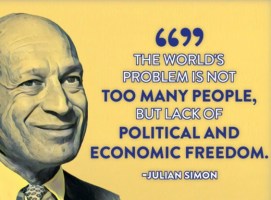
Though quite popular among many biologists (Paul Ehrlich), politicians (Al Gore), gurus (Sadhguru Jaggi), engineers (pick your favorite), and other assorted crazies, that explanation is wrong. The idiotic notions underlying the false explanation were laid to rest by Julian Simon and others many decades ago. But few people have the patience, the capacity or the desire to read Simon. Continue reading “The Beginning of Indefinite Economic Growth – Part 2”

The Beginning of Indefinite Economic Growth

Repent! The end (of economic growth) is near.

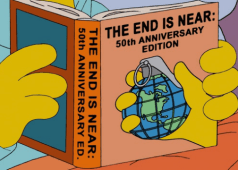
Just kidding. That’s just Homer Simpson-esque paranoia. His elevator doesn’t stop at all the floors. He’s a can short of a six-pack. A few sandwiches short of a picnic. He’s working with an unformatted disc.

Unfortunately, Homer is only one of the hundreds (perhaps thousands) of people who have been declaring that end-of-the-world emergency since time immemorial. No doubt the 5000th Anniversary Edition of “The End is Near” will also be a hot bestseller.

Predicted apocalypses have consistently failed to happen — evidently so since we are in the here and now busily calling bullshit on the doomsayers. But why do they produce the bovine feces so consistently, and why do some of the general public consume it so eagerly? Answer to both questions: basic stupidity, ignorance, and an extreme inability to reason. Continue reading “The Beginning of Indefinite Economic Growth”

How Sewers Work

Life expectancy at birth used to be a dismal 30 years or so not too long ago. Just about 10 generations before ours, child mortality was terrible. Tim Worstall notes in HumanProgress.org — 

The usual estimation is that half of all children died before adulthood in archaic societies, one quarter before their first birthday and another quarter before the age of 15, which is the end of puberty and our reasonable definition of becoming an adult. That seems to hold over all societies examined, including the Roman Empire, 18th century Britain, and all other groups of humans over time. (It is also, roughly speaking, true of the other Great Apes.)

This sorry state of affairs was brought to an end in three stages. The first stage was the discovery of infectious disease. John Snow, for example, showed that cholera cycled through the sewage and water systems. His discovery led to the single greatest aid to human health ever: the development of proper water systems, which provide fresh water and carry away sewage. Essentially, drains were the first step in reducing child mortality. Continue reading “How Sewers Work”

Rising Equality

I can justifiably claim that equality is rising in the world. Meaning, the world used to be less equal than it is today, and that in the future it will become more equal than today. The reason that claim appears to contradict reality is that I have not specified the dimension for the comparison implicit in any measure of equality. When it comes to comparisons of material wellbeing, there are three distinct dimensions — consumption, income, and wealth.

My claim is that consumption equality is increasing, not wealth or income.

Here’s a trivial case that illustrates what I mean. Warren Buffet’s income and wealth is six orders of magnitude greater than mine. Meaning his wealth is measured in units of “000,000,000” and mine is measured in units of “000.” Billions as opposed to thousands. Similarly his income per year is measured in billions and mine in thousands. Certainly, compared to Buffet in terms of wealth and income, I am dirt poor. But I am not dirt poor compared to Buffet in consumption. Continue reading “Rising Equality”

Buddha Jayanti

buddha01Siddhartha Gautam, aka Sakyamuni (the sage of the Sakyas), became a buddha around 2,500 years ago. Today, known as Buddha Purnima, the day of the full moon in May, is celebrated as his birthday. Here’s the Chinese singer Imee Ooi singing the Prajna Paramita Hridaya Sutra, aka The Heart Sutra. Listen.

The maha-mantra of the Heart Sutra, “om gate, gate, para-gate, parasum-gate, bodhi svaha om”, appears around the 3:50 time stamp. Continue reading “Buddha Jayanti”

What the Heck is Democracy

liberty bellI am persuaded that the word ‘democracy’ is one of the most abused words in India (another being ‘secular’.) The common people certainly don’t know what it really means or entails, but even the “intellectuals” (second-hand dealers of ideas, as Hayek defined them) and assorted pundits have only a feeble grasp of the concept at best.

Politicians cannot reasonably be expected to understand anything that requires intelligence and knowledge but people who claim to be educated cannot be excused for their ignorance of such a basic concept as democracy. Journalists, especially, ought to know what it means before they pontificate.

As a public service, let me provide a clue for the hundreds of millions of Indians and their sainted journalists what democracy means, and most importantly what it does not mean. Continue reading “What the Heck is Democracy”

Ask me anything – the Aron Ra edition

Greetings from the San Francisco Bay area. It’s great to be back in the old neighborhood visiting friends. I’ve been away for almost 15 months. The weather is as usual wonderful. Traffic on 101 and 880 is lighter than normal because of the pandemic-induced work from home situation. I’ve been driving around a bit. I miss being here.

Here are a couple of videos for your pleasure. I respect Aron Ra. He is a straight shooter, an activist atheist. I like his no-bullshit style. Here are a couple of videos of his I watched today. Continue reading “Ask me anything – the Aron Ra edition”

Is Competition Always Good?

lion gazelleIn a comment to a post, Prabhudesai asked “Is competition always good?” The simple answer is “It depends.” It depends on the circumstances and on whether one gains or loses from competition.

Competition

Competition is a feature of the biological world. The competitive struggle for survival is ubiquitous and ineradicable. And one may argue that it is also necessary and desirable for evolution to do its magic. The competition between predator and prey improves both groups. Competition is good for the group but not for the individuals who are unable to come up on the top. Continue reading “Is Competition Always Good?”

Barbaric Religious Discrimination of India

Hitler discriminated on the basis of religion — as does the government of India. India is a disgraceful state. Indians tolerate religious discrimination. Indians lack basic morality and humanity. Indians should be ashamed of their uncivilized backwardness.

Discrimination in the private sphere may or may not be morally and ethically excusable. But state-imposed policies that discriminate for or against particular segments of the population is unambiguously wrong, immoral and barbaric. Regardless of whether the discrimination is legally sanctioned or not, it is morally odious in principle and is pernicious in its effect on society. State sanctioned and state imposed discrimination among citizens on any criterion is bad in general but it becomes absolutely unacceptable when the criterion applied is religion.

What deserves unconditional denouncement and unreserved condemnation is when a self-professed secular state discriminates on a religious basis. No state in modern times can claim to be civilized while blatantly committing the crime of discriminating against segments of its population based on religion. The Indian State should be roundly criticized for breaking a universally recognized norm in this regard.

Continue reading “Barbaric Religious Discrimination of India”

Don’t be silly, People

The 1962 movie “Lawrence of Arabia” by David Lean is an all-time favorite. Peter O’Toole is superb as T. E. Lawrence and the cinematography is epic. It’s one of those movies that appears on practically all “Top 100 Movies” list.

The wiki notes (click on the image on the left):

“The American Film Institute ranked Lawrence of Arabia 5th in its original and 7th in its updated 100 Years…100 Movies lists and first in its list of the greatest American films of the “epic” genre. In 1991, the film was … selected for preservation in the United States National Film Registry. In 1999, the film placed third in the British Film Institute’s poll of the best British films of the 20th century, and in 2001 the magazine Total Film called it “as shockingly beautiful and hugely intelligent as any film ever made” and “faultless”.” Continue reading “Don’t be silly, People”