
Following my post yesterday on abusing children Mother Teresa style, I came across Christopher Hitchens’ article in the UK Mirror, “Why Mother Teresa Should Not Be a Saint.” I will quote only a bit here for the record but really you have to read the article to get a better understanding of what Teresa was all about. (I got to know of the article from a post by Anthony Loewenstein titled Mother Teresa Slammed Again.)
Continue reading “More on Teresa”
Category: People
Abusing Children Teresa Style
On Aug 1st British television carried an investigative piece by Donal McIntyre about the treatment of children in an orphanage run by Mother Teresa’s Missionaries of Charity. He quotes Dr Aroup Chatterjee, a medical doctor in London and the author of Mother Teresa: The Final Verdict, as saying that “the Indian government is “terrified” of her reputation but if similar practices were found in any other home, it would have been shut down.”
Continue reading “Abusing Children Teresa Style”
M K Gandhi’s Autobiography
I have started on Mahatma Gandhi’s autobiography. Absolutely fascinating. No doubt that he was a remarkable man. I find the book un-putdown-able. The reason I started on it is rather pedestrian: I am out of reading material and went to the Crosswords bookstore around the corner and found it to be the cheapest among the lot that I wanted to read. It was only Rs 30 (about $0.70.) Amazing window into the mind of a man who casts such a long shadow onto India. More about this man later.
Post script: Over the years I have written a bit about the man. Here’s the category link on Mohandas K. Gandhi.
The World is Mad (followup)
In response to my mentioning Thomas Friedman in my post The World is Mad, Prashant Kothari posted a comment and included an article from the NY Press titled Flathead. He did not warn me to fasten my seat-belt before reading the article and I ended up rolling on the floor laughing my head off. I was tickled but also felt envy: wish I could write like that. Continue reading “The World is Mad (followup)”
The World is Mad
Bestsellers touting the benefits of globalization are a regular feature of our times. Case in point: Tom Friedman’s The World is Flat. The title is supposed to shock the reader. “Damn! I thought the world was round. Thanks Tom, you are a bloody genius.”
Continue reading “The World is Mad”
Nehru and the Indian Economy (…Why is India Poor? )
The last posting, Why is India Poor?, has drawn sufficient attention that there needs to be a follow-up addressing some of the points raised in the comments.
It is interesting to note that the arguments against my view of Nehru and his failed economic policies are generic. I will repeat them and my counter-arguments here.
My argument. Economic policies matter. If you have sound economic policies, you get commensurate economic performance. India’s economic performance sucks. It performs dismally in any sort of ranking of human development and economic performance tests. Half the illiterates of the world call India their home. A third of all global poverty is in India. All things considered, India has been a colossal failure so far.
Why has India been a failure? Are Indians collectively stupid? Unlikely.
Did GOD decree it? I asked him and he categorically denied it.
Did nations around the world gang up and rape India for the last 60 years? Not that I know of.
I am left with the hypothesis that perhaps India’s economic policies sucked chrome off a bumper of a pickup truck parked at 400 yards.
Who makes economic policies? You? I? No, economic policy is made by the so-called leaders and visionaries of this sainted land. Who were the most powerful leaders of this land since its independence from Britain? Nehru and his descendants. He dictated policy—economic, foreign, domestic, you name it. The most charitable way of putting the matter is to say that Nehru was clueless.
He wasn’t just clueless about this or that. His cluelessness was all encompassing. He was clueless about foreign policy, military strategy, domestic development — you name it and he is the greatest screw-up that India has ever produced.
Then come the rebuttals which often start with the admission that Nehru was clueless but . . .
. . . but during his time, many others–including a few people one cannot dismiss as being clueless thought that Central planning was beneficial for countries like India. These included Nobel winner Gunnar Myrdal (Asian Drama, an Inquiry into the Poverty of Nations) and Mahalanobis.
The argument above says that it wasn’t the man, it was the circumstances. By that logic, everything is justifiable. Every crime can be explained away as the result of compelling circumstances and hence there can be no accountability.
Take, for instance, the WorldCom and Enron cases where executives committed theft on unprecedented and unimaginable scale. One could point to the fact that other companies were also doing shady accounting, that the internet boom was going strong, that the economy was very strong, that the GAAP was being followed. All those explanations would also paper over the fact that the crime arose out of the greed of the perpetrator. Given all the circumstances but absent the greed of the executives, the grand theft would not have taken place.
Now back to Nehru: even if one were to grant all the circumstances that you cite above (but only for the sake of argument), the fact remains that central planning was personally very convenient for the Cha-cha.
The children of Imperialism are not weaned on the milk of humility; they are brought up on heady diet of hubris. Nehru was an imperialist who believed that his destiny was to rule the brown masses and he continually rejected sane advice. Look deeply into any problem that India faces and you will see Nehru’s finger-prints all over it.
Take Kashmir. Who was it who let the matter get out of hand? Nehru with his idiotic insistence that the UN be called to mediate the dispute. Talking of the UN, who was it who rejected the proposal that India take a seat in the permanent security council? Nehru. There is not enough space here to go into all the horrendous mistakes.
Then there is the argument that says, “Don’t blame Nehru for the screw-up that India is. We, Indians, are to blame.” That line is similar to the one Niket made in the comments in the last post.
Yes, in fact, we are to blame. Indians are basically collectively a bunch of clueless retards. They collectively elect leaders who are clueless retards and these clueless retards choose policies that keep the country of hundreds of millions of people in abject poverty. No argument there. A country deserves the leaders it gets, especially so in a so-called democracy. I agree that Bihar deserves and gets Rabri Devi and Laloo Prasad Yadav.
So if the collective is to blame, why is Nehru elevated to the position of a demi-god? Not just that, anyone associated with his family is elevated as well. With very rare exceptions, everything in India which has a personal name associated with it is named after the Nehru-Gandhi family. The Borivali National Park close to my abode is named “Sanjay Gandhi National Park”. All sorts of educational institutions are named after the members of a family that collectively have fewer educational achievements than yours truly.
Allow me to repeat that: The entire Nehru-Gandhi family — Cha-chaji, Indira, Rajiv, Sonia, Sanjay, Rahul, Prianka – collectively haver fewer educational qualifications than I (an average person) do. If I am not mistaken, they don’t have one solitary single college degree among the whole lot of them.
{To be continued.}
Of Sly Mendacious Vindictive Idiots and Ignorant Gullible Myopic Retards
I did not bother to vote in the US Presidential elections this time even though I did receive my absentee ballot. I am registered in California which is guaranteed to not go to Bush. My anti-Bush vote would not matter, therefore. And I am not sufficiently interested in the local issues to cast a vote either way. So I decided that it is not worth the bother of mailing in my vote.
Continue reading “Of Sly Mendacious Vindictive Idiots and Ignorant Gullible Myopic Retards”
Diogenes of Sinope, the Cynic
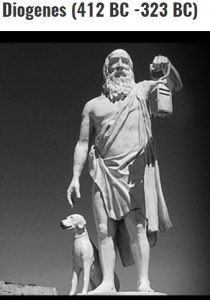
Diogenes of Sinope lived in a tub in the marketplace. Since it was a long time ago, around the 4th century BCE, the details are few. He is also known as Diogenes the Cynic. I feel a certain intellectual kinship to Diogenes because I too am a cynic. He must have been a remarkable man, going by the stories told about him.
It is said that he sometimes walked around with a lamp even in broad daylight. When asked why, he replied, “I am looking for an honest man.” A cynic to the core.
He lived an austere life, and claimed (correctly, I believe) that man’s needs are basically simple. He had few possessions and lived in a tub, and I suppose lived on handouts and charity. He must have been like the bhikshus that hung around the Buddha who, one must remember, lived a century before Diogenes.
During a sea voyage in his old age, he was captured by pirates and brought to a market in Crete to be sold. When asked for what he was capable of, he answered, “I can govern men; so sell me to someone who wants a master.”
Xeniades, a rich man of Corinth, heard this and bought Diogenes and gave him his freedom. Diogenes was in Corinth when Alexander the Great sent word through a messenger asking Diogenes to come see him in Macedonia.
What would you do if one of the most powerful men in the world sent word that he would like to meet you since he has heard so much about you?
Not Diogenes, though.
Diogenes told the Alexander’s messenger, “Go tell your emperor that Corinth is as far from Macedonia as Macedonia is from Corinth. So if your emperor wants to see me, he can come and find me here.”
Irrefutable logic and infinite self-assurance. The last bit can only come from someone who really does not need anything from anyone however high and mighty.
Alexander surely was not used to being turned down. But I suppose being a warrior, he admired courage. So he went to Corinth to meet Diogenes. Diogenes was sitting in his tub and enjoying the morning sun when Alexander showed up on his high horse with a whole bunch of soldiers.
After a brief introduction, Alexander proudly offered to give Diogenes anything that he needed. “Is there anything I can do for you, Sir?” asked Alexander. Diogenes replied, “Yes, you could. You are blocking the sun. Please stand aside.”

Alexander was a megalomaniac — you had to be if you wanted to (and indeed did) conquer a massive part of the world. So impressed he was with Diogenes that he later remarked, “If I had not been Alexander, I would have liked to be Diogenes.”
One more favorite story about Diogenes.
One afternoon, one of the emperor’s ministers was passing through the town square and saw Diogenes in his bathtub, eating gruel. The minister said helpfully, “Diogenes, you would not have to eat gruel, if you only did one thing. If you were friendly to the emperor, you’d be able to feast.”
Diogenes replied, “If you learned how to eat gruel, you would not have to grovel before the emperor.”
{PS: Also see this post from Sept 2009 about Diogenes, “Learning to Eat Gruel.”}
Open Letter to Buddhadeb Bhattacharya
Dear Chief Minister of West Bengal Mr. Buddhadev Bhattacharya:
I have come to learn that there is some possibility of renaming Park Street as Mother Teresa street and erecting her statue.
I think this is a very bad idea. The image of Kolkata has been forever tarnished as a result of Mother Teresa’s activities. For greater details on why this is so, I would urge you to read what some neutral observers have to say about the lady. I have a few articles on the subject and I recommend a book by a son of Kolkata — Dr Aroup Chatterjee’s “Mother Teresa: The Final Verdict” which I have reviewed here.
We in India are totally brainwashed to accept uncritically anything that is Western and white. Mother Teresa, motivated by missionary zeal, used the poverty of the poor of Kolkata to enrich her mission. While I do not deny that India has abject poverty, she used that poverty and showcased it around the world not to solve the problem but to evoke pity from affluent people so that they would contribute to the welfare of her mission, not for the welfare of the people she so ruthlessly used.
I urge you to carefully review the evidence and reconsider.
Sincerely,
Atanu Dey
I have followed the Mother Teresa phenomenon with a sick feeling in my stomach because of a number of reasons. The primary reason for me is that she epitomizes what is the fundamental flaw that led to what we see in India around us today. The flaw is in not thinking through things, of busying ourselves with the symptoms of an ailment rather than eradicating the cause.
Mother Teresa ceaselessly championed for uncontrolled breeding. She did her best to derail any serious attempt at addressing one of the primary causes of poverty in the developing countries, namely, the growth of human populations way beyond that which can be sustained at a humane level. All she wanted was that there be sufficiently large number of abjectly poor in a place so she could gather brownie points to assure her place amongst the sainted. As she honestly put it, if there were no poor, there would not be any reason for hermission to exist. The poor, she held, were blessed because they suffer.
I feel that she should be called Teresa, the Merciless. Millions will be forced lead miserable lives because of what she has done and the institutions she supported (the Vatican, primarily) and the institutions she has created.
I expect hate mail as a result of this post. But I hope that the writer of hate mail at least read some of the articles which I have provided the links to above. My request is that you send me hate mail only after you have honestly read the articles.
Idol-worshipping gone haywire
This is a followup to the comments on my post on Gandhian Self-sufficiency.
It is more than a bit unfortunate that we have a tendency to immediately label any criticism of any person as a sign of disrespect. Any person whose image cannot withstand the harsh glare of honest criticism says something about the fragility of that image. The image takes on a aura of such holiness and awe that any hint of possible flaws is taken as sacrilegious. Taken to an extreme, this sort of idol-worshipping ends up with the worshippers lynching anyone daring to profane the sacred image.
For the record, I do believe that Gandhi was a giant of a man. But for all his greatness, he was still cut from the same cloth as you and I. The same human frailties, the same hopes and ambitions and fears. The difference between a Gandhi and one of us is one of size, not of substance. If we keep that in mind — not just about Gandhi but everyone — I do believe that we would have a useful working hypothesis. Those great big people are magnified images of ourselves. And that which magnifies the virtues, magnifies the flaws as well. An old Chinese saying says that the bigger the front-side, the larger the back-side. Continue reading “Idol-worshipping gone haywire”
 Atanu Dey : Life is a Random Draw