
Decline

Thanks to the wonders of socialism and communism, China was either at par with or poorer than India for most of the 20th century CE. However, in 1978 China’s luck changed when Deng Xiaoping took over. Deng was a pragmatist, had the capacity to learn and do what needed to be done — make China great again.

In May 2014, when Modi came to power, I was absolutely delighted. India’s moment has come. Modi will do what Deng Xiaoping did for China.

But in about two months by July 2014, I realized that Modi was not Deng. In the years that followed, Modi showed his true colors: a power-crazed autocrat who was a cross between Nehru and Mao. He combined Nehru’s narcissistic self-obsession and general lack of vision, with Mao’s ruthless authoritarianism and disdain for people.

Modi was the amalgam of the worst that India and China had produced — Nehru and Mao.

It did not matter how duped and betrayed I felt after being an ardent supporter of his; what mattered was that India had missed a golden opportunity to lift hundreds of millions of people who are trapped in extreme poverty.

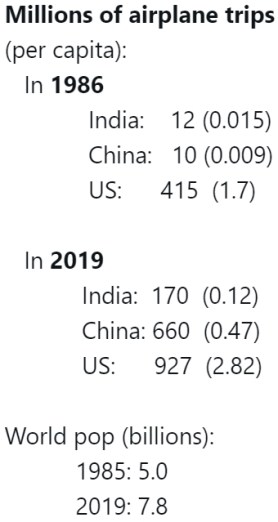
Back in May of this year, I wrote a bunch of tweets which was provoked by comparing the number of airline passenger-trips in India, China and US. (Click on image above to read the tweets.) I am reproducing them here, for the record. Continue reading “Decline”


Her Majesty’s Prison Belmarsh

H M P Belmarsh

“Her Majesty’s Government”, also known as the United Kingdom Government, is certainly not all evil but considered comprehensively across the centuries and around the world, it is as evil as governments get.

“Her Majesty’s Courts and Tribunals Service” administer civil and criminal justice through the courts of England and Wales (not Scotland and Northern Ireland). As part of that, Her Majesty runs prisons. UK prisons are not the worst in the world but it includes “Her Majesty’s Prison Belmarsh” which has the distinction of being “UK’s Guantanamo Bay”.

Julian Assange has been incarcerated in H M P Belmarsh since April 2019.  His “crime”? Exposing the criminal behavior of those who run the military-industrial complexes like Messrs. Bush and Blair. Which explains why the British government is punishing him by throwing him into Belmarsh and the US wants him extradited to the US.

Belmarsh is for the worst of the worst. Around a third of the inmates are Islamic terrorists.[1] Continue reading “Her Majesty’s Prison Belmarsh”

Right to Bear Arms

I took a Vistara flight from Mumbai to Bangalore a week ago Sunday. In preparation for the flight, I checked out their website and came across their ‘kirpan’ policy which states:
************
Carriage of “Kirpan” by Sikh Passengers

A ‘Kirpan’ with a total maximum length of 9 inches (22.86 cm), but a blade not exceeding 06 inches (15.24 cm), is permitted for carriage by a Sikh Passenger on their person, within India.
************

Kirpans[1] serve a function that is motivated by religion. The airline rule permits those who profess the Sikh faith to carry a weapon on board a commercial flight that is not allowed to non-Sikhs. This is discrimination based on religion.
Continue reading “Right to Bear Arms”

Ask me Anything — the Hayek Edition

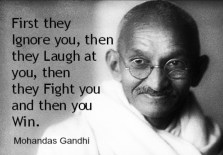
Gandhi First IgnoreHere’s the last bit from Hayek’s Dec 11 1974 Nobel Prize lecture:

If man is not to do more harm than good in his efforts to improve the social order, he will have to learn that in this, as in all other fields where essential complexity of an organized kind prevails, he cannot acquire the full knowledge which would make mastery of the events possible. He will therefore have to use what knowledge he can achieve, not to shape the results as the craftsman shapes his handiwork, but rather to cultivate a growth by providing the appropriate environment, in the manner in which the gardener does this for his plants. There is danger in the exuberant feeling of ever growing power which the advance of the physical sciences has engendered and which tempts man to try, “dizzy with success”, to use a characteristic phrase of early communism, to subject not only our natural but also our human environment to the control of a human will. The recognition of the insuperable limits to his knowledge ought indeed to teach the student of society a lesson of humility which should guard him against becoming an accomplice in men’s fatal striving to control society – a striving which makes him not only a tyrant over his fellows, but which may well make him the destroyer of a civilization which no brain has designed but which has grown from the free efforts of millions of individuals.

One of the recurring themes of Hayek’s was the idea that social engineering is quite distinct from engineering of the natural world. With the appropriate technology and scientific knowledge it is possible to engineer machines and use them to control the world of objects, perhaps for the better, but human beings are not objects without volition. Humans have a will of their own and they pursue ends that are dictated by their desires and preferences which are neither fixed nor can be known by others. Social engineering always fails and makes a bad situation worse. Continue reading “Ask me Anything — the Hayek Edition”

Will Durant on Great Minds and Ideas

Durant Great Minds IdeasWill Durant (1885 – 1981) the wiki informs us “was an American writer, historian, and philosopher.” He wrote the 11-volume The Story of Civilization, published between 1935 and 1975,  written in collaboration with his wife, Ariel Durant. His work The Story of Philosophy (1926) helped to popularize philosophy. “He sought to unify and humanize the great body of historical knowledge, which had grown voluminous and become fragmented into esoteric specialties, and to vitalize it for contemporary application,” the wiki notes.

Indians may find his view of India interesting. Once again let’s refer to the wiki:

In 1930, he published The Case for India while he was on a visit to India as part of collecting data for The Story of Civilization. He was so taken aback by the devastating poverty and starvation he saw as result of British imperial policy in India that he took time off from his stated goal and instead concentrated on his polemic fiercely advocating Indian independence. He wrote about medieval India, “The Islamic conquest of India is probably the bloodiest story in history. It is a discouraging tale, for its evident moral is that civilization is a precious good, whose delicate complex of order and freedom, culture and peace, can at any moment be overthrown by barbarians invading from without or multiplying within.”

Sadly hundreds million Indians continue to suffer “devastating poverty and starvation” nearly a century after Durant made the case for India’s release from British imperialism. Among the many causes for this immense tragedy is an important one missed by most Indians — that while British imperialism ended in 1947, imperialism did not end. The British designed and constructed the machine that imposed grinding poverty on India but Indians not only maintained the machine in good working order but improved its efficiency.

India’s heart-breaking poverty is entirely indigenous, made in India by Indians for Indians. Continue reading “Will Durant on Great Minds and Ideas”

Buddha Jayanti

buddha01Siddhartha Gautam, aka Sakyamuni (the sage of the Sakyas), became a buddha around 2,500 years ago. Today, known as Buddha Purnima, the day of the full moon in May, is celebrated as his birthday. Here’s the Chinese singer Imee Ooi singing the Prajna Paramita Hridaya Sutra, aka The Heart Sutra. Listen.

The maha-mantra of the Heart Sutra, “om gate, gate, para-gate, parasum-gate, bodhi svaha om”, appears around the 3:50 time stamp. Continue reading “Buddha Jayanti”

The Tragedy of Collectivism

F A Hayek“The tragedy of collectivist thought is that while it starts out to make reason supreme, it ends by destroying reason because it misconceives the process on which the growth of reason depends. It may indeed be said that it is the paradox of all collectivist doctrine and its demand for the “conscious” control or “conscious” planning that they necessarily lead to the demand that the mind of some individual should rule supreme — while only the individualist approach to social phenomena makes us recognise the super-individual forces which guide the growth of reason. Individualism is thus an attitude of humility before this social process and of tolerance to other opinions, and is the exact opposite of that intellectual hubris which is at the root of the demand for comprehensive direction of the social process.”
The Road to Serfdom. Friedrich August von Hayek. He was born on this day in 1899. Happy birthday, dear Prof Hayek.

Lee Kuan Yew – The Sage of Singapore

“Try and get a government on the cheap and you end up with a cheap government. … First job of a government is to equalize opportunities, right? You equalize results, you’re done for.”

It’s heartbreaking that hundreds of millions of Indians have to needlessly endure extreme poverty because of the insanely retarded policies of Gandhi, Nehru and the rest of the worthless bunch. If only, lord if only, India had the good fortune to get a leader like Lee Kuan Yew. Continue reading “Lee Kuan Yew – The Sage of Singapore”

Elementary, my dear

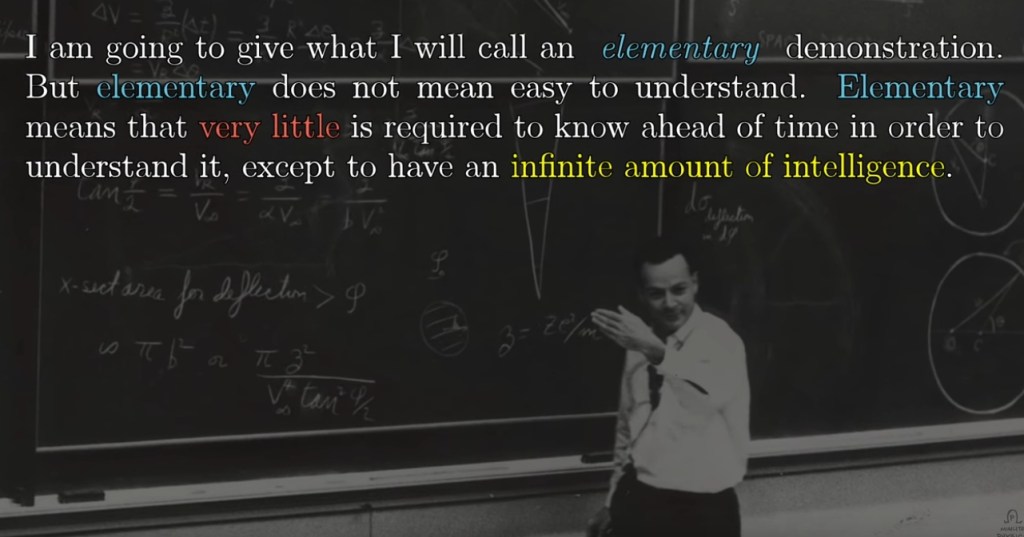
On top of being one of the greatest physicists of the 20th century CE, Feynman was a brilliant teacher. He presented complex ideas in elementary terms. Of course, one needed bring intelligence to the table. Best if one had an infinite amount of intelligence when it came to understanding the most elementary ideas.

“I am going to give what I will call an elementary demonstration. But elementary does not mean easy to understand. Elementary means that very little is required to know ahead of time in order to understand it, except to have an infinite amount of intelligence.”

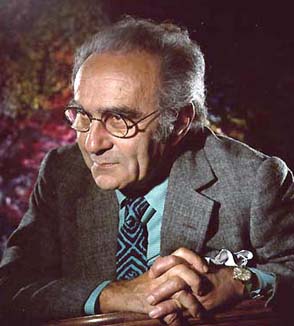
Dr Jacob Bronowski

There are a great many people I admire immensely. Some for their erudition, some for their immense contribution to the human condition, some for their enormous contribution to our understanding of the human condition, and some for their extraordinary ability to explain the great ideas of this world we live in. Thanks to the wonders of modern technologies, we are fortunate to be able to make their acquaintance even though some of them are no longer with us.

Dr Jacob Bronowski (1908 – 1974) was a great soul, a mahatma in the true meaning of the word. Here’s Michael Parkinson of the BBC interviewing Dr Bronowski in 1972. Watch, or listen, to this and you’ll know why I admire him. Continue reading “Dr Jacob Bronowski”