

AI agents are the coolest innovation of our modern world. Every time you turn around, one more appears. It’s becoming hard to keep up with the advances. I am amazed. So should you be. Just for fun, I gave grok a simple prompt: “Summarize Atanu Dey’s views on Gandhi.”
Here’s the response. Begin quote:
Atanu Dey, an economist and classical liberal, holds highly critical and negative views on Mahatma Gandhi (whom he often refers to as Mohandas K. Gandhi to reject the “Mahatma” title as inaccurate and undeserved).
Based on his blog posts, X (formerly Twitter) statements, and writings, Dey portrays Gandhi as one of the most harmful figures in history, responsible for perpetuating India’s poverty, misery, and underdevelopment. He dismisses Gandhi’s deification as a myth propagated for political control and argues that Gandhi’s ideas and actions were delusional, manipulative, and evil. Below is a structured summary of Dey’s key opinions across themes, drawn from his own content. Continue reading “Atanu Dey on Gandhi”



 Is Albert even a real German name, I wonder. Sounds English to me. Like the name of a character in a Wodehouse novel. Einstein should have had a good German first name. I know Germans with authentic German names — Karl, Ludwig, Hermann, Amadeus, Bodo, Arnold, Dieter, Konrad, Dagmar.
 The US has this weird convention of writing dates as MM/DD instead of the DD/MM which the rest of the world follows. So today is 3/14 in the US but it is 14/3 elsewhere. One gets used to it, just like you get used to flicking switches up to turn them on, whereas (say, in India) switches are turned on by flicking them down. Fortunately, we do drive on the right side of the road, both literally and figuratively.
 The internet reveals to me more than anything else how little I know about the world compared to how much others know. And how intelligent, wise, wealthy, famous, accomplished, and spectacularly talented some others are. In short, granted that I learn a lot through the internet, the unfortunate side-effect is that it gives me an inferiority complex.
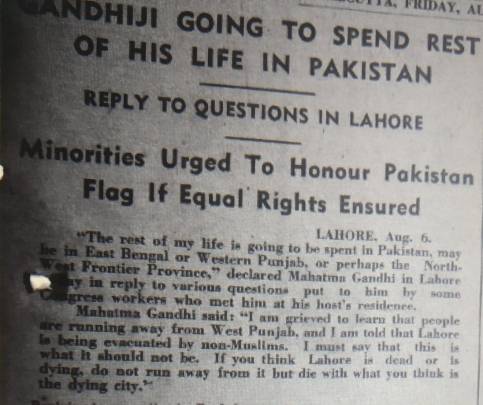 Gandhi matters enormously and he is rightly considered the “Father of the Nation.” That of course means that Gandhi is to a very large degree responsible for what India became (or failed to become) after India’s independence from the British raj.
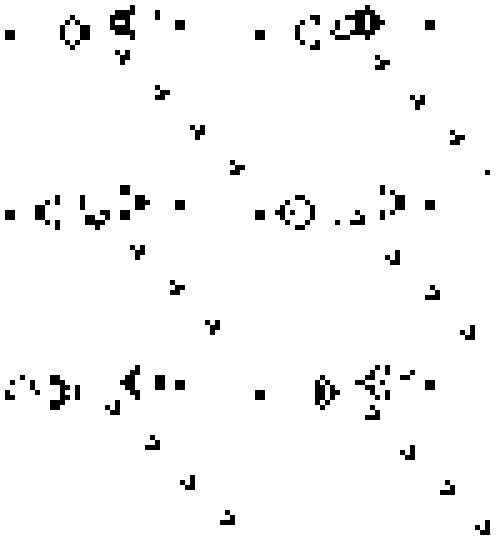 The great big game of life has a surprising counterpart in a cellular automata developed by John Conway in the 1960’s. It’s called “Game of Life.”
 About quotations, the German-born American actress Marlene Dietrich said, “I love them, because it is a joy to find thoughts one might have, beautifully expressed with much authority by someone recognizedly wiser than oneself.”
 Atanu Dey : Life is a Random Draw