Reading Ronald Coase

ronaldcoase Are you a well-read economist?

You aren’t if you cannot appreciate the Coase Theorem. (That theorem is one of the most cited in all of academic literature. Note, not just econ literature but all academic literature.) In other words, understanding the Coase theorem is part of being a complete economist.

Here are a few references to Ronald Coase, winner of the Economics “Nobel” Prize 1991, and his work:

Ronald Coase (Dec 1910 – Sep 2013) wiki page.

The Nature of the Firm” (1937) wiki page.

The Problem of Social Cost” wiki page.

Continue reading “Reading Ronald Coase”

Money is the root of all Evil

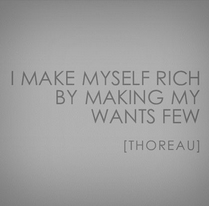
Thoreau_wants Many people — including some economists — often confuse money with wealth. This frequently leads to avoidable errors and bad policies. It is best to take money out of most discussions and focus on wealth, unless of course one is specifically discussing money. Continue reading “Money is the root of all Evil”

The Unbearable Stupidity of Controlling Prices

amazonlogoAn astonishing fact about Amazon, the giant retailer which aims to sell everything to everybody, is that it adjusts its prices over 2.5 million times daily. Let that sink in: two thousand five hundred thousand times a day. Around 100,000 price changes an hour. Granted Amazon has over 250 million SKUs (stock keeping units) on its catalog in the US. (See the data on US and other countries here, as of Aug 2014.) Still, that fact bears witness to what technology can do and what market competition can achieve in terms of economic efficiency.
Continue reading “The Unbearable Stupidity of Controlling Prices”

Notes on GDP, money and wealth

Considering how ubiquitous talk about GDP and growth rates is, it is noteworthy that as a concept it is of fairly recent vintage. The idea of having a measure of the “income” of a country was invented by the American economist Simon Kuznets for use in a US Congressional report in 1934. The “product” part of gross domestic product refers to the production of goods and services. It is an aggregate measure — and hence a macroeconomic measure. It is a measure of the total amount of goods and services that an economy produces. Full disclosure: I am not a macroeconomist and find the subject painfully boring. But here I am only discussing the limited idea of GDP.
Continue reading “Notes on GDP, money and wealth”

Central Planners and Wooden Boards

In my favourite Bruce Lee movie Enter the Dragon (which I have watched at least a dozen times) there’s a very telling scene. Just before a particular fight, Bruce Lee’s opponent, to demonstrate how awesomely tough he is, holds up a wooden board and with one swift punch smashes it to bits. Bruce Lee impassively looks him in the eye and calmly says, “Boards don’t hit back.”
Continue reading “Central Planners and Wooden Boards”

Money, Wealth, The Lion and Albert

Let me tell you a funny story about young Albert and Wallace the lion. The final lines of the poem surprisingly express a profound economic truth which gets too often ignored by government officials. As it happens, we can learn quite a bit if we care to look below the surface of simple tales. So here’s the story.

Continue reading “Money, Wealth, The Lion and Albert”

Happy 101st Birthday, Milton Friedman

Today is the 101st birthday of Prof Milton Friedman (1912 – 2006). His erudition, eloquence and dedicated struggle for human freedom and dignity have helped advance civilization. Here he is on Phil Donohue’s show in 1979. In this 2-minute extract, Donohue asks him about capitalism and greed. The response is classic Friedman — devastating but funny, profound and based entirely on common sense. Happy 101st birthday, Milton Friedman. May your tribe increase. Your eloquence has illuminated the world.

Market Structure, Political Parties and Collusion

Political parties are like firms in the marketplace. The same principles that drive the behavior of firms drive the behavior of political parties. They collude if they can, and gain from their collusion at the expense of the consumers.

Here I will outline my conjecture about the two major national political parties in India. If you are a supporter of either the Congress or the BJP, you may be disappointed by my analysis. Especially if you are a BJP supporter, you may wish to skip this post. BJP is complicit in Congress’s crimes.

In the following, I will lay out briefly how markets are structured (to take up where I left off in my previous post on the matter) and then reason analogically that the BJP and the Congress are not competing but rather they are colluding.
Continue reading “Market Structure, Political Parties and Collusion”

Three Lessons of Development Economics, or Why Utsav Mitra is Mistaken

ecodev101 The first lesson of development economics is that economic policies matter. Even if a country has everything going for it, lack of good policies condemn it to poverty. So it is easy to believe that if only good policies were known to those in power, economic development would necessarily follow. My good friend, the globe-trotting adventurer and consultant to capitalists, Utsav Mitra, brought that lesson to mind in a recent twitter exchange on my timeline. As a student of development, I have written a bit over the years on the matter and Utsav refers to it in a tweet which is embedded below.
Continue reading “Three Lessons of Development Economics, or Why Utsav Mitra is Mistaken”

On Competition and Markets

From a broad philosophical perspective, competition is encoded in the basic DNA of the universe. At every level of analysis, competing forces seek domination. At the largest inanimate scales, gravitational and electromagnetic forces constantly compete in stars. At the smallest scales, inside an atom, nuclear and electromagnetic force compete. In the biological world, living things compete all the time. It’s a constant battle between and among botanical and zoological species. Humans, as part of the animal world, are past masters of the game. We, like all other living organisms, are all descendants of ancestors who were successful in that competition at least long enough to have survived to reproduce.
Continue reading “On Competition and Markets”