

“The serious fact is that the bulk of the really important things that economics has to teach are things that people would see for themselves if they were willing to see. And it is hard to believe in the utility of trying to teach what men refuse to learn or even seriously listen to.” — Frank H. Knight
Conflating the words money and wealth is an easy mistake to make because in most everyday parlance we use the two interchangeably — if you are wealthy, you have a lot of money, and if you have a lot of money, you are wealthy — without loss of comprehension.
But money is a measure of wealth, not wealth itself, just like kilogram is a measure of mass but is not itself mass. They are not the same. They have to be distinguished if we are to reason cogently about the nature and causes of wealth of people (and progress in our “inquiry into the nature and causes of the wealth of nations.”)
I have written a fair bit about wealth and money over the years. Time for a TL;DR version. Continue reading “What is Wealth?”

 “The inverse relationship between quantity demanded and price is the core proposition in economic science, which embodies the presupposition that human choice behavior is sufficiently relational to allow predictions to be made. Just as no physicist would claim that “water runs uphill,” no self-respecting economist would claim that increases in the minimum wage increase employment. Such a claim, if seriously advanced, becomes equivalent to a denial that there is even minimal scientific content in economics, and that, in consequence, economists can do nothing but write as advocates for ideological interests. Fortunately, only a handful of economists are willing to throw over the teachings of two centuries; we have not yet become a bevy of
 I came across an
  Quite often I enjoy the pleasure of shocking people with my contrarian viewpoints. For some people, the shock is replaced with the pleasure of understanding something that goes against plain common sense. When that happens, I am very gratified but when it doesn’t, I feel sad.
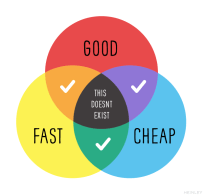 It would be best if we had zero crime, or zero pollution, or zero inequality (of wealth, income, health, beauty, intelligence, lifespans), or zero transportation deaths, et cetera. That is, it would be best if we could obtain the best and not have to pay too much for it. But, alas, the real world refuses to comply with our wishes. For anything good that the real world grudgingly gives us, it exacts a cost.
 Atanu Dey : Life is a Random Draw
Prabhudesai referred to JEE (Joint Entrance Exam) in a comment and wrote, “An examination that has too much of competition resulting to very high cost of producing one engineer. For a poor country like India it is a massive blow.”
Is that type of competition good? That is socially wasteful competition. It belongs to a broad class of activities that are technically known as “rent seeking.”
One of the principal ways of obtaining wealth is by earning a profit. Profits are the difference between the cost of producing something and the price obtained from its sale. Profits indicate that wealth has been created and value delivered. Rent seeking occurs when one attempts to obtain some wealth without actually creating wealth.
Continue reading “A Bit on Rent Seeking”