Maya, Moksha, Nama and Rupa

Maya

Pondering the fact of death, I am reminded that impermanence is a central feature of the world we live in. The phenomenal world — of things and events — is called maya in the dharmic traditions (namely Jain, Hindu, Buddhist & Sikh.)

The world is maya. Many people simply translate it as “ the world is an illusion” but that is incorrect. The world is real. Maya does not mean that the world is unreal or that it is an illusion. It means something like this: the world as we perceive it is not what the world actually is. We cannot directly perceive the reality that is at the foundation of what exists. That reality is given a word — Brahman. Most of us cannot comprehend the Brahman because we are limited beings. Continue reading “Maya, Moksha, Nama and Rupa”

Material and Cosmological Beliefs

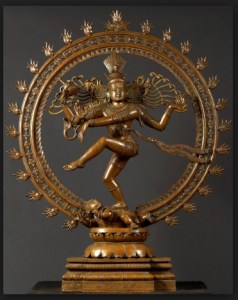
nataraja2I am a Hindu.

In what sense am I a Hindu? Does what I read, write, wear and consume make me a Hindu? I think, read and write in English, I wear Western style clothing, I live in a Western country, etc. Even then I am a Hindu at the core of my being.

What defines me as a Hindu is my core belief system. How I comprehend the world is what determines whether I am a Hindu or not. The important distinction here is between “material beliefs” and “cosmological beliefs.” Continue reading “Material and Cosmological Beliefs”

The Ownership Society — Revisited

deg320 The idea of “empowering” people was all the rage a few years ago. The answer to all of India’s woes, it seems, lay in empowering people, whatever that meant. I thought it was basically stupid. Why? Because people who are not free in any meaningful sense of the word cannot be empowered. Here’s what I wrote back in October 2005 on what is an “Ownership Society.” Brief excerpt follows: Continue reading “The Ownership Society — Revisited”

Nepotism and Modi

The word nepotism and the name Narendra Modi do not belong in the same sentence. Just read this piece The Other Modis (Dec 29, 2017 2016) in the IndiaToday magazine.

While the story is very interesting and it does show up as a shining exception to the pervasive nepotism of politicians, I am not too touched by the neglect of one’s family. Family and friends matter because they are our support and our inspiration. Certainly, nepotism is bad but not caring deeply about one’s flesh and blood is not a virtue.
Continue reading “Nepotism and Modi”

Ask Me Anything — The Demonetization Edition

amaMoney is important. The real economy cannot function without a stable and predictable currency. Money serves as a numéraire, which the wiki defines as “a basic standard by which value is computed . . . the numéraire is one of the functions of money, to serve as a unit of account: to provide a common benchmark relative to which the worth of various goods and services are measured.”

These days, nearly all money is fiat money issued by the central bank of an economy which is controlled (indirectly perhaps) by the government. The quantity, and therefore the “price” of money (which is the interest rate), is controlled by the central bank. Continue reading “Ask Me Anything — The Demonetization Edition”

Thomas Schelling (April 14, 1921 – December 13, 2016) RIP

schellingthomas-cCelebrated economist Thomas Schelling died today at the age of 95. He was the recipient of the 2005 Nobel Memorial Prize in Economic Sciences for “having enhanced our understanding of conflict and cooperation through game-theory analysis”. I note his passing because he was instrumental in my recognizing that I belonged to his tribe — that I was at heart an economist. Mere accident led me to pick up his book Micromotives and Macrobehavior (1978) at the Sunnyvale Public Library sometime back in the early 1990s. He received his bachelors degree in economics in 1944 from UC Berkeley, my alma mater.  Continue reading “Thomas Schelling (April 14, 1921 – December 13, 2016) RIP”

Constitution for a Free India

I have been arguing for a while that the fountainhead of India’s troubles is the Indian Constitution. Recently I contributed a chapter to the CCS publication “Liberalism in India: Past, Present and Future“, and also wrote an opinion piece for LiveMint on the same topic “Why India Needs a New Constitution.” The question naturally arises: replace the constitution with what? Here’s my answer. Continue reading “Constitution for a Free India”

Why India Needs a New Constitution

On Livemint, I have an opinion piece titled “Why India Needs a New Constitution” which is part of a series on the book Liberalism in India: Past, Present and Future.

Here it is, for the record:

Why India needs a new Constitution

Continue reading “Why India Needs a New Constitution”

Liberalism in India: Past, Present and Future

CCS Book Cover
Liberalism in India

The Center for Civil Society convened a day-long conference on Nov 20th at The Claridges Hotel, New Delhi, to honor the memory of S V Raju. I attended and had the opportunity to meet with many friends and also some people I had heard about but never met before.

About the event, CCS notes: Continue reading “Liberalism in India: Past, Present and Future”

A Tale of Two Shocks

Two shocks rocked the world: Donald Trump’s upset victory in the US presidential elections, and the demonetization of high-denomination currency in India. Both can be expected to have profound repercussions. I will pass commenting on the tears of Hillary Clinton — delicious though they are to yours truly — except to say that to me the result was as unexpected as it was delightful.

The Indian economy experienced a massive shock with the announcement that Rs 500 and Rs 1000 currency notes will no longer be legal tender starting from just a few hours after the announcement. An astounding 86 percent of all currency was rendered worthless for transactions, and only the remaining 14 percent was expected to serve for a short term (hopefully) the myriad purposes that money usually serves in an economy. A monetary shock of that magnitude cannot but have complex intended and unintended consequences. Continue reading “A Tale of Two Shocks”