
 The title of this post is a question on Quora. Confession: I have a truckload of stuff to get done. Whenever I have stuff to do, I do all sorts of useless stuff. Clean the desk drawers. Or something silly like that to avoid the more difficult important tasks. I put off doing important stuff by answering silly questions on Quora. Here’s my answer to the above question. Continue reading “Why Do We Hate Capitalism?”
Author: Atanu Dey
Economist.
Neam Chimpsky
 OK, enough of Noam Chomsky. His brilliant theories of human language structure and generative grammar holds one’s attention only for so long before boredom descends. His opinions on politics is mildly amusing but his take on economics is totally wacko.
Let’s move on to the chimpanzee named after him, Neam Chimpsky (1973 – 2000). Nim, as he was called, was the subject of an extended study of animal language acquisition at Columbia University. To pay for his study, I suppose Nim had to do household chores, doing the dishes etc. I guess that Nim’s take on economics could not have been much worse than Noam’s.
My friend Akshar pointed me to a YouTube video in which Thomas Sowell talks about intellectuals in society. They briefly discuss Chomsky. As always, Sowell is insightful. Check it out, below the fold. Continue reading “Neam Chimpsky”
Hayek on Liberty
 18 Hayek Quotes That Show the Importance of Liberty
by Gary M. Galles
May 8th marked Friedrich Hayek’s birthday. Called “the most prodigious classical liberal scholar of the 20th century,” Milton Friedman explained his importance:
“Over the years, I have again and again asked fellow believers in a free society how they managed to escape the contagion of their collectivist intellectual environment. No name has been mentioned more often as the source of enlightenment than Friedrich Hayek’s.”
One cannot compactly summarize Hayek’s contributions of 130 articles and 25 books. However, since one of his major contributions has been arguing persuasively for “that condition of men in which coercion of some by others is reduced as much as possible in society,” his understanding of liberty, now in retreat, is particularly worth noting.
-
-
- “A society that does not recognize that each individual has values of his own which he is entitled to follow can have no respect for the dignity of the individual and cannot really know freedom.”
- “If we wish to preserve a free society, it is essential that we recognize that the desirability of a particular object is not sufficient justification for the use of coercion.”
- “Coercion is evil precisely because it…eliminates an individual as a thinking and valuing person and makes him a bare tool in the achievement of the ends of another.”
- “The argument for liberty is…an argument…against the use of coercion to prevent others from doing better.”
- “Individual liberty…demonstrate[s] that some manners of living are more successful than others.”
- “It is always from a minority acting in ways different from what the majority would prescribe that the majority in the end learns to do better.”
- “Liberty not only means that the individual has both the opportunity and the burden of choice; it also means that he must bear the consequences…Liberty and responsibility are inseparable.”
- “Liberty is not merely one particular value…it is the source and condition of most moral values. What a free society offers to the individual is much more than what he would be able to do if only he were free.”
- “All political theories assume…that most individuals are very ignorant. Those who plead for liberty differ…in that they include among the ignorant themselves as well as the wisest.”
- “The individualist…recognizes the limitations of the powers of individual reason and consequently advocates freedom.”
- “Once wide coercive powers are given to government agencies…such powers cannot be effectively controlled.”
- “The chief evil is unlimited government…nobody is qualified to wield unlimited power.”
- “Economic control…is the control of the means for all our ends. And whoever has control of the means must also determine which ends are to be served.”
- “The case for individual freedom rests largely upon the recognition of the inevitable and universal ignorance of all of us concerning a great many of the factors on which the achievements of our ends and welfare depend.”
- “The system of private property is the most important guarantee of freedom, not only for those who own property, but scarcely less for those who do not.”
- “There is no justification for the belief that, so long as power is conferred by democratic procedure, it cannot be arbitrary…it is not the source but the limitation of power which prevents it from being arbitrary.”
- “Equality of the general rules of law and conduct…is the only kind of equality conducive to liberty and the only equality which we can secure without destroying liberty.”
- “Under the Rule of Law…the individual is free to pursue his personal ends and desires, certain that the powers of government will not be used deliberately to frustrate his efforts.”
-
Friedrich Hayek observed that “It used to be the boast of free men that, so long as they kept within the bounds of the known law, there was no need to ask anybody’s permission or to obey anybody’s orders. It is doubtful whether any of us can make this claim today.” He led the fight against declining belief in freedom, recognizing that “unless we can make the philosophic foundation of a free society once more a living intellectual issue, and its implementation a task which challenges the ingenuity and imagination of our liveliest minds, the prospects of freedom are indeed dark.” That is why his ideas need to be understood, and deeply considered, by more Americans, if our liberty is not to erode still further.
 Gary M. Galles is a professor of economics at Pepperdine University. His recent books include Faulty Premises, Faulty Policies (2014) and Apostle of Peace (2013). He is a member of the FEE Faculty Network.
This article was originally published on FEE.org. Read the original article.
Chomsky, the Father of Modern Linguistics
 Noam Chomsky is a very intelligent person. I do have more than a hint of his brilliance in linguistics because I studied formal grammar and languages during my computer science days. It would be foolish to deny his stellar contributions to his field of expertise. It will be equally foolish to take him seriously in matters that are outside his field.
Insight, knowledge and understanding in some domain does not overflow into other domains, sometimes not even into neighboring domains. Shakespeare was a great poet and an acute observer and commentator on the human condition. But I would not trust him to teach me quantum mechanics. Continue reading “Chomsky, the Father of Modern Linguistics”
Capitalism is based on Selfishness and Greed
 Bringing you lower quality and fewer choices since the 16th Century, reads the caption to the image of capitalism. The grim image of the evils of capitalism is captured in William Blake’s evocative phrase “the dark satanic mills.” Is it true that because capitalism rests on selfishness and greed that we don’t have a heaven on earth?
In human society in all ages the number of angels devoid of any greed and selfishness is astonishingly low. Most people are self-interested at least, if not outright selfish; and most people want more of the good stuff for themselves and their loved ones, if not outright greedy. That’s the truth about the human condition. That’s what we have to work with, and bemoaning that fact, or worse ignoring that fact, is not going to help at all. Continue reading “Capitalism is based on Selfishness and Greed”
Buffet and Munger on Cryptocurrencies
 I wouldn’t bother commenting on crypto currencies because I don’t understand the topic. But this is just too good to pass up. Buffet and Munger are not fans of the stuff. CNBC reported back on Jan 10, 2018 that Warren Buffett thinks cryptocurrencies will end badly.
Buffet considers it a method of transmitting money and has no intrinsic value. He has said that bitcoin is “probably rat poison squared” and noxious.
This is from the Berkshire Hathaway AGM last weekend in Omaha, Nebraska: Continue reading “Buffet and Munger on Cryptocurrencies”
McCloskey on Economics, Economists and Physicists
 When Nobel laureate physicist Ernest Rutherford (1871 – 1937) claimed that “Physics is the only real science. The rest are just stamp collecting” he was perhaps displaying the arrogance that comes with the territory of knowing certain fundamental truths that are denied to non-physicists.
Economists too can be arrogant for similar reasons. They know something about human society that others are generally not aware of — and what’s more — are unaware of their ignorance.
It’s not a sin to be arrogant but displaying it is definitely impolite and predictably makes a person unpopular. I speak from experience. What am I going on about, you may ask. I was reading Deirdre McCloskey today. Continue reading “McCloskey on Economics, Economists and Physicists”
Jehangir Ratanji Dadabhoy Tata
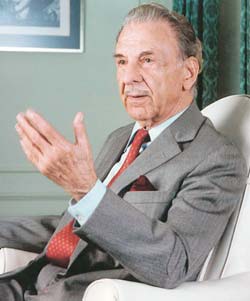 J.R.D. Tata was born in Paris, France in 1904 and died in Geneva, Switzerland in 1993. You’d think that he was as Indian as one gets but he was only half Indian. His father was Ratanji Dadabhoy Tata and his mother Suzanne “Sooni” Brière. His mother tongue was French. As a French citizen, on turning 20, he had to serve in the French army for a year.
J.R.D. was the founder of many Tata companies, including Tata Airlines in 1932 (which became Air India in 1946 — which was nationalized in 1953) for which he is known as the “Father of Indian Civil Aviation.” He was chairman of Air India until Prime Minister Morarji Desai fired him in 1977.[1] Continue reading “Jehangir Ratanji Dadabhoy Tata”
The Peter Principle in Action
 Almost half a century ago, in 1969, Laurence Peter published what’s known as the Peter Principle. The principle, originally formulated to explain the dynamics of hierarchical organizations such as firms, is applicable broadly across many domains, including governance.
The principle notes that people tend to get promoted till they reach a level which they are not qualified for and at which they are incompetent. “In a hierarchy, every employee tends to rise to his level of incompetence, … and in time every post tends to be occupied by an employee who is incompetent to carry out its duties.” Continue reading “The Peter Principle in Action”
Mamata Banerjee is a Retard
 Sorry that I have to disturb the serene silence of this blog with a rant against the Islamist chief minister of West Bengal, Mamata Begum (or whatever her Arabic name is.) As this is a family-friendly blog, let me put it as politely as I can: she’s a f**king retard. And what’s more, the people of Bengal who support her are bigger effing retards than she is. What provoked me? Here’s her tweet:
I am sorry to read in the media about the Govt inviting expression of interest for selling Air India, the jewel of our nation. We strongly oppose this and want this order to be withdrawn immediately. This Govt must not be allowed to sell our country
— Mamata Banerjee (@MamataOfficial) March 28, 2018
Air India is the jewel of our nation? Are you effing kidding me? Is it just ignorance or stupidity (perhaps both) that the average Indian who is not ever likely to set foot in an airplane has been forced (at the point of a gun) to pay for the incompetency of those who run Air India? Is she that abysmally stupid and/or heartless that she wants Air India to continue bleeding the poor of India, while the politicians and bureaucrats and their hanger-ons use Air India as their private FREE airline?
Continue reading “Mamata Banerjee is a Retard”
 Atanu Dey : Life is a Random Draw