
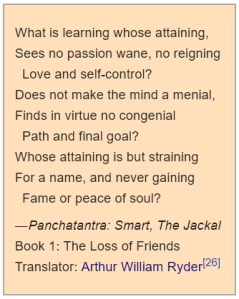
The following is an extended edited excerpt from Arthur Ryder’s introduction to his translation of the Panchatantra. What’s the book about? Ryder begins his introduction with:
“The Panchatantra contains the most widely known stories in the world. If it were further declared that the Panchatantra is the best collection of stories in the world, the assertion could hardly be disproved, and would probably command the assent of those possessing the knowledge for a judgment.”
The editing consists of removing quotations from the main text. Even if you don’t get around to reading the translation, you must read the introduction in full. And if you don’t want to do that either, you must read this shorter version.
(The following is quoted material, not my original. For neatness of presentation, I have avoided the use of ellipses to indicate deleted text. I have highlighted in bold font what I find most important. )
The Panchatantra is a niti-shastra, or textbook of niti. The word niti means roughly “the wise conduct of life.” Western civilization must endure a certain shame in realizing that no precise equivalent of the term is found in English, French, Latin, or Greek. Many words are therefore necessary to explain what niti is, though the idea, once grasped, is clear, important, and satisfying.
First of all, niti presupposes that one has considered, and rejected, the possibility of living as a saint. It can be practiced only by a social being, and represents an admirable attempt to answer the insistent question how to win the utmost possible joy from life in the world of men.
The negative foundation is security. For example, if one is a mouse, his dwelling must contain recesses beyond the reach of a cat’s paw. Pleasant stanzas concerning the necessity of security are scattered throughout the work.
The mere negative foundation of security requires a considerable exercise of intelligence, since the world swarms with rascals, and no sensible man can imagine them capable of reformation.
Yet roguery can be defeated; for by its nature it is stupid.
Having made provision for security, one faces the necessity of having money. The Panchatantra being very wise, never falls into the vulgar error of supposing money to be important. Money must be there, in reasonable amount, because it is unimportant, and what wise man permits things unimportant to occupy his mind?
Needless to say, worldly property need not be, indeed should not be, too extensive, since it has no value in possession, but only in use.
Now for the positive content of niti. Granted security and freedom from degrading worry, then joy results from three occupations — from resolute, yet circumspect, use of the active powers; from intercourse with like-minded friends; and above all, from worthy exercise of the intelligence.
Necessary, to begin with, for the experience of true joy in the world of men, is resolute action. Time and again this note is struck the difficulty and the inestimable reward of sturdy action.
Equal stress is laid upon the winning and holding of intelligent friends. The very name of the second book is “The Winning of Friends”; the name of the first book is “The Loss of Friends.” Throughout the whole work, we are never permitted to be long oblivious of the rarity, the necessity, and the pricelessness of friendship with the excellent.
Last of all, and in a sense including all else, is the use of the intelligence. Without it, no human joy is possible, nothing beyond animal happiness.
One must have at disposal all valid results of scholarship, yet one must not be a scholar. One must command a wealth of detailed fact, ever alert to the deceptiveness of seeming fact. One must understand that there is no substitute for judgment, and no end to the reward of discriminating judgment.
One must be ever conscious of the past, yet only as it offers material for wisdom, never as an object of brooding regret.
This is niti, the harmonious development of the powers of man, a life in which security, prosperity, resolute action, friendship, and good learning are so combined as to produce joy. It is a noble ideal, shaming many tawdry ambitions, many vulgar catchwords of our day. And this noble ideal is presented in an artistic form of perfect fitness, in five books of wise and witty stories, in most of which the actors are animals.
The stories, indeed, are charming when regarded as pure narrative; but it is the beauty, wisdom, and wit of the verses which lift the Panchatantra far above the level of the best story-books.
The large majority of the actors are animals, who have, of course, a fairly constant character. Thus, the lion is strong but dull of wit, the jackal crafty, the heron stupid, the cat a hypocrite. The animal actors present, far more vividly and more urbanely than men could do, the view of life here recommended a view shrewd, undeceived, and free of all sentimentality; a view that, piercing the humbug of every false ideal, reveals with incomparable wit the sources of lasting joy.
Berkeley, July 1925. Arthur W Ryder
On reading the last paragraph, I wondered. Among those who presently hold political power in India, who is the strong but dull-witted lion, who the crafty jackal, who is the stupid heron, and who the hypocrite cat? The lion and the jackal are easy matches. Arun J is the hypocrite cat. There are a few contenders for the stupid heron. Leave your guess in the comments, please.
NOTES:
[1] Arthur William Ryder (1877 – 1938) was a professor of Sanskrit at the University of California, Berkeley (my alma mater, I can’t resist noting.) He is best known for translating a number of Sanskrit works into English, including the Panchatantra and the Bhagavad Gita. In the words of G. R. Noyes,
Taken as a whole, Ryder’s work as a translator is probably the finest ever accomplished by an American. It is also probably the finest body of translation from the Sanskrit ever accomplished by one man, if translation be regarded as a branch of literary art, not merely as a faithful rendering of the meaning of the original text.
[2] How old is the Panchatantra? Ryder states that it is dated to at least the 2nd century BCE, and before. His translation is from a version that is dated around 1199 CE. For more on the authorship and chronology, see the wiki.
Pretty picture of a Fall sunset in my neighborhood a few days ago.
 To understand the relationship between producing, consuming, saving and investment, it is useful to start with a simple story.
 Recently I got to know about Zoom and even had a zoom webinar a few days ago. I think we should give Zoom a spin and hold an “ask me anything” session. Just generally chat. Particularly we can discuss why Shabana Azmi is a moron. Here are the details:
 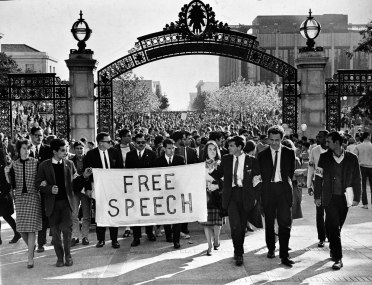 You know why free speech? Because we humans are not infinitely wise. That’s all. If we, or some of us, were infinitely wise, we would be able to tell which speech was OK and which not-OK. Then the wise could sort out which speech to allow. But none of us is infinitely wise.
 It may seem odd to begin a piece regarding the on-going struggle surrounding the centuries-old
 Here we go again. Now that India’s 2019 general elections are just a few months away, Mr Modi wants you to help him “transform India.”
 Atanu Dey : Life is a Random Draw