A bit on the Principal Agent Problem

Recently, Sambaran Mitra asked:

Why would an honest person run for public office or serve as a committee member of a resident welfare association? What kind of system will provide the right incentives for honest people to assume public office?

Designing proper mechanisms for ensuring honest behavior in officials is well-understood. The general class of problems is known as the “principal agent” problems. 

The politicians are the agents of the citizens who are the principals; the resident welfare association members are the agents of the residents who are the principals. The managers of a firm are the agents and the shareholders of the firm are the principals. The workers are the agents and the owner of the firm is the principal.

Continue reading “A bit on the Principal Agent Problem”

The Importance of Epistemic Humility

In one of his interviews, Milton Friedman was asked if he would stop someone from doing something that he, Friedman, knew to be wrong. Is it his moral duty, the interviewer pressed on, to prevent someone from doing what could lead to harm. Friedman replied (and I am paraphrasing here; I will find the exact quote later) that yes, it was his moral duty but he added, “But how can I be sure that I am right? How can I know for certain? Because I can’t know for sure, I should resist the urge to interfere with another.”

This is what I would call epistemic humility. Epistemic — of, relating to, or involving knowledge and cognition. Humility — the attitude that acknowledges weakness or incompleteness in one’s capacities. Epistemic humility is when you know that you don’t know, and resist the pretense of knowledge.

People who hold absolutely rigid views on matters that are intrinsically unknowable or incompletely known cause a lot of misery. They lack the wisdom to realize that as imperfect beings we are subject to all sorts of illusions and have at best an incomplete understanding of the world. We have to be especially wary of our beliefs. Bertrand Russell was once asked if he was prepared to die for his beliefs and he replied, “Certainly not, after all I may be wrong.” That’s prudent.

Continue reading “The Importance of Epistemic Humility”

Is a vaccine a public good?

Prabhudesai asked: Is a vaccine a “public good”?

In economics, goods that are non-rival (consumption of the good by someone does not decrease the amount available for others to consume) and non-excludable (no one can be prevented from consuming) are called pure public goods. By that definition, clearly a vaccine is not a pure public good.

A good that is non-rival but excludable is called a “club good” — a large park in a gated community, for example. A good that is rival but non-excludable is called “common pool” — a pasture for grazing cattle with no fences, for example. 

Continue reading “Is a vaccine a public good?”

Elementary, my dear

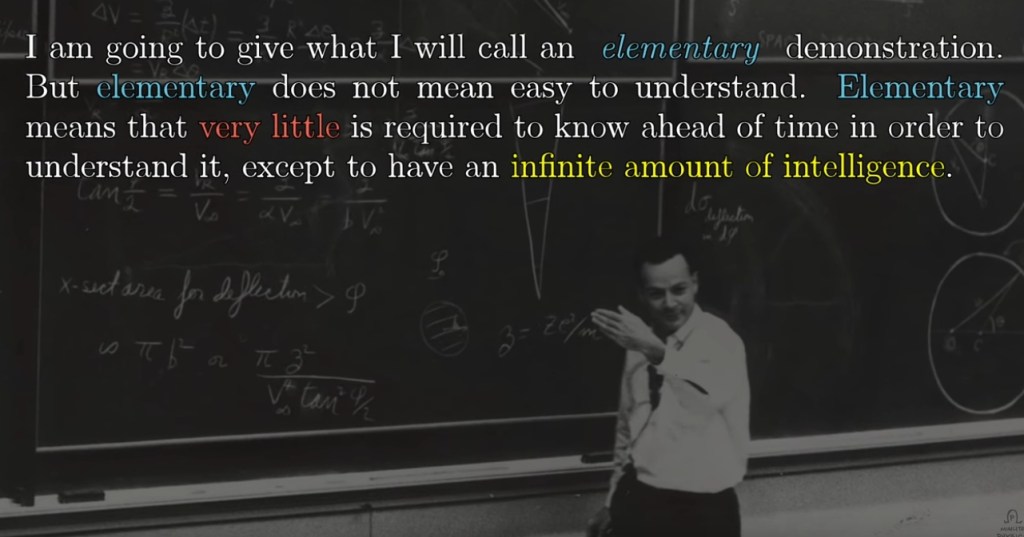
On top of being one of the greatest physicists of the 20th century CE, Feynman was a brilliant teacher. He presented complex ideas in elementary terms. Of course, one needed bring intelligence to the table. Best if one had an infinite amount of intelligence when it came to understanding the most elementary ideas.

“I am going to give what I will call an elementary demonstration. But elementary does not mean easy to understand. Elementary means that very little is required to know ahead of time in order to understand it, except to have an infinite amount of intelligence.”

The End is Near for the RoP

Some people would like humanity to regress to the savagery of 7th century CE Arabia but their days are numbered. Chief reason for the rapid decline and death of the savagery is the internet and smartphone revolution.

Don Boudreaux on “Covid Tyranny”

tyranny-brancoDon Boudreaux over at Cafe Hayek makes very important points:

A government that acts without rules, that consistently changes course in favor of exercising ever-more and longer-lasting power, and that now refuses to publicly state guidelines for ending its unprecedented assault on ordinary human liberties is tyrannical. I don’t see how this word fails to accurately describe today’s British government – as well as many other governments across the globe. Continue reading “Don Boudreaux on “Covid Tyranny””

Fagradalsfjall

From the wiki

Fagradalsfjall is a shield volcano and tuya with multiple prominences located on the Reykjanes Peninsula, around 40 kilometres from Reykjavík, Iceland. Its highest summit is Langhóll (385 m / 391 m). A volcanic eruption began on 19 March 2021 in Geldingadalur to the south of Fagradalsfjall, which is still emitting fresh lava as of 27 March 2021.

Update: Another video. This one is from a drone.

Barbaric Religious Discrimination of India

Hitler discriminated on the basis of religion — as does the government of India. India is a disgraceful state. Indians tolerate religious discrimination. Indians lack basic morality and humanity. Indians should be ashamed of their uncivilized backwardness.

Discrimination in the private sphere may or may not be morally and ethically excusable. But state-imposed policies that discriminate for or against particular segments of the population is unambiguously wrong, immoral and barbaric. Regardless of whether the discrimination is legally sanctioned or not, it is morally odious in principle and is pernicious in its effect on society. State sanctioned and state imposed discrimination among citizens on any criterion is bad in general but it becomes absolutely unacceptable when the criterion applied is religion.

What deserves unconditional denouncement and unreserved condemnation is when a self-professed secular state discriminates on a religious basis. No state in modern times can claim to be civilized while blatantly committing the crime of discriminating against segments of its population based on religion. The Indian State should be roundly criticized for breaking a universally recognized norm in this regard.

Continue reading “Barbaric Religious Discrimination of India”

Don Boudreaux on Externalities

I have long held the belief that a reasonably educated person — regardless of his professional specialization or occupation — should be familiar with the basic principles of the natural sciences (physics, biology, etc.), the social sciences (psychology, economics, etc.), know how to do arithmetic, know something about law and history, philosophy, etc.

I confess that I was not “reasonably” educated when I graduated from engineering school. Other than what I was minimally required to learn — the basics of science, engineering and math — I knew hardly anything else. Today I would judge my 20-something year old self as a barely educated, mostly ignorant person. Fortunately for me, I am naturally thoughtful, curious and quite intelligent, which allowed me to overcome some of my deficiencies. I was doubly fortunate in being able to learn economics — first neoclassical and eventually Austrian. Now I consider myself a reasonably educated person. And getting more educated by the day. Continue reading “Don Boudreaux on Externalities”