
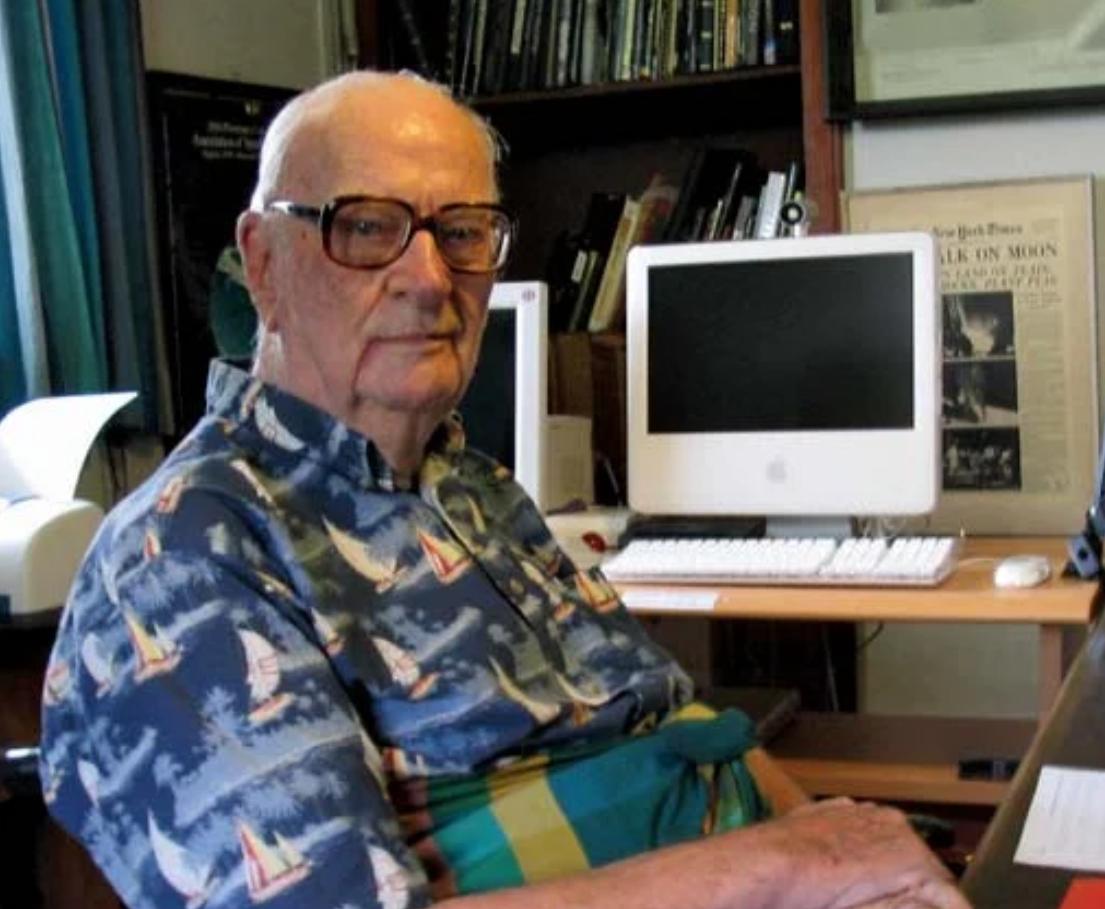
Sir Arthur C. Clarke (1917–2008) was a British science fiction author, inventor, futurist, and undersea explorer. His science fiction naturally appealed to my cohort and me as engineering students. In the 70s in India, we had access to only a few books and the occasional sci-fi movie.
His Rendezvous with Rama (1973) was my introduction to hard science fiction. The novel explores the arrival of an enigmatic cylindrical alien megastructure which enters the solar system in 2131. Scientists name it Rama, the 7th avatar of Vishnu. [Notes 1]
I later read Clarke’s 1953 novel Childhood’s End. It’s a philosophical exploration of humanity’s peaceful subjugation by the mysterious “Overlords” and subsequent transcendence. Overlords end war and poverty; the real purpose is a leap in human evolution. Often called his masterpiece.
Alongside Isaac Asimov and Robert A. Heinlein, he was celebrated as one of the “Big Three” of 20th-century science fiction. Asimov’s Foundation Trilogy and Heinlein’s The Moon is a Harsh Mistress are brilliant.
Clarke was not merely a storyteller. He was also a scientist. In a 1945 paper published in the British journal Wireless World titled “Extra-Terrestrial Relays—Can Rocket Stations Give Worldwide Radio Coverage?”, he outlined the concept of geostationary communications satellites. [Notes 2]
He lived in Sri Lanka from 1956, was knighted in 1998, and has an SF award named after him (the Arthur C. Clarke Award, for the best SF novel published in the UK each year—not an award he won himself).
2001: A Space Odyssey
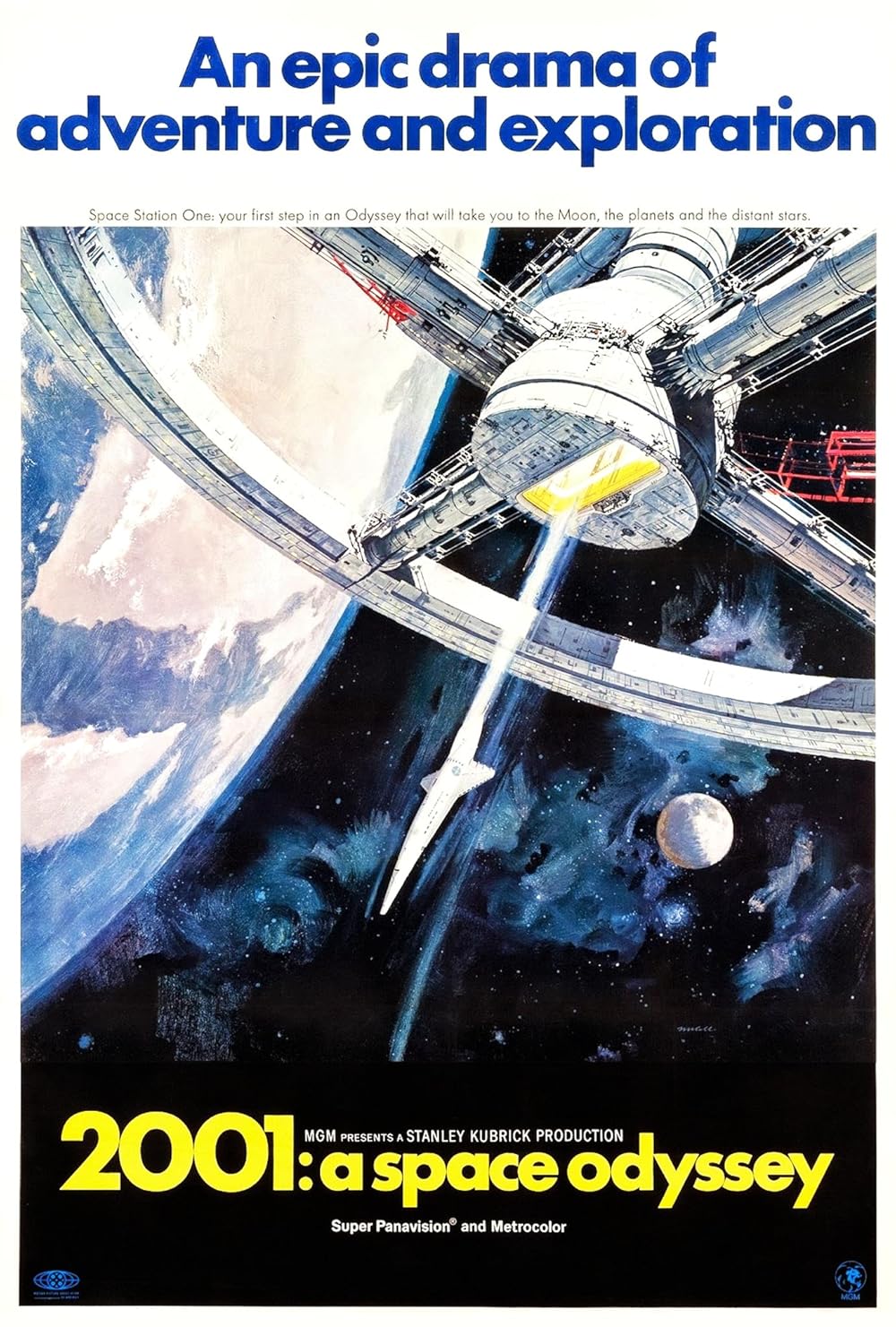 In 1968, Clarke’s collaboration with Stanley Kubrick led to the development of the book and the movie. It explored human evolution, artificial intelligence (HAL 9000), and extraterrestrial contact. Many critics contend that it is the greatest sci-fi movie. I agree with them. I watch it every time I am able to rope a friend to watch it.
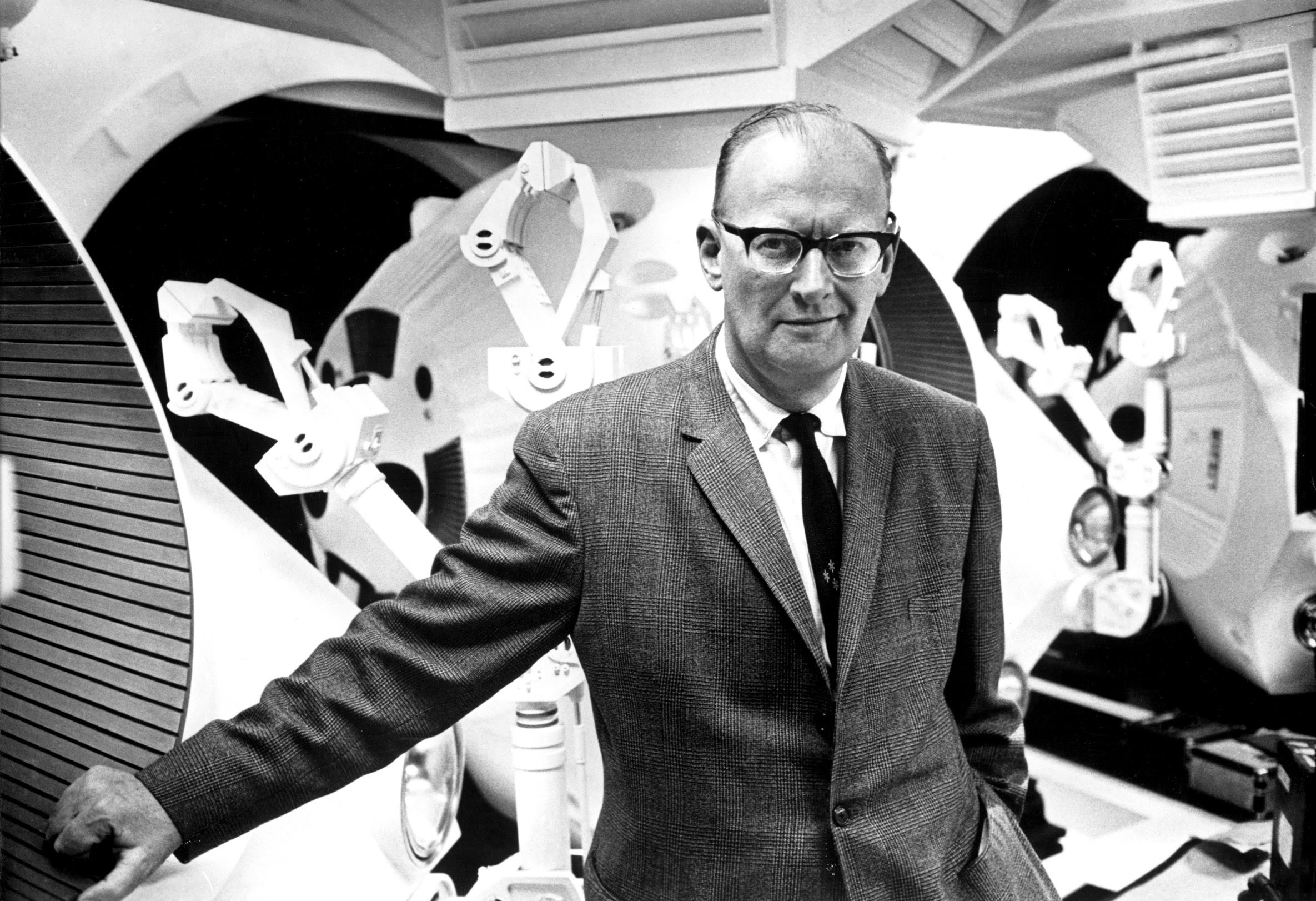
Here’s Clarke on the set of 2001.
Talking of Stanley Kubrick, in a future piece I will post a bit from a Playboy September 1968 interview. Conducted by Eric Norden, shortly after 2001: A Space Odyssey came out, it explored the film’s meaning (not explicit in the movie, though the concurrent book did), mortality, the indifference of the universe, nuclear risk, possible extraterrestrial intelligence, and why he thought life is still worth living even if it has no built-in purpose.
The Visionary Extraordinaire
Clarke’s vision of the future is amazing. Without further comments, here are two brief videos from BBC’s Horizon program from 1964 that illustrate the point.
That’s it for now.
The title music for the movie 2001 is an extract from Also Sprach Zarathustra (1896) by Richard Strauss, opus 30, inspired by Friedrich Nietzsche’s Also Sprach Zarathustra (1883–1885).
Thank you, goodnight, and may your god go with you.
NOTES
[1] The vessel named Rama is a 50 km long by 20 km diameter rotating cylinder (an O’Neill-style habitat) of unknown origin and purpose. The story is about the crew of the spaceship Endeavour as they explore its interior before it slingshots around the Sun and leaves the Solar System.
The builders of the artifact are called “Ramans.” I wonder if CV Raman (1888 – 1970) of the Raman effect fame, physics Nobel 1930, read that book.
[2] Clarke demonstrated that three equidistant satellites orbiting at an altitude of approximately 35,786 km (22,236 miles) above the equator would match Earth’s rotational speed, remaining fixed over one spot to provide near-global telecommunications. In recognition of this foundational contribution, geostationary orbit is officially designated by the International Astronomical Union as the Clarke Orbit.
Note that Clarke was not first to notice geostationary orbit. Hermann Potočnik described it in 1929, and Clarke cited that work. George O. Smith’s Venus Equilateral stories also used synchronous stations. What Clarke added was a public, quantitative communications architecture: altitude, coverage geometry, ionosphere problem, and the argument that three stations beat a global tower network. (Source: Grok.)


