

Bill Watterson created one of the most loveable characters in modern American fiction. I suspect that the comic strip Calvin & Hobbes is probably more well-known than Mark Twain’s characters Tom Sawyer & Huckleberry Finn. I conjecture that Twain would have enjoyed Watterson’s creation.
About C&H I wrote in 2022, “The protagonist of our beloved strip is named after the French theologian, John Calvin (1509 – 1564), and his sidekick is named after the English philosopher, Thomas Hobbes (1588 – 1679). I don’t know much about Calvinism but I am familiar with Hobbes’s work Leviathan, as I have an interest in political economy theory.”[1]
Our precocious Calvin’s pronouncements are funny for certain but frequently they are accurate as well: “People think it must be fun to be a super genius, but they don’t realize how hard it is to put up with all the idiots in the world.” I relate to that sentiment all the time. I can’t stand retards.
Though I am not a super genius, or even a genius, I do find average people aggravating. I think geniuses who are also good-natured are extremely rare.
Anyway, here are a few bits of wisdom from Watterson’s strip for your entertainment.
-
-
- The secret to happiness is short-term, stupid self-interest!
- Getting an inch of snow is like winning 10 cents in the lottery.
- A little rudeness and disrespect can elevate a meaningless interaction to a battle of wills and add drama to an otherwise dull day.
- It’s only work if somebody makes you do it
- H: What are you doing?
C: Being cool.
H: You look more like you’re bored.
C: The world bores you when you’re cool. - In my opinion, we don’t devote nearly enough scientific research to finding a cure for jerks
- That’s the difference between me and the rest of the world! Happiness isn’t good enough for me! I demand euphoria!
- I asked Mom if I was a gifted child… She said they certainly wouldn’t have PAID for me
- Reading goes faster if you don’t sweat comprehension
- The problem with being avant-garde is knowing who’s putting on who.
- I don’t know which is worse . . . that everyone has his price, or that the price is always so low.
-
I end this piece with a couple of panels from Watterson.
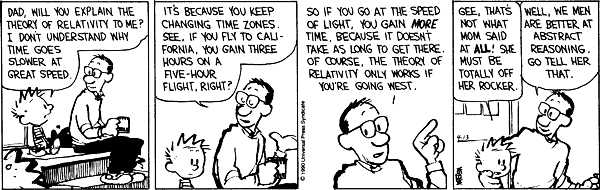
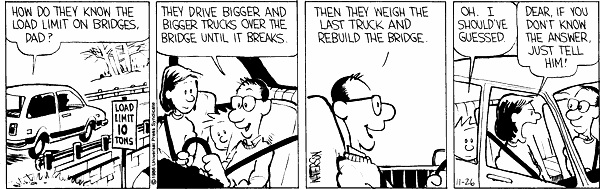
Let’s listen to “It don’t come easy” by George Harrison.
As George Harrison sings in the song, “Hare Krishna!” George, born into a Catholic family and baptized a Catholic, fortunately for him he learned about Hindu dharma and became a Hindu. Good for him.
Be well, do good work, and keep in touch.
NOTES
[1] Thomas Hobbes described life in his 1651 work Leviathan in the state of nature as “solitary, poor, nasty, brutish, and short,” arguing that a world without government would be dangerous. Humans act primarily out of self-interest and fear, leading to constant conflict.
He described this natural condition as a “war of every man against every man”, where there is no industry, no culture, no navigation, no arts, no letters, and no society. People live in continual fear of violent death, and survival depends solely on one’s own strength and cunning.
Hobbes used this description to justify the need for a strong, centralized authority—a Leviathan—to maintain peace and prevent society from descending into chaos. Without such authority, covenants and agreements are meaningless, and life remains insecure. His argument emphasizes that government and laws are essential to protect individuals from the destructive tendencies of human nature.


