

Simple Flying reports that Delta Air Lines Retires Its Oldest Widebody After Nearly 36 Years & 150,000 Flight Hours.
The plane’s a Boeing 767-300ER, tail number N171DN, which entered service in June 1990. It had been flying since then, with a brief break in storage during the peak of the Covid-19 pandemic. Its last revenue flight was from SFO to ATL on April 9th. It had passed 150,000 hours of flight hours in 2026. Its flying days were done. Its last flight, a ferry flight, from ATL to BHM (an airport in Chicago) was on April 10th, where it will be scrapped.
I did a bit of back-of-the-envelope calculations. Commercial jetliners at cruising altitude do between 500 and 600 mph. This varies depending on the altitude (faster at higher altitudes due to lower air density), the prevailing wind (tail winds help increase the ground speed, head winds lower it.) But their average speed over a flight has to be lower because during both ascent and descent it flies much slower than during cruise.
Assuming that the average cruising speed to be around 550 mph at altitude, I estimate that the average speed would be around 10% lower for the entire duration of the flight — or 500 mph. Going with that conservative speed, during its 150,000 flight hours, the 767 covered around 75 million miles.
The earth’s circumference is 25,000 miles. So the distance it flew is equivalent to 3,000 trips around the earth. The moon is approximately 240,000 miles. So one could say that the plane covered the distance equivalent to 150 round trips to the moon. I hope that like me, you are impressed.
Next, since the plane has been doing a mix of transatlantic flights (around 9 hours long) and domestic flights (around 5 hours long), let’s assume that an average flight for it was 7.5 hours. Therefore I estimate that it has done about 20,000 flight cycles. Meaning it has landed 20,000 times. Only landings count, not takeoffs. Why? For most planes, the two numbers match; for a few planes, the number of landings is (at most) one fewer than takeoffs. But those are extremely rare obviously.
The Boeing 767-300ER has a passenger capacity of 210 to 290, depending on whether it was configured as 1, 2 or 3 class. Let’s say this one could carry 250 people. But the load factor is rarely 100%. Let’s reduce that by 20% and say that on average it carried 200 passengers over the 20,000 flights it did. Therefore, it ferried approximately 4 million passengers during its nearly 36 years of service.
I am always impressed by the build quality of these airplanes and how amazing they are in service. These are modern marvels. Actually, even the older propeller-driven planes were pretty impressive too. Consider the DC-3. It went into production in 1936 and ended in 1950. A few DC-3s continue to fly even after 75 years. Some have racked up over 80,000 flight cycles (over four times that of our Boeing 767.)
They don’t make ‘em like that any more!
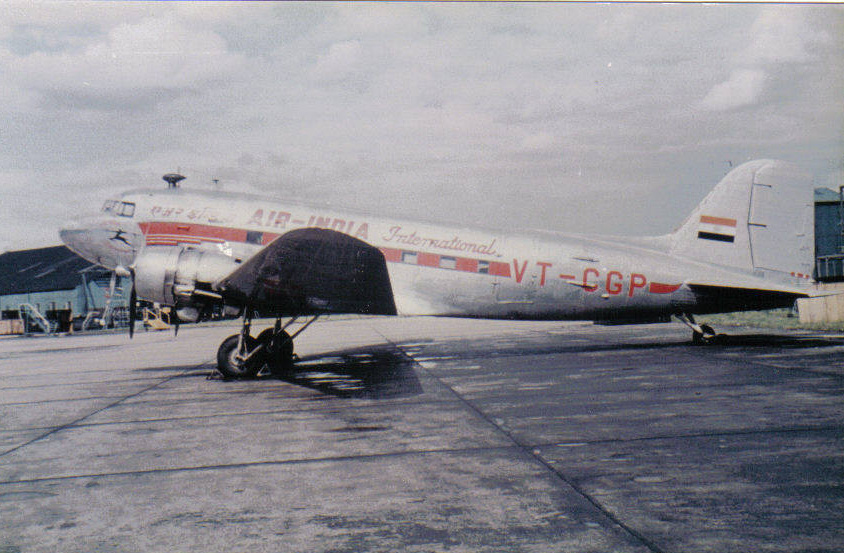
No, actually that’s not true.
The DC-3s were not pressurized airplanes; modern jetliners are. Modern jetliners bodies balloon up (slightly) when they are in flight and then the body relaxes after landing. Therefore modern jetliners end up being stressed with every flight cycle because of the pressurization and depressurization. That leads to metal fatigue and the planes have to be retired (scrapped) at the end of their service life of a specified number of flying hours and number of flight cycles.
You might wonder why I’m going on about the retirement of a silly plane. The fact is that I love planes. I have probably taken over 800 flights, around half of them over 10 hours long, and the other half around 4 hours long. I estimate I have therefore spent around 56,000 hours in commercial jetliners. That means I have spent 8 months of my life traveling at 35,000 feet at 500 miles an hour.
And yet — and yet I get myself a window seat and look out of the plane and take pictures and videos of takeoff and landings. If you saw me on flight, you’d think that it was the first time I was on a flight.
Time to say goodbye to dear old N171DN. May parts of you get recycled and may they fly again.
Which reminds me of a song about a river boat.
I know I will remember,
when I cannot hear that horn,
that would roll up by the mountains,
as she took us through the storm.
I know they’ve got to take her,
but I can’t say I approve,
’cause she’s won so many battles
that I hate to see her lose.
Thank you, good night and may your god go with you.


