
Scumbag politicians and clueless citizens are a matched pair. You cannot have one without the other. The criminality of the one is enabled by the cluelessness of the other—and the two are entwined in a dance macabre which is the continued destitution of India.
The interesting question then is what gives rise to this situation? Indians are fairly unremarkable in that they are not genetically programmed to be stupid. They are only as flawed as any other large segment of humanity.
India is not spectacularly gifted natural resource wise (to put it mildly) but neither is it entirely devoid of them. India has not been repeatedly visited by natural catastrophes that periodically send it back to square one. Over the centuries, India has had a fairly stable existence — barring the occasional Islamic invasions murdering a few tens of million infidels. All things considered, India had all the material and human resources to make a go of it. What went wrong?
I place great store on a cooking analogy. How good a dish you cook up depends on the ingredients and the recipe you use. In the case of an economy, the set of rules is like the recipe. A bad recipe can ruin even the best ingredients.
If the rules of the game are such that crooks don’t get to power and continue in power, the country will have good policies. Good policies will in turn help increase the stock of human capital. Human capital in turn will create physical capital.
Who makes the rules is a bit of a crap shoot. At the time of the American Revolution, the rules were made by a handful of extraordinarily smart people. The US lucked out.
Luck varies. Some countries are lucky in the kind of rule-makers they get. For Singapore, Lee Kuan Yew made the rules, and it turned out extremely good for it. In the case of the US, the “Founding Fathers” were brilliant scholars and philosophers; they made the rules, and it became the most powerful nation ever in human history.
Some countries are endowed with huge natural resources — which contrary to expectations, is not all that lucky. Economists call it the “natural resource curse.” Sometimes the natural resource curse is compounded with an ideological curse. Saudi Arabia and some other Arab states have that double whammy curse.
India’s curse was that at a very critical time around India’s independence from Britain, the rule-makers were an incompetent bunch. It all starts with a supremely arrogant man, Mohandas Gandhi. An able dictator but a very poor thinker, Gandhi chose as the rule maker someone who was largely incapable of figuring out his own incapacity to make sensible rules. This is the Dunning–Kruger effect, a cognitive bias in which people make unfortunate choices, but they lack the metacognitive ability to realize that they cannot make good choices.
If the rules of the game are bad, then the outcome is unlikely to be good. India’s poverty—material and otherwise—is a consequence of poor rules.
So, here’s my thesis. India has corrupt politicians because the rules of the game allow criminals to come to political power. Once they get political power, they can then game the system to continue to be in power. Part of the gaming of the system is to make sure that the people don’t have any way of getting criminals out of power.
Take the recent set of politician-criminals. (This refers to the period around 2010.) Dr. Manmohan Singh was appointed as the prime minister. The guy whose job should have been to make sure that criminals should be behind bars, instead makes sure that the criminals continue to be union ministers. Singh got that job for being extremely flexible—no rigid moral or ethical rules to prevent him from bending to the will of his master (Sonia Maino Gandhi.)
But his master did not get to be the master without the public actually allowing it. India is too big for any invader’s army to hold it against the will of the people. In the present case, a more or less “democratic” process has ensured the power that the master has. Theft on a colossal scale goes on under the protection of the master and her appointed minion, and the apathetic public goes about its business as if this was divinely ordained.
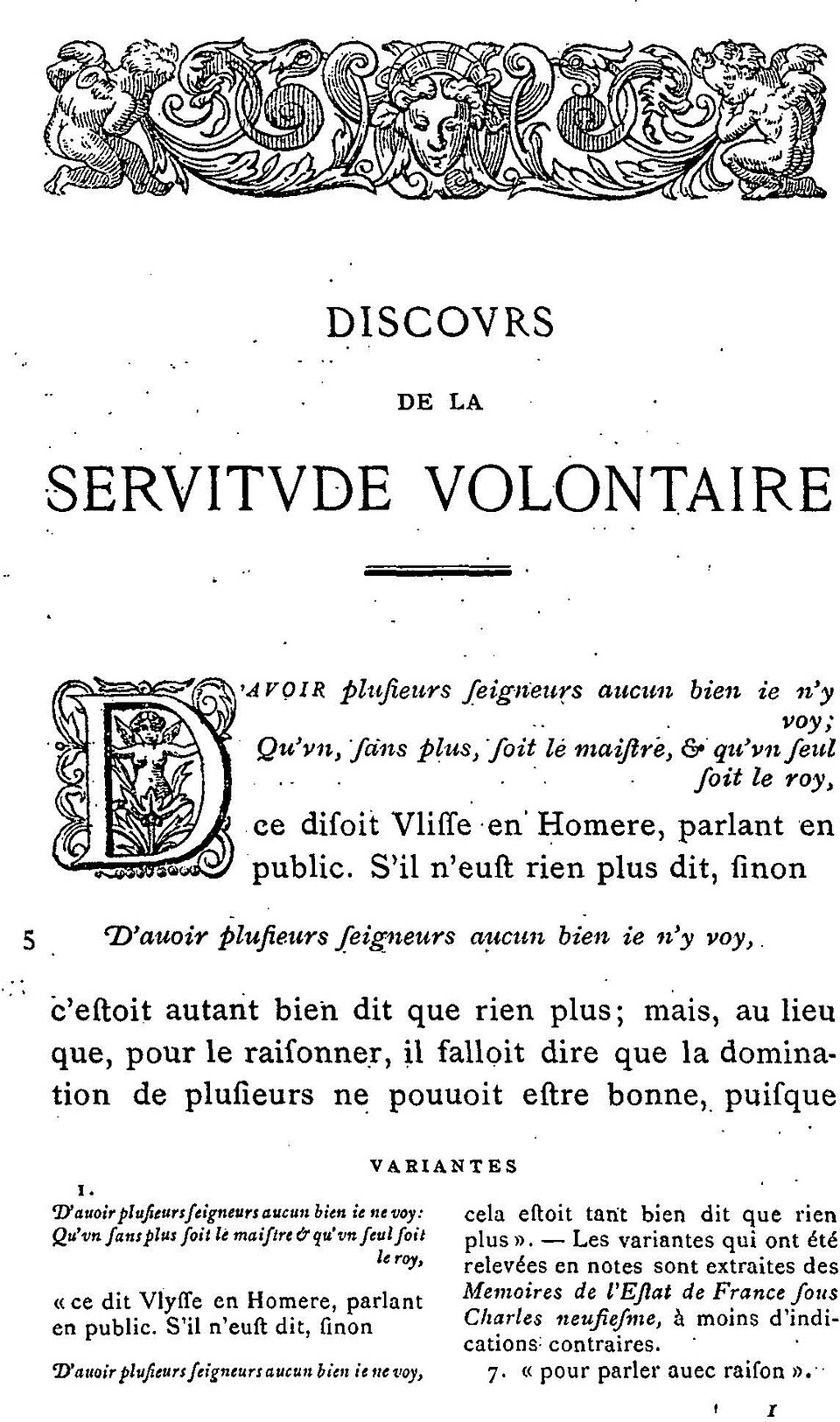
In a May 2010 post (THE POLITICS OF OBEDIENCE: The Discourse of Voluntary Servitude), I had referred to a book by Étienne de La Boétie, The Discourse of Voluntary Servitude (1577).[1] In an introduction to a modern edition of the book, Murray Rothbart wrote that Boétie’s fundamental insight was:
. . . that every tyranny must necessarily be grounded upon general popular acceptance. In short, the bulk of the people themselves, for whatever reason, acquiesce in their own subjection. If this were not the case, no tyranny, indeed no governmental rule, could long endure. Hence, a government does not have to be popularly elected to enjoy general public support; for general public support is in the very nature of all governments that endure, including the most oppressive of tyrannies. The tyrant is but one person, and could scarcely command the obedience of another person, much less of an entire country, if most of the subjects did not grant their obedience by their own consent.
A large country like India cannot be ruled without some degree of popular consent. That the population gives that consent despite the enormous harm the tyranny does to them would be inexplicable but for the fact that the tyrants make sure that the population does not ever become informed enough to know that they are living under a tyranny.
If I were to rule as a tyrant in India, I would do the following. First, make sure that the population is extremely poor. Starving people can be easily controlled. How to do that? Take control of all economic activity. Put things in the public sector. And then keep the private sector under control. Make sure that only a few large firms constitute the private sector. If any large private sector firm steps out of line, punish disproportionately so that it is a lesson for the others. This will keep the population poor and under control.
Next, keep control of the press. Punish and reward the press, depending on whether they toe the tyrant’s line or not. Then get the courts under control. Don’t like a particular court verdict? Overturn it. Rajiv Gandhi did that.
Finally, keep absolute control over the education system. Too often educated people get uppity. Not a good thing for the tyrant.
In short, have a ruthless license-control-quota-permit raj.
If I had the chance to be India’s ruling tyrant, I would do all that and more. Actually, come to think of it, that’s exactly what India’s ruling tyrants have been doing all along.
In conclusion, sure it takes two to tango: the scumbag politicians and clueless citizens. In the end, it is not the dancers but rather the dance that determines what the dancers do. It’s the rules. The rules rule.
[This post is hauled from the archives. A longer version was posted in November 2010 under the title It Takes Two to Tango.]
NOTES
[1] The “Discourse on Voluntary Servitude” is an essay by Étienne de La Boétie, published clandestinely in 1577. In this work, La Boétie explores the question of why a minority of rulers can maintain power over a majority of subjects who willingly submit to their authority. He argues that this submission is often voluntary, as people accept their servitude rather than resist it. The essay is considered a foundational text in political theory, raising profound questions about freedom, obedience, and the nature of power.


