Economics has from its origins been concerned with how an extended order of human interaction comes into existence through a process of variation, winnowing and sifting far surpassing our vision or our capacity to design. Adam Smith was the first to perceive that we have stumbled upon methods of ordering human economic cooperation that exceed the limits of our knowledge and perception. … We are led — for example by the pricing system in market exchange — to do things by circumstances of which we are largely unaware and which produce results that we do not intend. In our economic activities we do not know the needs which we satisfy nor the sources of the things which we get. Almost all of us serve people whom we do not know, and even of whose existence we are ignorant; and we in turn constantly live on the services of other people of whom we know nothing. All this is possible because we stand in a great framework of institutions and traditions – economic, legal, and moral – into which we fit ourselves by obeying certain rules of conduct that we never made, and which we have never understood in the sense in which we understand how the things that we manufacture function.
Modern economics explains how such an extended order can come into being, and how it itself constitutes an information-gathering process, able to call up, and to put to use, widely dispersed information that no central planning agency, let alone any individual, could know as a whole, possess or control. Man’s knowledge, as Smith knew, is dispersed.
[Except from The Fatal Conceit (1988) by F. A. Hayek. pg 14]

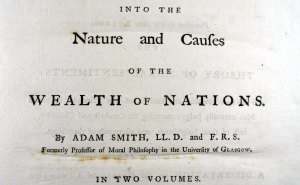 Born 16th June, 1743, Adam Smith was one of the greatest minds of the Scottish Enlightenment. He is regarded by many to be the “Father of Economics”, and deservedly so. His book, An Inquiry in the Nature and Causes of the Wealth of Nations, published in that miraculous year 1776, set the theoretical foundations of free markets.
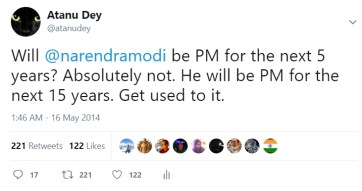
 Change is not something that arises out of random chance. If the underlying factors that motivate the electorate don’t change, the outcome will be the same. If party A promoted a certain set of policies as a result of a set of constraints, another party B will have to also adopt the same or a very similar set of policies as well. Why? Because the underlying reality is the same.
  As regular readers of this blog know, I believe that cities are the engines of progress. I am bigly into urbanization. I am delighted that Russ Roberts has
  “As per a study by the Federation of Indian Export Organisations, India’s global merchandise exports for 2018 were $324.7 billion, of which $51.4 billion were to the US.” [Source:
  One major premise of public choice theory is “behavioral symmetry”.
 It’s deja vu all over again, as Yogi Berra observed. We’ve seen this play before. Not once but all throughout human history.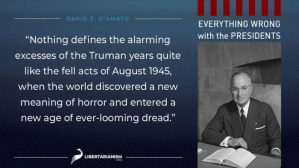
 Atanu Dey : Life is a Random Draw